POD Network 2026 Meet memoryOS in Baltimore, 18–21 November: conference session, booth and a live Mind Palace playtest. Book a time

memoryOS Education · for higher ed

Foster Learner Independence, Not AI Dependency

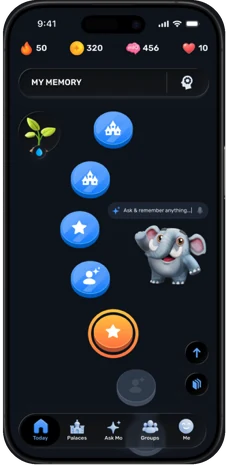
memoryOS equips learners with the Mind Palace—the proven spatial visualization technique used by world memory champions. Delivered through an intuitive, gamified 3D app, complex memorization becomes as effortless as a stroll through the park.

Students build seamless recall in less time with less repetition—ensuring knowledge stays with them long after the final exam and into subsequent courses. Most importantly, it gives them an unshakeable foundation of memory they can rely on, replacing AI dependency with true cognitive self-reliance.

Method co-built with Jonas von Essen, two-time World Memory Champion

Palace · Organic Chemistry I Functional groups
Route: your apartment
  1. Front door → Hydroxyl group (–OH) The handle is dripping wet. You shout “OH!”
  2. Hallway mirror → Carbonyl group (C=O) A car made of bones is reflected in the glass.
  3. Kitchen sink → Carboxyl group (–COOH) A cardboard box of sour lemons fizzing in the sink.
  4. Sofa → Amino group (–NH₂) Your friend Amy asleep on it, smelling faintly of fish.
  5. Bookshelf → Ester group (–COO–) Your sister spraying banana perfume on the books.

Gateway courses that build intellectual autonomy

Give students memory they own, free from AI dependence.

Students struggle to remember gateway course material, and AI could compound the problem. AI can sound right when it's wrong, and students who haven't mastered the material can't tell the difference. Active memorization creates a base for students to think for themselves.

  • Students forget. They typically lose a quarter to a third of basic science knowledge within a year.² In gateway courses, struggle tracks closely with attrition: 49% of students who didn't return had earned a D, F or W in gateway chemistry, compared with 26% of those who stayed.³
  • Relying on AI, they retain less. In a study of nearly 1,000 students, those who practiced with ChatGPT scored 48% higher during practice but 17% lower on the exam once it was taken away, and didn't realize they had learned less.⁴
  • They can't catch AI's mistakes. You can only spot an error in something you know. People who trust AI more apply less critical thinking to its answers.⁵
  • Our hypothesis: owned memory is a remedy. Method-of-loci training more than doubled recall, with gains that held four months later.¹ We believe students who encode course material themselves will retain more, do better on tests and critical-thinking activities, and persist through gateway courses. We're recruiting faculty to test it.

How it works

A 2,500-year-old technique, rebuilt as a game.

memoryOS turns the method of loci into short, gamified lessons, then puts it to work on the course material students actually have to learn.

  1. 01

    Learn the method

    Gamified lessons designed with Jonas von Essen teach students to build and walk a mind palace. No prior memory training needed.

  2. 02

    Build a palace for the course

    Students place key course content along routes they already know (their home, a street, a walk across campus), each concept a vivid image at a fixed spot.

  3. 03

    Walk it back on exam day

    Recall becomes a walk through the palace, in order. Material encoded this way keeps its structure, so students can reason with it, not just recognize it.

Where it fits

Content students must hold in memory before they can use it.

  • Pharmacy Drug classes, mechanisms and side effects for NAPLEX
  • Nursing & health sciences Lab values, assessment sequences, medication safety
  • Organic Chemistry Functional groups, reagents, reaction mechanisms
  • Anatomy & Physiology Nerve pathways, muscle groups, the cardiac cycle
  • Biology Cell processes, metabolic pathways, taxonomy
  • World Languages Thematic vocabulary, placed in context

The evidence

Memory champions aren't born. They're trained.

26 → 62

Words recalled from a 72-word list, before and after 40 days of 30-minute method-of-loci sessions, by adults with no prior memory training. Four months later, with no further practice, they still recalled substantially more.

¹ Dresler, M. et al. (2017). Mnemonic training reshapes brain networks to support superior memory. Neuron, 93(5), 1227–1235.

² Custers, E.J.F.M. (2010). Long-term retention of basic science knowledge: a review study. Advances in Health Sciences Education, 15(1), 109–128.

³ Gardner Institute (2018). Digging Into the Disciplines: The Impact of Gateway Courses in Accounting, Calculus, and Chemistry on Student Success. Chemistry DFWI rate 49.2% among students who left vs 25.9% among those retained.

⁴ Bastani, H. et al. (2025). Generative AI without guardrails can harm learning: Evidence from high school mathematics. PNAS, 122(26). Randomized trial, ~1,000 students.

⁵ Lee, H.-P. et al. (2025). The Impact of Generative AI on Critical Thinking. CHI 2025, Microsoft Research & Carnegie Mellon; survey of 319 knowledge workers.

Flash cards alone vs. memoryOS

Flashcard & review apps memoryOS
Requires multiple reviews over weeks and months Fewer reviews, longer retention
Facts learned discretely, in isolation Facts learned through the method of loci
Strengthen recall of what's already learned Encodes it into memory from the start

For institutions

Ready for privacy review, procurement, and accessibility checks.

The documentation legal and accessibility teams will ask for, ready in the full info pack.

  • FERPA

    Available

    Student data privacy and protection compliance.

  • GDPR

    Available

    European data protection compliant.

  • Institutional terms

    Available

    Standard higher-ed master service agreement.

  • Accessibility

    Published

    VPAT / WCAG documentation available.

  • SOC 2 Type II

    In progress

    Security and data protection controls.

  • Canvas LTI 1.3

    In development

    LMS integration and single sign-on.

Request the full info pack →

Pilot program

Join the Spring 2027 pilot cohort.

Bring memoryOS to your campus, run a pilot with your faculty, and evaluate student outcomes.

  • 01

    One class or many

    Study improvement in a single class, or compare results across courses.

  • 02

    Licenses at no cost

    Free access for all participating students and faculty.

  • 03

    Your criteria, your measures

    Each school or class sets its own success criteria, such as D/F/W rates, exam scores or persistence, and can track results with the memoryOS knowledge bank.

  • 04

    Author research

    Opportunity to publish findings on learning outcomes.

  1. Now Apply for pilot Tell us the course(s) and cohort you have in mind.
  2. [Dec 2026] Scope the pilot Agree on courses, measures and data terms.
  3. [Jan 2027] Spring term launch Students start with the method lessons.
  4. [May 2027] Results Shared findings and a co-authored write-up.

Reviews

What students and educators say

From students preparing for high-stakes exams to faculty running memoryOS in their courses.

[4.8]
[N] ratings · App Store & Google Play
Student · Pharmacy
[Student review: e.g. using a palace for drug classes during NAPLEX prep, and how it changed their study routine.]
[First name L.] [PharmD, Year 2] · [Institution]
Student · Organic Chem
[Student review: e.g. placing reaction mechanisms along a route and walking them back during the exam.]
[First name L.] [Pre-med, sophomore] · [Institution]
Teaching center
[Faculty developer review: how the technique fit a workshop or course redesign, and how faculty responded.]
[Full name], [Title] [Center for Teaching & Learning] · [Institution]
Student · Nursing
[Student review: e.g. remembering assessment sequences or lab values on clinical placement and in exams.]
[First name L.] [BSN, Year 3] · [Institution]
Used memoryOS in a course? Share your experience → Reviews are published with permission and edited only for length.

FAQ

Questions faculty ask us

Something else? Write to [education@memoryos.com]

Is memoryOS a flashcard or spaced-repetition app?

No. Those tools schedule when students review material. memoryOS teaches the mind palace, an encoding technique that shapes how material is stored in the first place. Students can keep the review tools they already like.

Do I need to redesign my course?

No. The pilot is built around your existing syllabus. Students map the content you already teach into their own palaces.

What does the pilot cost?

Licenses are free for the pilot term. Institutional pricing is a conversation for after the results are in.

Which courses work best?

Content-dense courses where students must hold sequences, structures or terminology: pharmacy, nursing, organic chemistry, anatomy, calculus and world languages.

How is student data handled?

We sign a DPA and Student Data Privacy Addendum, align with FERPA and GDPR, and your institution keeps ownership of its pilot data.

Does it integrate with our LMS?

A Canvas LTI 1.3 integration is in development. During the pilot, students use the memoryOS app directly.

Request a pilot call

Bring memoryOS to your campus.

Tell us about the course or courses you have in mind. We reply within two business days with a pilot outline for your department.

Request a pilot call

By submitting, you agree to our Privacy Policy.