4 in 5 People Say Memory Is a Career Skill, But Almost Nobody Trains It – Data Reveals
Table of Contents
What would you do if you could remember everything that mattered? We asked 39,637 people that question – and the answers revealed something surprising: memory anxiety is widespread, the desire to improve is strong, but the tools to actually do it remain almost completely unknown.
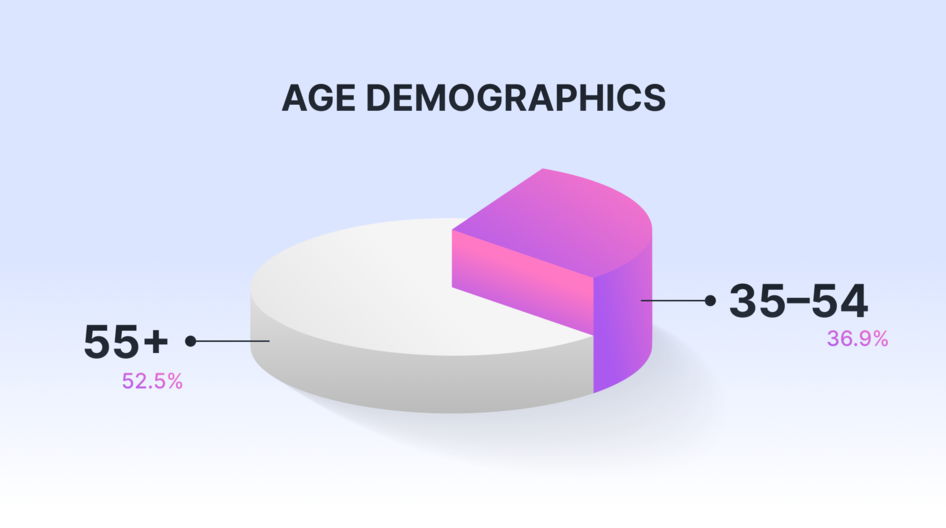
From April 2025 to April 2026, memoryOS collected responses to in-app quiz questions designed to understand how people think about memory, what worries them, and what they want to change. The respondents skewed older – 52.5% are 55 or above, 36.9% are 35–54 – and come primarily from the US (40.8%), Australia (7.2%), and the UK (6.8%). Here is what they told us.
The Career Blind Spot
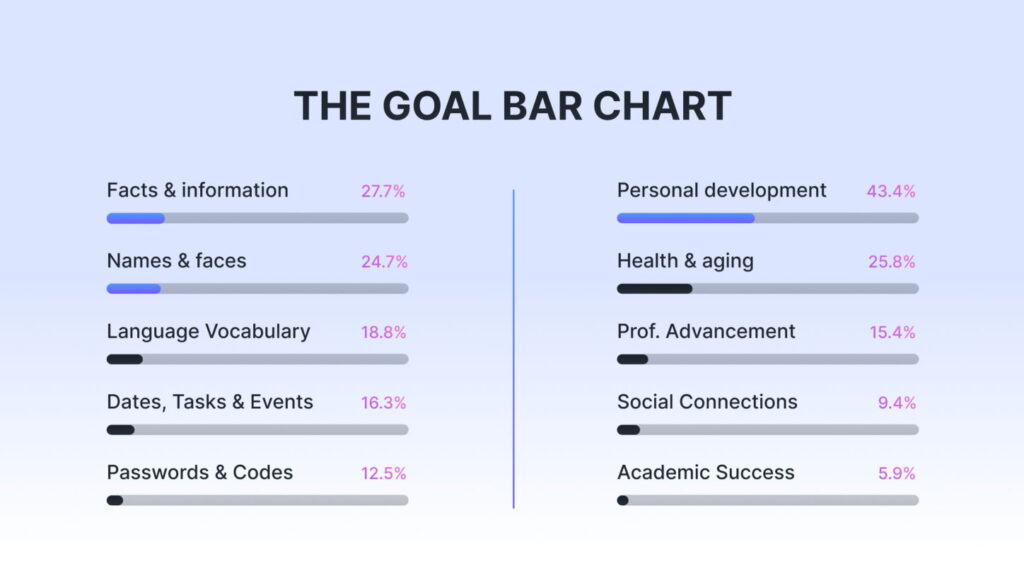
The most striking finding: 78.9% of respondents believe a better memory would directly help their career. Yet almost none describe themselves as actively training their memory the way they might train their fitness or build a professional skill. When asked what they’d most want to remember better, the top answers were practical and professional
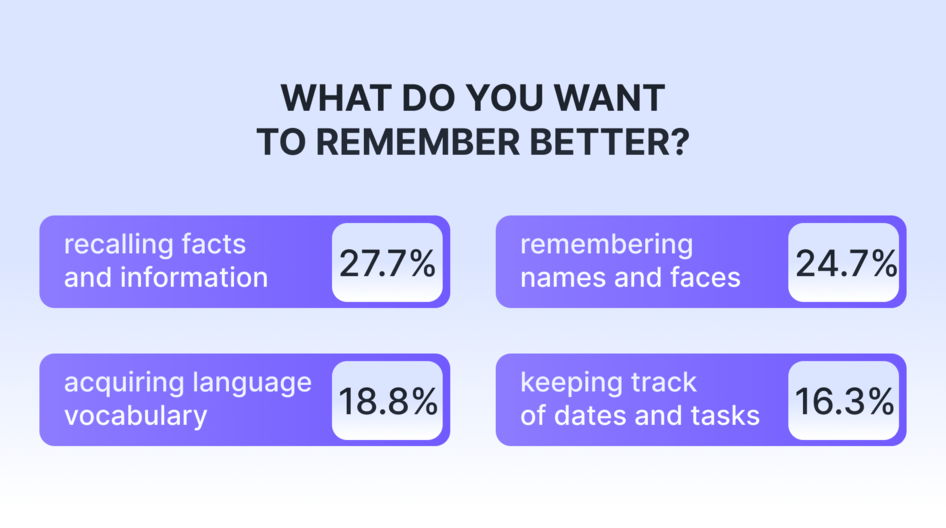
- recalling facts and information (27.7%),
- remembering names and faces (24.7%),
- acquiring language vocabulary (18.8%),
- keeping track of dates and tasks (16.3%).
Every one of these has a direct, measurable impact on work performance and every one is trainable.
“Memory is increasingly the unspoken requirement for professional success. We rehearse presentations and polish LinkedIn profiles. We almost never practice the skill that makes all the rest possible.” – Jonas von Essen, Co-founder of memoryOS, World Memory Champion
The Age-Related Fear Factor
Among those who encountered a question about aging, 77.1% said that age-related decline or dementia is at least somewhat on their mind. This is not a fringe concern, it is a majority experience, cutting across age groups. What is striking is the gap between fear and action.
Only 65.2% believe that anyone can develop a great memory, meaning roughly one in three people have already written off their own potential for improvement before they even begin.
The Everyday Forgetting That Costs Us
The data paints a picture of daily friction. 66.6% of respondents say they often forget someone’s name immediately after being introduced. Nearly half (45.3%) report regularly forgetting important information. When asked about family memories specifically, 75% said their recollections are not fully vivid.
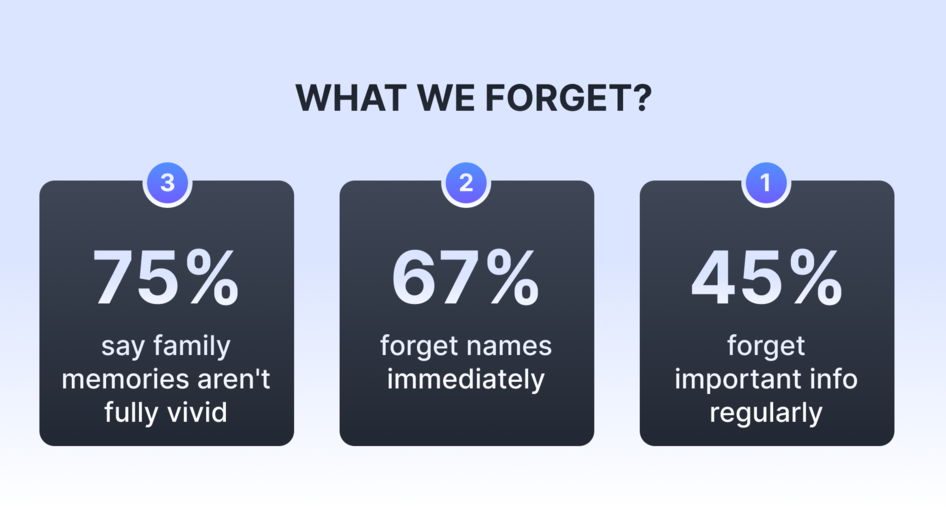
These are not clinical failures. They are the ordinary texture of an undertrained memory and the survey data confirms that most people experience them constantly, regardless of age.
The Technique Nobody Knows
Perhaps the most practically significant finding: 78.5% of respondents had never heard of the Mind Palace technique also known as the Method of Loci, despite it being one of the most well-researched and effective memory methods in existence, with documented use dating back to ancient Greece.
This is a knowledge gap, not a motivation gap. The appetite is there: 77.2% associate regular mental training with better workplace performance. The problem is that most people don’t know where to start.
What People Actually Want
When asked what they’d use a superior memory for, personal development was the dominant answer (43.4%), followed by health and aging concerns (25.8%) and professional advancement (15.4%). Social goals are remembering connections, being more present with people and accounted for 9.4%.
Most tellingly, 63.1% said they were ready to start right now. The remaining 36.9% described themselves as curious but needing more convincing, not resistant, just cautious. The barrier to adoption is largely informational.
The Bottom Line
Across 39,637 responses, the picture is consistent: memory anxiety is high, motivation is strong, and knowledge of effective techniques is almost nonexistent. The vast majority of people want to improve, they just don’t know that improvement is possible, or how to pursue it.
That is the gap memoryOS was built to close.
Survey Data Summary — n = 39,637
| Question | Top Answer | % | Runner-Up | % |
|---|---|---|---|---|
| What would you use a superior memory for? | Personal development | 43.4% | Health & aging | 25.8% |
| Which memory skills would you most want? | Facts & information | 27.7% | Names & faces | 24.7% |
| Would better memory help your career? | Yes | 78.9% | Not sure | 21.1% |
| Do brain workouts improve work performance? | Yes | 77.2% | Not really | 22.8% |
| Can anyone develop a great memory? | Yes | 65.2% | Not sure | 34.8% |
| Top daily frustration (forgetting) | Names | 25.3% | Facts / info | 23.6% |
| Awareness of Mind Palace technique | Never heard of it | 78.5% | Have heard of it | 21.5% |
| Age-related decline on your mind? | Yes / somewhat | 77.1% | Not really | 22.9% |
| Preferred training session length | 5–10 min/day | 63.7% | 15–20 min/day | 36.3% |
| Readiness to start | Ready now | 63.1% | Curious, need more info | 36.9% |
Methodology
This report is based on 39,637 responses collected via the memoryOS application between April 18, 2025 and April 7, 2026. Respondents self-selected into giving responses during standard onboarding and engagement flows; no external panel or random sampling was used.
The data therefore reflects the attitudes and behaviors of people who were already interested in memory improvement at the time of download, which should be considered when interpreting results. Duplicate responses were excluded prior to analysis. The respondent base skews toward adults aged 35 and above (89.4%), with the largest geographic concentrations in the United States (40.8%), Australia (7.2%), the United Kingdom (6.8%), and Canada (4.3%).