
7 Best Flashcard Apps for Students in 2026: Beyond Anki & Quizlet
Table of Contents
Students today find themselves under greater pressure to learn their lessons faster, remember vast amounts of data, and maintain consistent performance in academic studies. Regardless of the time invested in studying notes, re-reading, and understanding, much of the material remains forgotten after just a few days or even a few hours.
Such an inability to retain learned information despite hard work does not depend on intelligence or dedication. It simply stems from the natural flaws of human memory. Information is simply not reinforced in a way that fits how our brains work.
To fight this problem, various study techniques have been developed in recent years, with flashcard apps being the most popular. Some flashcard apps use repetition schemes to drill the studied material; others try to apply cognitive science concepts to enhance memory retention.
Those seeking cognitive power must be aware of popular software like Anki and Quizlet, along with their benefits and shortcomings. To further develop cognitive processes, students and learners can consider a more contemporary way of remembering by going beyond flashcards and working on cognitive organization and structured recall.
So let’s look at how memory works from a cognitive perspective and why some methods work better in terms of knowledge retention compared to others.
Knowing more about learning apps is important for anyone who wants not just to study but also to create an effective memory system.
Why Students Are Moving Beyond Anki & Quizlet
Spaced repetition is still among the most empirically validated ways to enhance memory retention. This method functions based on stimulating neural circuits at optimal times, mimicking the process through which the hippocampus solidifies new knowledge.
This explains why most students depend on the best flashcard apps to organize their exams. However, even the most efficient methods have weaknesses that become apparent when they are applied for prolonged periods without changes in mental activity.
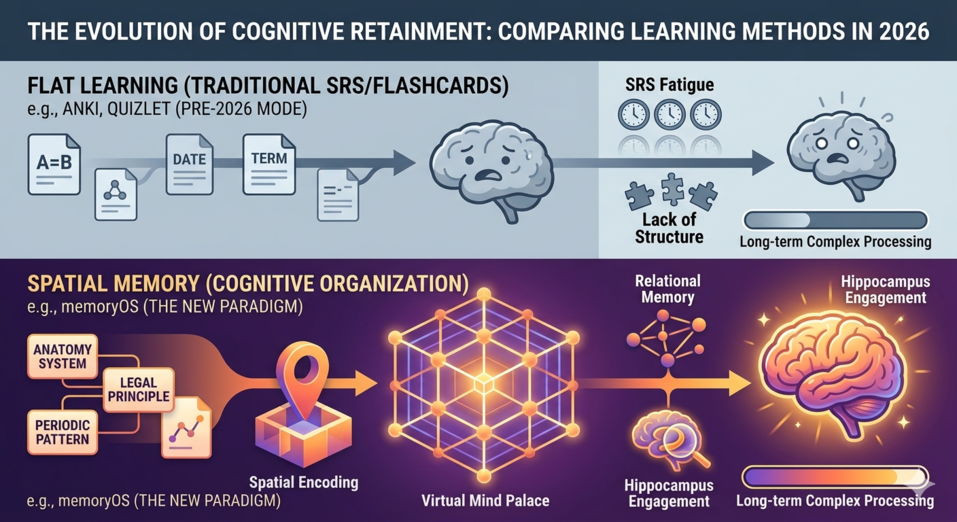
SRS fatigue
Spaced repetition systems function effectively by basing their review schedule on the pattern of forgetting. However, repetitive cycles of using flashcards might become stressful over time. The mind appreciates repetition, especially when it is purposeful and varied, but the lack of variation and context might make the whole process less stimulating and engaging. Learning will thus eventually become a mere exercise rather than a cognitive activity. This is why many people who use apps like Anki may want something different.
Lack of structure
Memory itself is relational, and according to neuroscientific studies conducted under cognitive psychology, the brain tends to retain information much more efficiently when it is organized in some form. It can involve categories or associations. The lack of a structuring mechanism forces memory to rely on random cues instead of an integrated concept.
Consequently, learning through Quizlet is often replaced by Quizlet alternatives such as memoryOS, since the app offers structure and is efficient in organizing knowledge.
Flat learning vs spatial memory
By flat learning, we understand linear learning based on memorization, where information is memorized in separate pieces without any connection between them. Although such an approach may help prepare for exams in a short period, its main disadvantage is its lack of complexity in long-term cognitive processing.
In turn, spatial memory is linked to how the brain naturally encodes information. Scientific studies in neuroscience demonstrate that spatial encoding leads to the involvement of the hippocampus, which results in various ways of retrieving the data.
#1 memoryOS: Virtual Mind Palace System
The limitations of simple rote memorization and bits-and-pieces learning reveal a core principle of human thinking: the brain functions optimally when information is organized within an ordered and meaningful environment.
Memory, contrary to popular belief, is not static but a dynamic system of associations and connections that is optimized for organizing information based on its relationship to other concepts. Such a principle guides the design of memoryOS, offering a completely new paradigm for digital learning.
Whereas most digital memorization tools utilize traditional flashcards to facilitate recall, memoryOS offers a Virtual Mind Palace framework inspired by Sherlock’s Mind Palace, which takes advantage of the brain’s spatial abilities. It helps organize information into more than 850 structured loci, providing an environment in which knowledge is coded based on position rather than on rote memorization.
The system is further improved with 3D memory environments that apply the principle of spatial cognition involved in navigating the real world. According to cognitive neuroscience studies, spatial processing engages a greater portion of the hippocampus than linear memorization, providing a robust structure for retrieving memories. Based on such processes, memoryOS facilitates effective memory encoding.
The method is successfully applied by memory champions such as Jonas von Essen, whose phenomenal encoding reveals the effectiveness of organizing memories through spatial means, showing that memoryOS makes it possible to learn systematically and efficiently even under academic pressure.
On its user base of about 500,000 learners, memoryOS reports an average improvement of +70% in memory performance based on performance data generated within the system. The improvements are a result of engaging in systematic spatial organization while practicing active retrieval.
Top Alternatives (Task-based)
Selecting the appropriate learning software should be based on much more than simple popularity or ease of use. These programs are designed based on specific cognitive philosophies, meaning that effectiveness depends on study goals, workload intensity, and the level of structure a student needs.
For many individuals, the problem is not selecting the optimal solution among available alternatives but understanding the differences between various types of flashcards and how each influences memory formation.
Anki (power users)
Anki is one of the most popular software packages for experienced users. This app is based solely on SRS algorithms and offers unparalleled customization of card intervals, formatting, and review algorithms. Its features make it perfect for medical students, linguists, and other individuals with extensive memorization requirements.
Its complex nature could also pose challenges. The app’s interface works effectively but isn’t intuitive enough for newcomers. Although Anki is very efficient for self-disciplined learners, it relies too much on regular adjustments made manually, something that isn’t done by all students.
Quizlet (baseline)
Quizlet is the simplest introduction to digital memory aids and thus the default choice for most students. Being one of the go-to flashcard apps, it is quite easy to use and doesn’t require extensive cognitive effort.
Nevertheless, while Quizlet excels when it comes to the basics, it lacks advanced functions aimed at deeper knowledge encoding. In fact, it is more of a tool for revising information shortly before tests than a system for studying and developing cognitive skills.
Brainscape (simplicity)
With Brainscape, you have a confidence-based repetition algorithm where your review timings depend on how confident you are about the material. It offers a more intuitive experience compared to most SRS systems. At the same time, the app has been designed in a way that makes it very easy to use for students who do not like complicated configurations.
RemNote (notes + SRS)
This app incorporates note-taking and spaced repetition. It allows the user to turn their study materials into flashcards for learning. This combination works great for students who have lots of lecture notes to go through in preparation for their studies.
Mochi (minimalism)
This tool has a clean interface that gets rid of any unneeded distractions. This feature makes it great for students who do not want anything distracting while studying.
Zorbi (smooth workflow)
Zorbi suits best those students who mostly learn using content found on the internet. Flashcards can easily be created with its help straight out of articles, notes, or any other web-based learning material. This workflow works perfectly for disciplines requiring lots of research, where the user keeps discovering new knowledge.
Cram (light users)
Cram is meant for individuals who don’t spend much time studying but still require memorising some facts quickly. Cram doesn’t offer cognitive structuring but rather aims at achieving quick results and high efficiency.
When comparing these programs, one aspect becomes clear – not every program is capable of promoting cognitive engagement to the fullest extent. For example, some flashcard apps aim at helping you to memorize facts fast, while others offer more complex mechanisms that require time.
It is helpful to determine the level of cognitive performance one starts from before adopting any system. For example, the number memory test to check your baseline before choosing an app will be an appropriate starting point. That way, it is possible to understand the level of one’s working memory and the most effective means through which retention efficiency can be improved.
It is not important to find out what features the chosen system includes, but whether it suits one’s cognitive abilities. The most efficient tools for learning are those that allow one to study in a natural mode of attention and recall.
Comparing Free Flashcard Apps
Most students start their academic careers using free flashcard apps because the ease of accessing them serves as the initial push to develop a proper learning routine. While such apps facilitate data encoding, their drawbacks tend to become evident with time. It is important to know what features each free application provides to understand its limitations.
The Quizlet free tier is considered one of the most popular ways to initiate the learning process. Users can take advantage of a variety of basic features to memorize information in flashcard sets, including studying material from other learners or developing their own content. The free tier serves as a decent option for quick reviewing and superficial information acquisition, but does not include advanced options, such as cognitive structuring and spaced repetition logic.
Mochi’s free version is characterized by minimalist design principles and spaced repetition basics. The app delivers a clean layout and allows for review cycles without overloading users. Consequently, it attracts learners who need simple solutions. Nevertheless, its functionality is quite limited regarding advanced study conditions, cross-disciplinary structuring, and cognitive mapping frameworks.
In comparison with other applications, such as memoryOS, both tools reveal an essential difference. Although free platforms are good for repetition, they fail to offer spatial encoding and organized knowledge structures. As a result, learning processes may be fragmented, especially when covering comprehensive academic subjects.
Nevertheless, despite their shortcomings, free flashcard apps retain significant value as entry-level instruments. Using them, learners create regularity in the development of memory skills, after which they can switch to more sophisticated cognitive systems.
How to Memorize Complex Subjects
Difficult academic topics are not just about repetition; they involve organization, context, and multiple levels of recall. The memory system should accommodate these various needs depending on the topic.
For instance, when learning anatomy, it is much easier to build connections between body systems, organs, and their functions rather than just trying to memorize names. In fact, using mind palaces such as those offered by memoryOS, one can create structured 3D environments for the body parts that allow them to “navigate” the human body rather than just remember it.
Legal reasoning and cases present difficulties of multi-layered logic and interrelatedness. In this case, hierarchy is very important because principles of law, court decisions, and exceptions may all be placed into the structure of related loci. It increases the accuracy of information search for exams. Flashcard programs such as Anki or Mochi are helpful in memorizing vocabulary, although a structural approach to cognition is even more useful here.
Spaced repetition through free flashcard apps such as Quizlet and Cram helps preserve regularity. However, it is much more effective to combine repetition with a structured approach to memory than to use repetition only.
The periodic table presents a different challenge—pattern recognition and relational memory. Grouping elements by properties and embedding them into structured mental frameworks improves recall far more effectively than linear memorization. Spatial encoding enhances retrieval speed by linking elements into predictable cognitive structures.
Ultimately, memorizing complex subjects depends on how well information is structured in the mind. Systems like memoryOS extend beyond traditional repetition by combining spatial memory, structured environments, and adaptive recall, while other tools support specific parts of the learning process.
Conclusion
Learning in today’s world is measured not by the amount of information that is reviewed, but by the efficiency of converting exposure into knowledge that will last. While most people stick to using repetitive tools, the mechanism of memorizing operates by building structure and spatial organization.
The gap between various systems becomes visible at this point. Tools such as Anki and Quizlet promote repetition; however, the emerging approach implies a complete departure from repetition-based learning to structuring-based learning, in which information is organized in a special manner, making recall easier, faster, and less demanding.
In general, the best outcomes can be expected from using systems that complement our brain’s functioning. Flashcard platforms become not only a preference but also a way to facilitate the process of attending, remembering, and understanding under pressure.