Language Learning Apps Better Than Duolingo (2026 Rankings)
Table of Contents
Learning languages is currently one of the most competitive spheres within digital education. Dozens of popular apps, such as Duolingo, claim to help users learn foreign languages. However, every app uses a different approach to language learning, so none of the software options can be considered a comprehensive means for studying a language. This knowledge will be beneficial when selecting an appropriate technique.
To gain a better understanding, let’s explore the language learning apps better than Duolingo. Let’s consider techniques that will help us improve our language proficiency using different apps.
For example, the first application to start with is Babbel, which is great for working on grammar skills. At the same time, Pimsleur is an application focused on improving spoken fluency.
Apart from regular language apps, there are other cognitive technologies, like memoryOS, that act as a great support for language learning. In effect, through enhanced memory structures and recall patterns, memory technologies can be useful for better retention of new vocabulary and grammatical elements learned during language courses. This way, language learning becomes a process not just of linguistic development but also of general cognitive development.
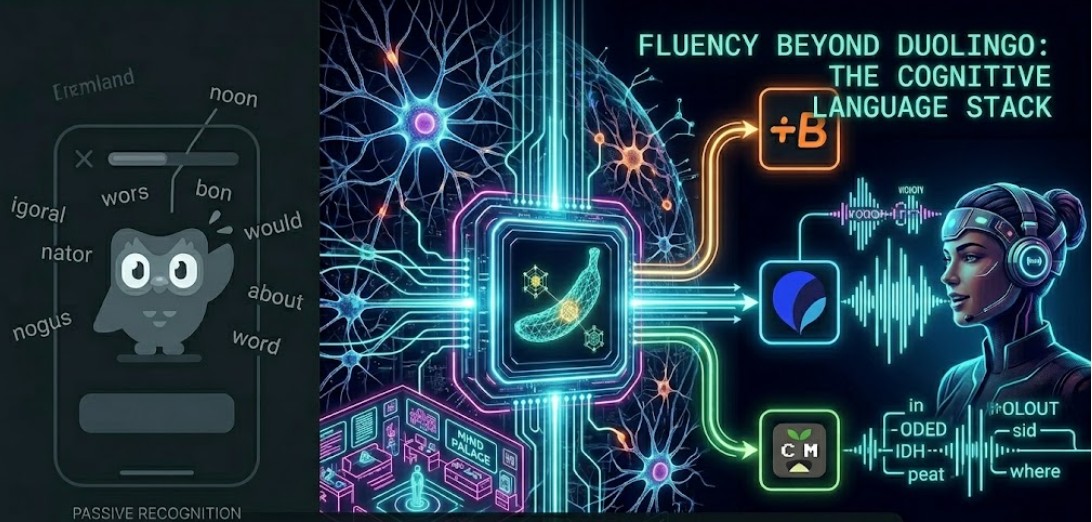
Why Duolingo Fails for Real Fluency
Even with its widespread use, Duolingo is often guilty of making users believe they have made good progress, despite their struggles with conversing freely and constructing complex sentences. Indeed, the problem often lies in three key weaknesses that arise when comparing language learning apps that are better than Duolingo.
Streak addiction
One of the greatest aspects of Duolingo that makes the platform engaging for users is also one of its worst cognitive disadvantages. It is a streaking system that helps in having regular contact, but at the same time, it may lead one to be more engaged with maintaining a streak than actually learning language elements properly.
Recognition vs recall problem
The platform uses mostly recognition methods of language acquisition when users choose the right option from among others. While that is an intuitive way to learn, it does not foster recall. True proficiency comes only with generating language on one’s own and not just recognizing it.
Shallow vocabulary encoding
Words and vocabulary are usually presented in abstract or oversimplified ways that make it hard to remember them and even harder to use in other situations. As a result, you have recognition but do not know enough vocabulary to be able to use it outside of your comfort zone.
memoryOS: Vocabulary Retention Engine
Learning a language goes beyond just mastering it. Memory is an important aspect here that influences how well and quickly you can absorb vocabulary, grammatical structures, and other essential components. That is where memoryOS becomes one of the best language learning apps and offers the most effective way of learning a language.
While classical systems simply rely on storing words chaotically, memoryOS relies on using mind palaces to arrange vocabulary within specific spatial structures. Unlike regular data storage, the approach makes it possible to associate words with certain locations for stronger encoding.
This technique is highly efficient for memorizing complex languages with such aspects as irregular verbs, grammatical gender system, and case-based languages. The approach is based on memorizing language elements via structural encoding, which helps create patterns as a result of repetitive processes.
The system is designed specifically for those who want to have stable, long-term vocabulary memories rather than temporary memorization. As internal data analysis shows efficiency among more than 500K users, there is no doubt that memoryOS is an effective technique.
The memoryOS app is used in cognitive learning systems like the best brain training games 2026 as an additional program that helps build up the memory infrastructure for language learning. In addition, it is considered one of the best memory apps for adults, where, due to age, recall is more important than exposure.
Through its focus on how the brain structures knowledge, memoryOS turns vocabulary memorization into structured cognition, laying the basis for fluency.
7 Better Apps Than Duolingo
True language learning is based on many mechanisms. Fluency is reached by applying grammar structure, exposure, recall exercises, corrections, and interaction.
Although Duolingo makes language learning accessible and consistent, more experienced language learners need applications that would help them build up certain linguistic competencies in their minds.
Thus, the best language learning apps are those that specialise rather than generalise, allowing one to improve various aspects of language fluency.
Babbel
One of the primary drawbacks of many beginner software programs is that they often lack a logical progression in terms of grammar. To solve this problem, Babbel incorporates systematic grammar structures into its program design and progresses from simple to increasingly complex lessons, emphasizing sentence structure.
Pimsleur
Fluency is not only visual. Being fluent requires being able to hear and react to something. This approach is utilized within Pimsleur, where one is encouraged to speak during the lesson to improve one’s reaction time and comprehension of sentences.
Lingopie
Language learning is much more effective when it mimics language use in real life. Lingopie includes TV series and movies in the learning process to help learn new words in their context, including pronunciation and cultural background.
Clozemaster
It is important for vocabulary mastery to place the words in context, which is why Clozemaster incorporates such activity into the learning experience. It does not involve learning individual words but rather filling in blanks in sentences, which allows for comprehension through context rather than rote memorization.
Busuu
Correction is an important part of language learning, and Busuu introduces it with its exercise feedback. In addition to receiving automated feedback on exercise results, users will have a human validator who will point out mistakes.
Memrise
Retention of information becomes easier when it is associated with human expressions. Memrise provides video clips with pronunciations by native speakers in real-life settings, helping the learner memorize vocabulary through visual and auditory stimulation.
iTalki
No app could offer the level of immersion provided by a conversation with another person. The app iTalki offers users one-on-one tutoring sessions in which they engage in adaptive conversations, allowing them to develop conversational skills and find their weak points.
These apps prove that language learning has many dimensions. Every technology addresses a certain dimension, so using several tools together would be more beneficial than focusing on a single system.
Efficient Free Language Apps
Learning technologies vary in cognitive efficiency. Despite the number of applications available for free use, their efficiency depends on the degree to which they aid the encoding process, retrieval strength, and long-term retention. That is why the comparison of free language learning apps is a must before choosing the learning technique that might not fit personal needs.
Duolingo continues to be one of the most popular options due to the game-like nature of the platform. This application can help establish good habits and expose learners to some vocabulary, which is important for beginners who require routine more than anything else. However, Duolingo is only helpful in terms of engagement, but it does not contribute to cognitive growth.
The advantage of Memrise is that its free version provides exposure to real-life usage of the language through native speaker video tutorials. Such a feature allows getting familiar with pronunciation and using context as an element to make vocabulary usage seem natural.
However, Clozemaster for free incorporates an even more sophisticated model, where vocabulary items are embedded into sentences. In this way, it fosters inferential learning and enables bridging the gap from recognition to usage. Nonetheless, similarly to other free language learning apps, the system does not have full access to optimized spaced repetition and personalized learning routes.
In terms of cognitive science, free tools play an important role in establishing exposure and consistency. Nevertheless, research in memory science proves that retention will greatly benefit from learning that is based on adaptive repetitions, structuring retrieval, and gradually increased difficulty levels.
Subscription models usually incorporate such learning mechanisms and facilitate more efficient reinforcement of neural networks.
Therefore, although free language learning apps prove to be effective in introducing learners to new languages, their efficiency as a comprehensive learning tool is limited.
How to Combine Tools for 2x Speed
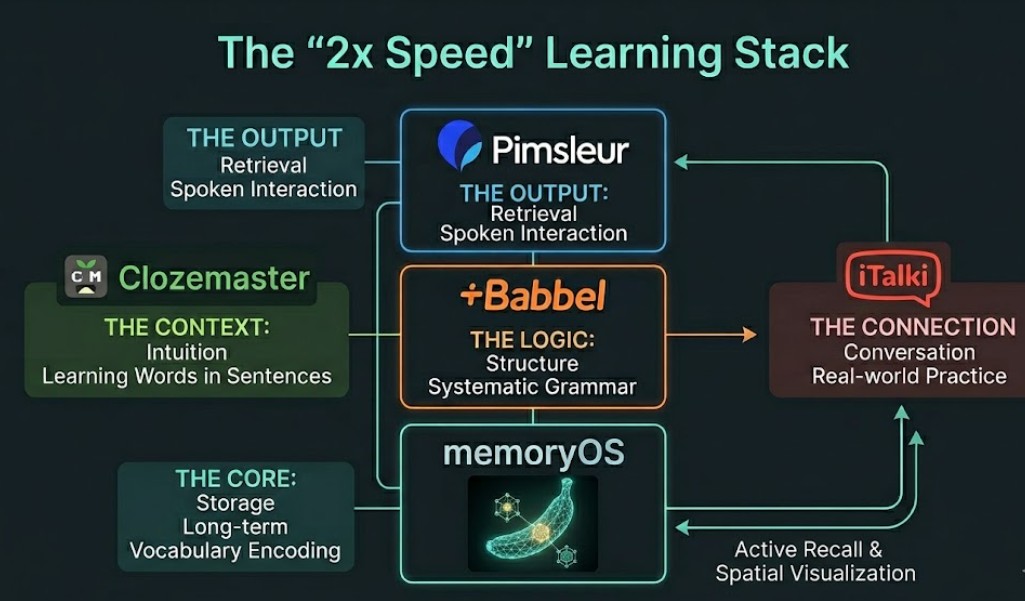
For you to learn a language faster, a mix of brain techniques is vital. Each of these techniques is responsible for a specific way of encoding, storing, and retrieving information. The best technique for learning languages involves activating multiple layers of this process.
The memoryOS app serves as the core of the system. It works as a layer for storing vocabulary. Unlike other methods, memoryOS doesn’t store vocabulary words one by one; rather, they are kept inside different Mind Palaces, which makes words much easier to retrieve.
As Albert Einstein famously stated:
“Education is what remains after one has forgotten what one has learned.”
The effectiveness of this principle lies in its ability to work with the brain’s memory systems – what lasts is not the repetition itself but the acquired information organized in neural patterns.
Based on this, Babbel and Pimsleur form two complementary layers for inputs and outputs. Babbel improves the structure of grammatical knowledge through sentence construction, making sure that language skills are not just memorized but put together logically. At the same time, Pimsleur builds auditory competence by pushing the person to answer immediately in conversation. Thus, it trains the brain to retrieve linguistic information in real-life conditions.
When used together, Babbel and Pimsleur help create a cognitive circle. Babbel works on grammatical skills and structural knowledge, while Pimsleur helps convert knowledge into speech. Finally, memoryOS provides efficient long-term vocabulary storage.
The main benefit of using these three applications one after another lies in their complementarity and high cognitive efficiency. While working simultaneously on all aspects, the brain will get trained to organize and process memory efficiently.
Moreover, you can add even more tools to your brain training routine. For example, a number memory test will keep your encoding and thinking in shape, preparing your mind for simpler language learning.
This is the point when language learning moves forward into a new era, far beyond what typical apps can provide. No longer will learners need to rely on one app alone; the entire concept is going to evolve into a holistic cognitive experience, which would reflect the natural way in which the brain learns and retains languages.
Conclusion
Learning a language does not mean being exposed to a language but building a framework around it. The key to success in this process is not hours invested in a particular app but the structure with which the language is learned. This is what creates stability and measurability within language learning.
As we consider various tools, a clear distinction arises—each of them builds only one aspect of language. Some create habits, some comprehension, some speech, and even intuition. Fluency, however, is not created through any of these aspects, but through the interactivity of all of them together.
This explains why contemporary language learners gradually drift away from a single-channel approach. Language learning becomes a multi-dimensional experience where memory, structure, and interaction play equal roles. In terms of productivity, it happens when one’s cognitive functions complement each other instead of struggling to dominate.
Understanding the way the human mind stores information about language plays an important role in this development. Words cannot be memorized separately and without links. They are part of semantic networks and pathways that make language accessible. Weakness in these networks means that language is fleeting. Strength in these processes means that language can be utilized when necessary.
Ultimately, fluency will never be achieved simply due to constant repetition. Rather, it will arise as a result of creating a learning system that matches the principles of cognitive organization. This means that what really matters is not the individual instruments but the overall architecture of the language learning process.