The Ebbinghaus Forgetting Curve and How to Hack It
Table of Contents
Memory rarely fails because the brain is weak; it fails because the process of learning is poorly structured. It is common for people to spend hours studying, highlighting, and revising, yet still most forget the material they worked so hard to learn.
The Ebbinghaus forgetting curve can help us understand why our encoding fails and why memory disappears.
There is a mechanics of memory at play every time an individual learns anything. This means that there is a need to encode, strengthen, and structure the information. Without these steps, an individual can experience rapid mental fading.
This is where the strategic importance of spaced repetition training comes into play. Following the brain’s consolidation cycles when reviewing helps memories stick.
Once you understand why forgetting happens, you can structure practice around it. This is the moment when memory stops feeling like a delicate thing you’re afraid to lose and becomes a skill you can build.
What Is the Forgetting Curve?
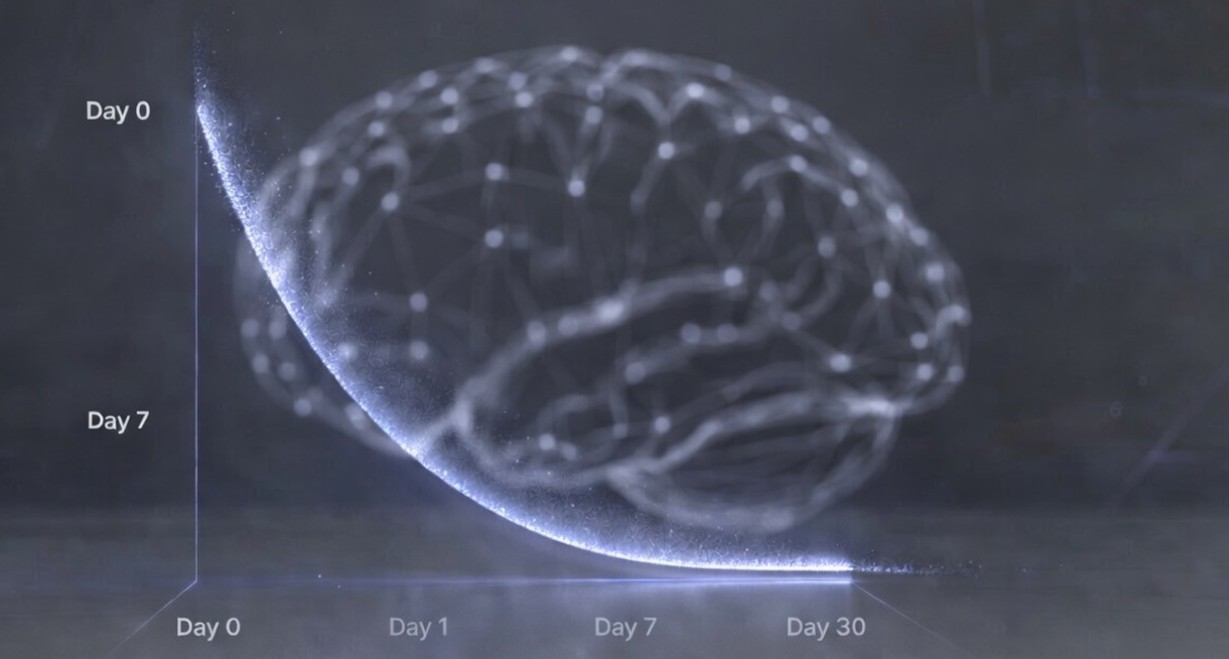
The forgetting curve is a mathematical representation of the predictable decline of memory strength. It illustrates the rapid weakening of the memory trace for the learned material after the initial period, showing that the memory trace is not a static cognitive process but a dynamic one.
The famous Ebbinghaus forgetting curve explains forgetting as a natural and adaptive feature of the brain. The mind is designed to forget what it considers to be unimportant unless signals of importance are continually sent. Without these signals, the paths to information become increasingly difficult to traverse. Forgetting, in this context, is not a failure of the mind; rather, it is biological efficiency.
What makes this principle useful is the way in which it can be applied. The principle of the forgetting curve implies that forgetting is a predictable process, which means we can plan when to review what we’ve learned. Reviewing, testing ourselves, and making knowledge meaningful will help prevent memory from fading away. Every time we reinforce it, our brains make stronger connections, making it easier to remember when it really matters.
The curve also illustrates why cramming results in short-lived confidence. While intense exposure can lead to a false sense of understanding, the lack of review ensures that the recalled knowledge is fleeting. Students often think they’re not smart if they forget often, but it’s really about how memory and learning work. The brain needs periodic reminders that the learned information is still relevant; otherwise, it re-assigns cognitive resources to other tasks.
A simple memory test, taken after some time from the initial learning, will demonstrate this dynamic with uncomfortable clarity, exposing the gap between perceived understanding and actual retention. The distinction between students’ understanding and the retention of the learned material is often the area where high-performing students or professionals make the greatest mistake. The forgetting curve does not penalize effort; it simply highlights the unreinforced effort.
Once the mechanism is understood, the improvement of memory is no longer a vague concept but a practical one. Learning can be tailored to the curve rather than trying to overcome it. Reinforcement makes the memory a robust cognitive ability, not a fleeting trace of knowledge, which can be retrieved when precision and speed matter.
The Science Behind the Famous Ebbinghaus Forgetting Curve
Experiments conducted by Hermann Ebbinghaus in 1885 were among the first to study memory as a scientific process, not a vague mental ability. Ebbinghaus chose meaningless syllables for his experiment to study the effect of the lack of meaning on the process of memorization.
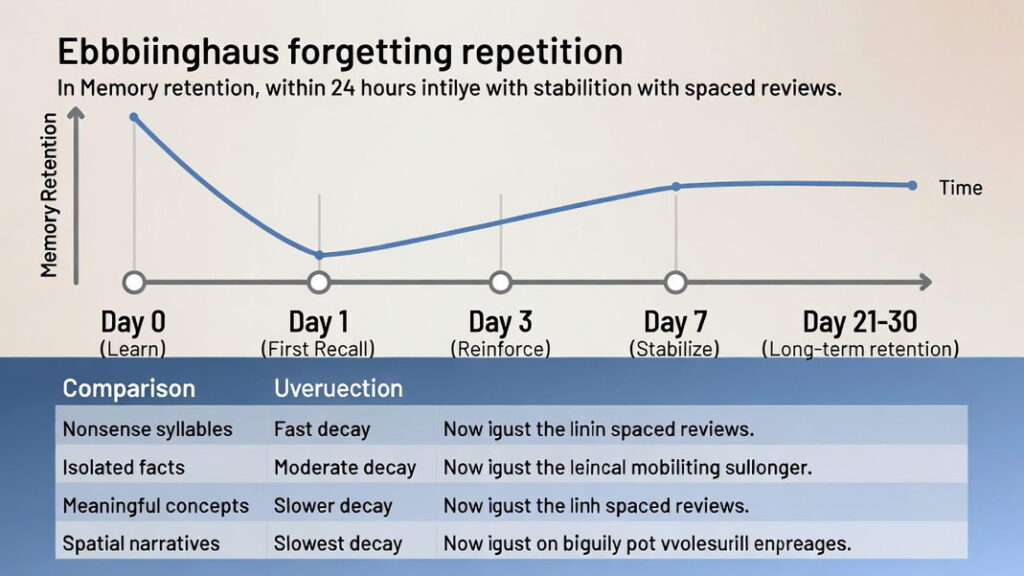
During experiments, the forgetting curve was revealed, which showed a definite relationship between time and memory: memory drops off rapidly at first, then more slowly unless reinforced.
What this means to modern learners is that the method, not the era, is important. Ebbinghaus demonstrated that memory has patterns, and therefore those patterns can be expected, challenged, and managed.
How Long-Term Memory Works
Long-term memory is not a storage box; it is a biological process. It involves the transformation of information, which is stabilized through short-term neural activity, then consolidated for later recall. This happens through the cooperative activity of several brain systems.
The hippocampus is the key to this process, which integrates various aspects of experience to create a unified memory. The information, meaning, and context are integrated before being relayed to the long-term connections in the cortex. This process can be disrupted by distraction or information overload. As a result, the memory that is created is weak.
Research studies published in journals such as Nature and The Journal of Neuroscience revealed that the sleep-dependent consolidation process enhances communication between the hippocampus and the cortex. The results of this study indicate that memory retention can be improved following slow-wave sleep, which reactivates and consolidates the newly learned information.
From a systems perspective, the Ebbinghaus curve shows the effects of a lack of support for the consolidation process. Without reinforcement, the neural pattern will decay before it can be fully integrated into the long-term network. This is not a problem with biology but a matter of resource allocation. The brain retains only the information that can be revisited, contextualized, and connected to other existing knowledge.
Spatial memory offers an alternative route to memory stability. The human brain has evolved to map spatial environments and navigate space. This explains why recalling information encoded spatially is more stable. When spatial memory is used, abstract concepts are linked to specific spatial locations. This is different from memorizing, which depends on repetitive practice and has few recall prompts.
Neuroimaging research has found that there is greater hippocampal brain activity for spatial memory. This is because there are more recall paths for spatial memory, which are less impacted by stress, fatigue, and interference.
This is where structured training is relevant. Memory consolidation is not based on the amount of exposure, but the quality of exposure. The more you can organize information in a way that is consistent with how your brain works, the more you will remember and the less you will forget. Structured reinforcement is based on natural biological cycles, rather than fighting them.
The Method of Loci is an implementation of this approach that involves associating an information set with a fixed mental location. Rather than relying on speed of retrieval, an individual moves through a familiar spatial pattern to retrieve an element of that set. The speed and reliability of that retrieval are increased by activating multiple pathways.
Significantly, spatial memory does not replace conceptual learning; it supports it. As abstract concepts are organized spatially, they can be better comprehended because they then have a relational rather than a sequential quality. The student does not rely on fleeting serial recall but on a rich web of interrelated clues.
Factors Affecting Memory Retention in 2026
The formation of memory takes place in an environment that the brain never really adapted to. We are constantly receiving notifications and can access external storage devices at any time. The brain then undergoes a phenomenon called digital amnesia, where it stores memories externally and forgets them internally.
The Ebbinghaus curve becomes more extreme in this new environment, where the formation of memory takes place in a disrupted manner. The brain undergoes divided attention, and the hippocampus never really receives the full message to consolidate memories. The more the brain is distracted, the harder it is to retain memories.
The modern environment also introduces more stress to people, which impacts their brain chemistry. The brain becomes more alert and can focus on fewer things. It is then barely able to retain basic information, not because it is complex, but because it is in a state of defense and not in a state of learning.
Why Nonsense Fades Faster Than Meaning
The brain tends to hold information that has a connection to something already familiar, emotional, or spatial. Nonsense information has no such connection, which is why it fades quickly. Meaningful information, however, has more neural networks working with it, which slows down the fading process.
| Material Type | Initial Encoding Strength | Rate of Decay | Typical Recall After 24 Hours | Why It Decays This Way |
| Nonsense syllables | Low | Rapid | Minimal | Few semantic anchors; weak hippocampal binding |
| Isolated facts | Moderate | Moderate | Partial | Limited context; single retrieval path |
| Meaningful concepts | High | Slower | Substantial | Multiple associations; deeper cortical integration |
| Spatial narratives | Very high | Slowest | High | Anchored to hippocampal mapping systems |
This explains why memorizing random information leads to a rapid decline in retention, while information that can be associated with a story or a mental pattern will be retained for a longer time. The human brain is wired to recognize patterns and will retain information that can be associated with a pattern and discard information that does not fit.
The Brain’s Response to Cognitive Load
When the brain is subjected to cognitive load, the prefrontal cortex will shift focus to task-switching, which undermines the formation of long-term memory. This explains why information that feels learned will be impossible to recall later.
In a digital environment, the brain will enter a state of infinite scroll, which will keep it in a state of low-level vigilance. In this state, our minds will be torn between the need to seek novelty, which is driven by dopamine, and the need to form memories. The brain will not be overwhelmed by cognitive load; it will be responding to an environment that is geared to interrupt it at every turn.
Tools, Aids, and the Illusion of Recall
External tools can help or be a memory barrier, depending on their application. A memory app that helps retrieval and review of material can actually strengthen internal recall processes. On the other hand, tools that store data and don’t force recall can lead to dependency and digital amnesia.
This same pattern of reasoning can be followed for conceptual memory models. For example, Sherlock’s Mind Palace method is the dramatic representation of spatial memory. Though fictionalized, the method is actually a representation of the hippocampus and the formation of memory: memory is only consolidated when data is placed within a navigable space.
Why Simpler Things Feel Harder to Remember
Content is now optimized for speed, not retention. This breaks down the media into smaller parts, fragmenting the meaning. This makes it difficult for the brain to retain the information.
This is why training is important. It suggests cognitive balance by re-creating the structure and the space. This combats the environmental effects on the quality of encoding. The brain becomes responsive to conditions for processing because plasticity is preserved throughout life.
The current problem of memory is not capacity but context. When the learning environment is reorganized to facilitate consolidation, memory is strengthened even in the presence of digital distractions. Memory is made robust again—not by opposing technology but by employing it in a manner that is consistent with how the brain learns.
How to Hack the Curve with Spaced Repetition Training
It’s simple: spaced repetition leverages the natural rhythm of forgetting to optimize the timing of your review sessions. Rather than reviewing your material at random times, you review it when forgetting begins to set in.
This essentially slows down the forgetting process and converts it into a memory-strengthening exercise before the forgetting process accelerates again under the famous Ebbinghaus forgetting curve.
How to Implement Spaced Repetition Training
This is a simple and evidence-based framework for implementing a spaced repetition training protocol for any subject of your choice:
Step 1 – Encode with Intent (Day 0)
Learn the material by trying to explain the concept in your own words and relating it to your existing knowledge base. This is the most important step, and you should create your own meaning and understanding of the material.
Step 2 – First Retrieval (Day 1)
Test your memory by recalling the material without any external help. This is a very powerful technique because the retrieval of memory has a greater impact on memory formation.
Step 3 – Reinforcement under Light Pressure (Day 3)
Recall again, with some constraints, such as time limits.
Step 4 – Stabilization (Day 7)
Review the material and reinforce the weak spots. The more successful recalls, the more robust the durability.
Step 5 – Long-term anchoring (Day 21-30)
Conduct a final recall for long-term retention. Memory is no longer fleeting but reliable.
This is a dynamic process. Review the schedule according to the difficulty and performance. Memory does not fade away but becomes stronger intentionally.
Mnemonics and the Method of Loci
The Method of Loci, or Memory Palace, is a mnemonic technique that uses mental images to encode and retain information. It is a powerful technique for creating vivid mental images that help the brain retain the information for a long time. It is a direct antidote to the Ebbinghaus forgetting curve.
Mnemonics help encoding by providing additional layers of depth. This can be done through the use of rhymes, acronyms, and associations to help differentiate each piece of memory. This, combined with the spatial approach, provides the brain with ways to recall data.
The practical application of this technique is simple. An individual can think of walking through their childhood home and mentally placing different pieces of memory in different rooms. As they move through the house, the memory is recalled naturally. This becomes second nature after several repetitions, turning memory into knowledge.
This technique is especially useful for professionals or students who deal with complex data. This method helps navigate the data quickly and accurately, creating a system of memory retrieval. Memory is no longer a static entity; it is a dynamic and interactive system.
FAQ
How long does the average forgetting curve last?
The initial memory loss occurs within the first 24 hours of acquiring the memory. This is followed by a gradual reduction in the ability to recall the memory unless it is reviewed and practiced.
Can you reverse memory decay?
It is possible to reverse memory decay by using a system of review and practice. This helps recreate the memory and strengthen cognitive connections.
Why is spaced repetition better than cramming?
Unlike cramming, which only helps create a memory that decays quickly, spaced repetition helps strengthen the memory by reviewing the material when neural connections are most receptive.