Who Has the Highest IQ in the World? We Audited the Top 15 Claims – Most Aren’t Test Scores (2026 Study)
Table of Contents
Who has the highest IQ in the world? There is no verifiable answer – and this is the result, not a dodge. The Guinness World Records “Highest IQ” category was retired in 1990. The problem is that test scores could not be meaningfully compared. In recent decades, high-IQ societies, private testing organisations, and researchers have claimed extraordinary scores from a variety of testing, scoring, and validation systems.
We examined the origins of the 15 most-cited person-score claims. 9 of the 15 fall under the T4 and T5 categories: those that are supported by identifiable childhood or retrospective evidence, and those that can’t be linked back to an identifiable assessment.
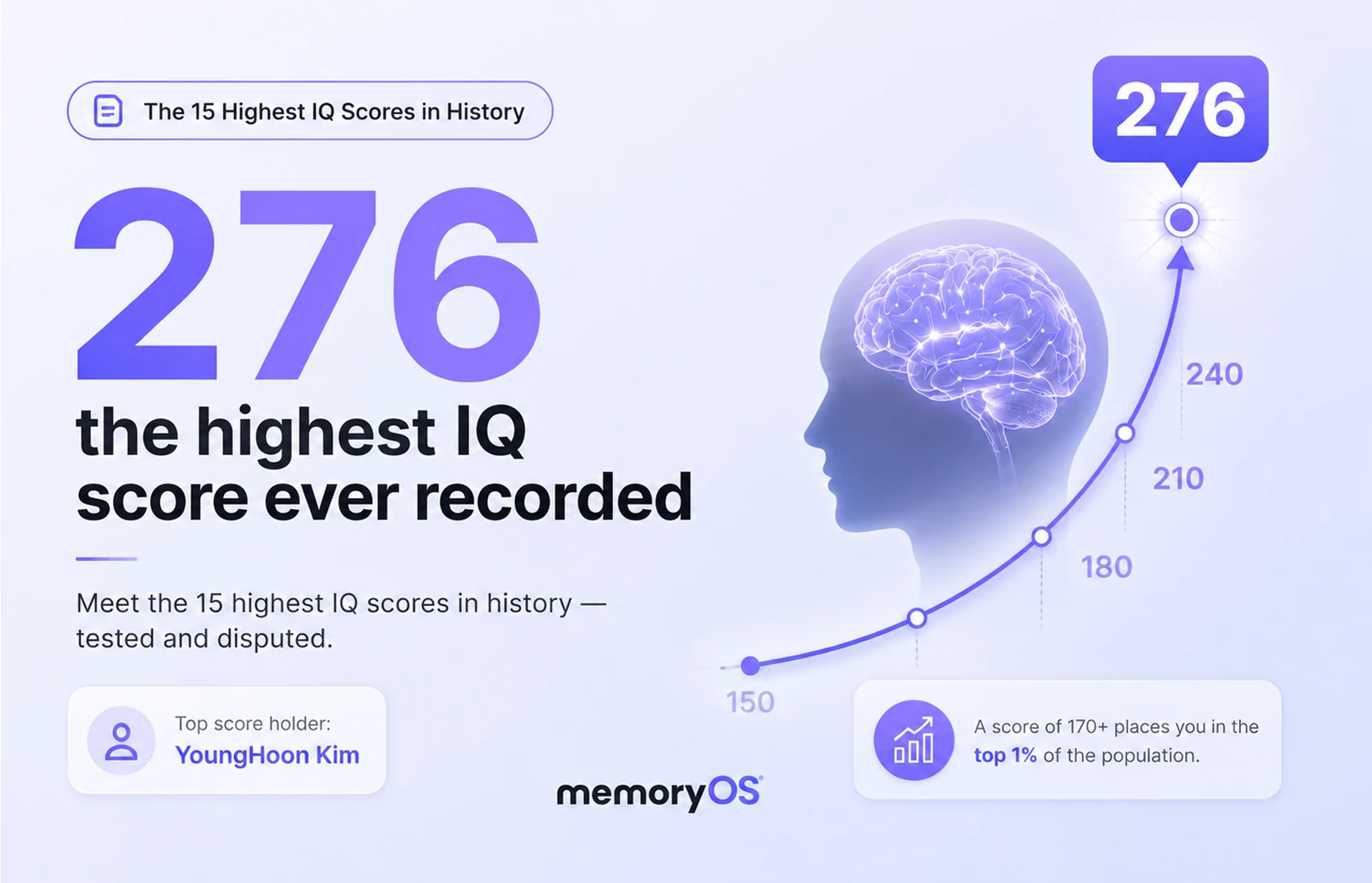
People who are looking for the person with the highest IQ in the world in 2026 will probably find the answer: YoungHoon Kim, whose IQ is claimed to be 276. That claim is supported by the validation report, and the 2025 TPM paper examined the psychometric basis of the 276 score.
Here is what that number actually is.
Who has the highest IQ in the world? The short answer
If you search for the smartest person in the world or the highest IQ ever recorded, the same names appear again and again. But the ranking below is not a ranking of intelligence. It is a ranking of the 15 most frequently repeated person–score claims found in our audit of high-ranking search results.
| Rank | Name | Claimed score | Scale stated | Evidence tier | Was a test administered? |
|---|---|---|---|---|---|
| 1 | YoungHoon Kim | 276 | Sometimes SD24 | T3 | The 276 claim has organizational recognition and psychometric support, but no publicly accessible primary clinical test record was found. |
| 2 | Terence Tao | 225–230 | Rarely stated | T4 | Identifiable childhood assessment |
| 3 | Marilyn vos Savant | 228 | Ratio IQ | T2 | Yes — Stanford-Binet, age 10 |
| 4 | Christopher Hirata | 225 | Rarely stated | T4 | Specific childhood test identified |
| 5 | William James Sidis | 250–300 | Not stated | T5 | Underlying test or assessment not identified |
| 6 | Marilyn vos Savant | 186 | SD16 | T3 | Yes — Mega Test |
| 7 | Garry Kasparov | 190 | Rarely stated | T5 | Underlying test not identified |
| 8 | Johann Wolfgang von Goethe | ≈210 | Not stated | T4 | No — identifiable retrospective estimate based on Cox’s study |
| 9 | Christopher Langan | 195–210 | Rarely stated | T3 | Claimed high-range testing |
| 10 | Evangelos Katsioulis | ≈200 | Rarely stated | T3 | IQ society / high-range testing |
| 11 | Sho Yano | ≈200 | Rarely stated | T5 | Underlying assessment not identified |
| 12 | Kim Ung-Yong | 210 | Rarely stated | T4 | Childhood claim |
| 13 | Rick Rosner | 192–198 | Rarely stated | T3 | High-range testing reported |
| 14 | Marnen Laibow-Koser | 268 | Not stated | T5 | Self-reported/unverified |
| 15 | Ainan Celeste Cawley | 263 | Not stated | T5 | Family/prodigy claim |
None of these measures exactly the same thing: there are modern high-range deviation scores, historic ratio IQs, and retrospective estimations. Marilyn vos Savant’s 228 and 186 were obtained in different measuring systems, and Sidis’s 250-300 score has never been confirmed with any surviving test report. This is the reason why one cannot easily tell who has the highest IQ in the world: YoungHoon Kim’s 276 score is mentioned in our assessment, but it is still T3; on the stated SD24 and SD15 scales, 276 corresponds mathematically to 210.
We traced every claim. Here’s where the numbers come from
The central problem with online IQ rankings is not that they contain unusually high numbers. It is that they often place different kinds of numbers on the same line and call them scores.
For each claim “who has the highest IQ in the world” and “highest IQ ever recorded,” we extracted named individuals and claimed scores, traced each claim to the source cited by the page where possible, and assigned one primary evidence tier to each claim. The 15 claims above are ranked by their estimated number of independent appearances in those results.
The tier system makes the distinction visible.
T1 — Administered and normed. Professionally administered and normed test, with the score falling within the documented range of scores on that test. In this audit, T1 refers to a publicly documented modern adult deviation IQ score that falls within the norms of that particular test.
T2 — Ratio IQ. Old-style mental age IQ, as used on the old Stanford-Binet tests. This category includes Marilyn vos Savant’s famous score of 228. It represents a different scoring methodology than modern deviation IQ.
T3 — High-range or society test. The claim is related to either a high-range test, an IQ society, an organization’s recognition, or psychometric analysis, but the actual result achieved is not recorded as a score from a modern clinical test with independent norms.
T4 — Identifiable childhood or retrospective claim. The score can be traced back to a particular childhood test, assessment, study, or other source that provides the reasoning behind the estimation, despite the fact that the test result is no longer publicly available.
T5 — Untraceable or unsupported claim. The claimed score cannot be traced to a specific underlying test or assessment. This classification uses mostly secondary sources, later estimates, self-reports, family claims, or other sources that do not show what assessment produced the score.
That produces a striking distribution:
T1 — 0
T2 — 1
T3 — 5
T4 — 4
T5 — 5
Evidence-tier distribution
| Evidence tier | Claims | Share of Top 15 |
|---|---|---|
| T1 — Administered & normed | 0 | 0% |
| T2 — Ratio IQ | 1 | 6.7% |
| T3 — High-range / society | 5 | 33.3% |
| T4 — Retrospective / childhood | 4 | 26.7% |
| T5 — Untraceable/circular | 5 | 33.3% |
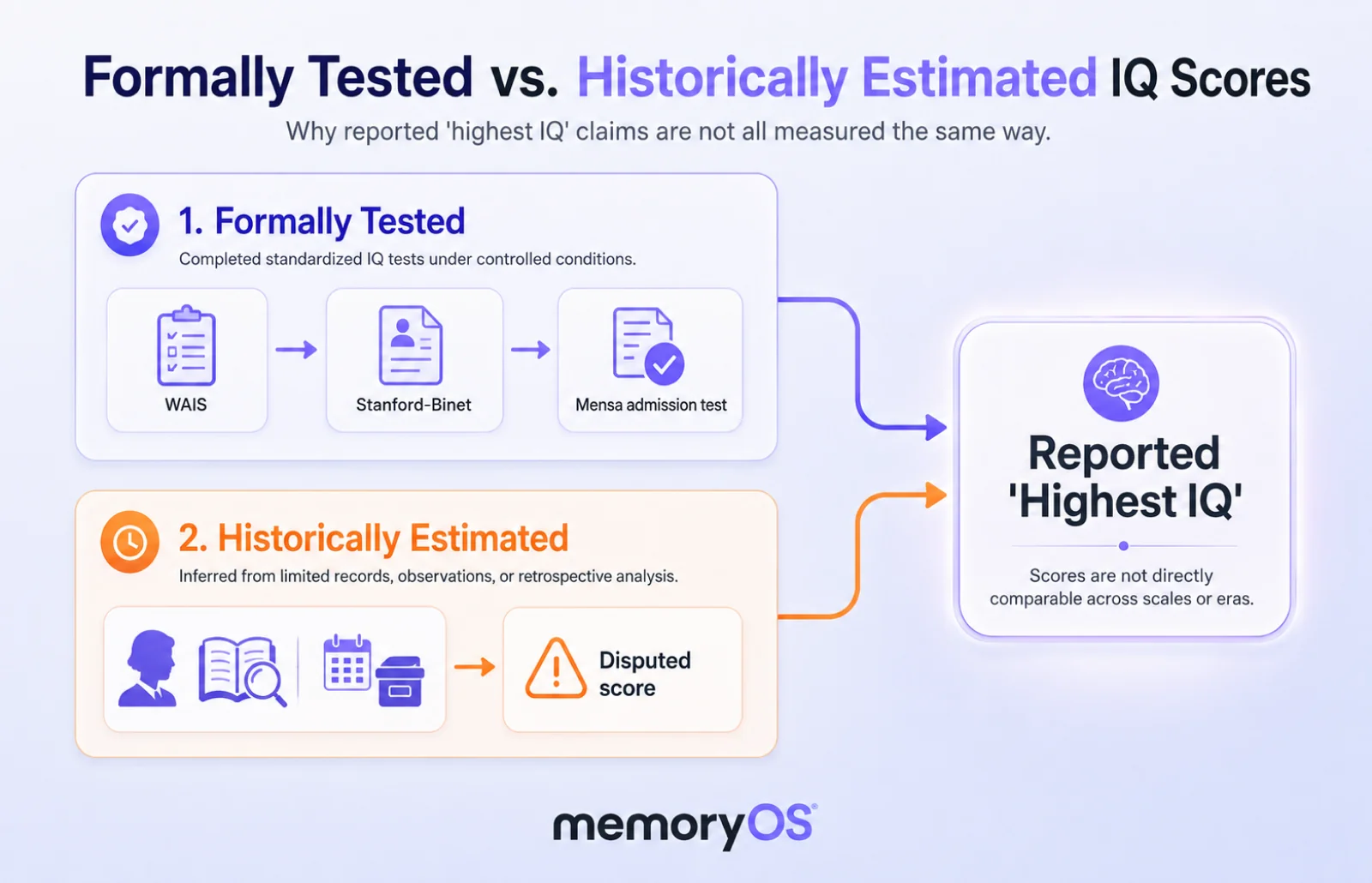
Of the 15 claims, 9 are T4 or T5 claims. They are based on identifiable childhood or retrospective evidence, or cannot be traced to an identifiable underlying test or assessment. None of the 15 claims in the audit is an officially documented T1 modern adult deviation-IQ score in the specified documented/normed range.
This does not mean that the people included in the sample are unintelligent. The difference between the intellectual capability and the basis for the IQ claim is important due to the way the web erases it.
A number is copied; the origin is lost. Then the copied number becomes the basis of the next article.
Our audit follows that chain in the other direction: from the repeated number back to the evidence behind it.
The 15 highest IQ scores ever claimed
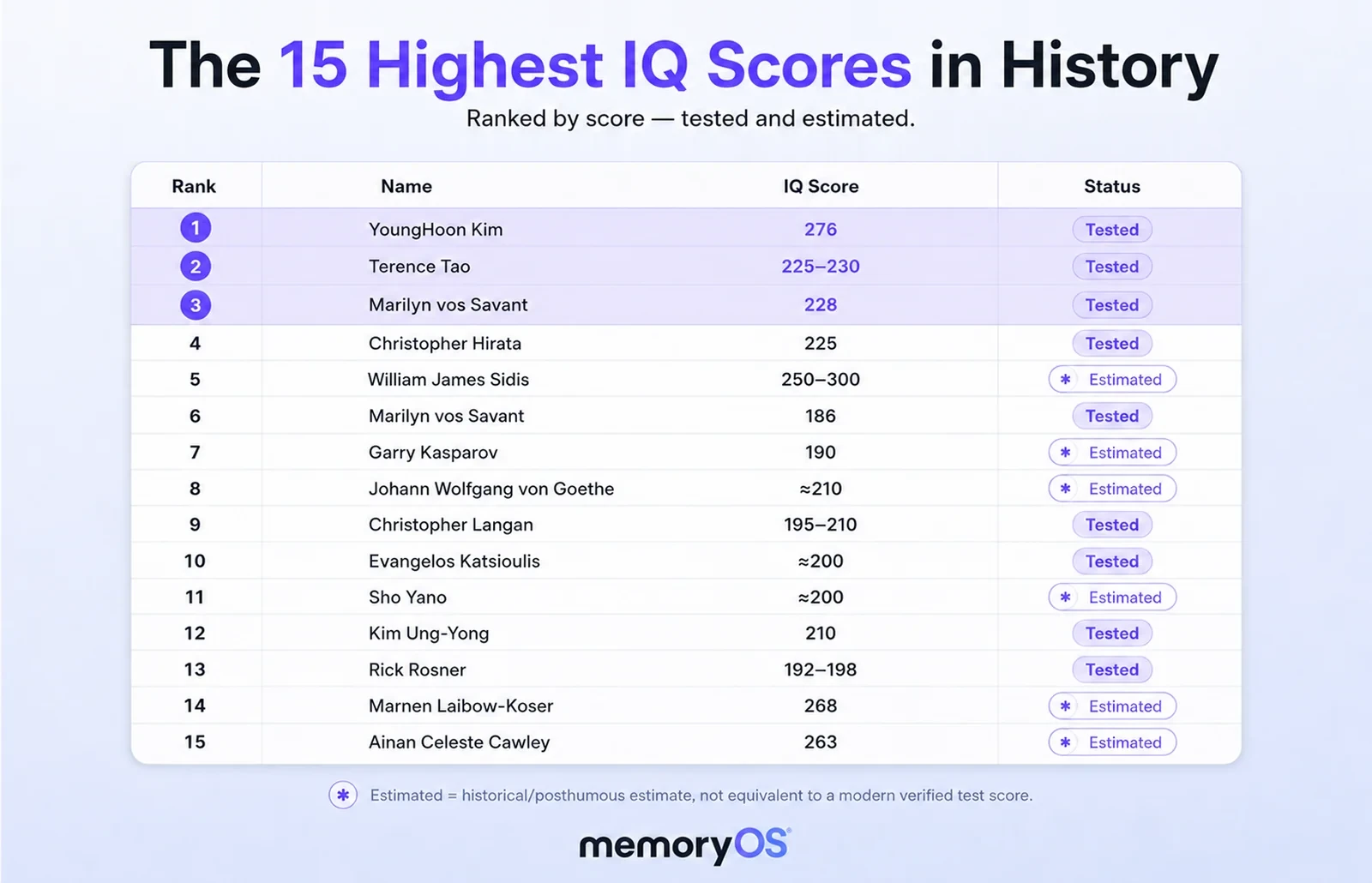
The following list is based on the most commonly cited claims of person-to-score in our audited top scores, not intelligence. The list contains 15 claims of 14 individuals, where Marilyn vos Savant is listed twice with scores calculated by different methodologies.
1. YoungHoon Kim — claimed IQ 276
YoungHoon Kim is a South Korean writer and member of a high-IQ organization. He has reported an IQ of 276 using the SD24 scale, which equates to an IQ of about 210 using the SD15 scale. In 2024, the World Memory Sports Council and World Memory Championships recognized his claim, and it was also examined in a 2025 TPM article and another separate psychometric validation report.
This validation report states that the number 276 can be validated using several types of evidence, including high-range tests, statistical conversion, and corroborations. But the validation process described above does not offer us the publicly available primary clinical test results required for our definition of T1.
The mathematical conversion is straightforward:
(210 − 100) / 15 = 7.33
100 + (7.33 × 24) ≈ 276
This shows that 276 (SD24) and 210 (SD15) represent the same z-position. However, this does not mean that the score 276 was produced using modern clinical instruments and is comparable to the standard clinical IQ percentile.
Our audit thus categorizes the claim as T3 instead of T1, since even though the claim is recognized by the organization and has psychometric backing, there is no independent evidence in the form of the clinical test record available in the public domain.
Sources: World Mind Sports Council — YoungHoon Kim · YoungHoon Kim — official IQ record page · TPM paper on the psychometric evaluation of the 276 IQ score (2025) · Psychometric validation of Kim’s 276 IQ score
2. Terence Tao — claimed IQ 225–230
Terence Tao is a mathematician at UCLA who won the Fields Medal award. The range of 225–230 is based on childhood testing and not the current deviation-IQ test. According to Tao, his childhood Stanford-Binet results could imply an IQ above 220 when interpreted using the older scoring method. However, he believes that a score above 175 is more realistic.
Tao’s documented achievements include getting a Ph.D. from Princeton University at age 20, being appointed to UCLA at age 24 as a professor, and winning the Fields Medal in 2006.
Sources: Terence Tao’s explanation of the IQ claim · Tao’s UCLA biography
3. Marilyn vos Savant — claimed IQ 228
The 228 figure is a result of a revision of the Stanford-Binet test made in 1937 and administered in 1956 when vos Savant was 10 years old. The mental age was 22 years and 10 months, which gave her a ratio IQ of 228. Guinness included her in its category of Highest IQ in the 1980s. It is a historical test claim based on the ratio-IQ method, so it falls under T2.
Source: Marilyn vos Savant background and test history
4. Christopher Hirata — claimed IQ 225
Christopher Hirata is a theoretical physicist and child prodigy from America. Our audit places this number under T4 because the claim is tied to a specific childhood test, even though the original record is not publicly available.
Source: Christopher Hirata IQ provenance review
5. William James Sidis — claimed IQ 250–300
William James Sidis was a child prodigy in America who enrolled in Harvard University at age eleven. The 250-300 range became known in 1946 when Abraham Sperling published his book Psychology for the Millions. Sperling cites Sidis’s sister as the source of the statistic, but no record of any testing exists. It belongs in category T5.
Source: William James Sidis — biography and IQ provenance
6. Marilyn vos Savant — claimed IQ 186
The second claim by vos Savant is based on the Mega Test, which is linked to Ronald Hoeflin, in the mid-1980s. The score she attained was 46/48, which was equivalent to an IQ score of 186.
This is different from her ratio IQ of 228.
Source: Mega Test and Marilyn vos Savant background
7. Garry Kasparov — claimed IQ 190
Garry Kasparov is a former world chess champion whose IQ of 190 features in many online lists. Our audit ranks the claimed IQ of 190 under T5 because the underlying test for that specific score could not be identified.
The testing for Kasparov was done back in 1987 at the initiative of Der Spiegel. His IQ score on the Eysenck test was 135, and on Raven’s Progressive Matrices test was 123. The results explain why the frequently quoted 190 IQ score should not be considered a documented score.
Sources: Der Spiegel 1987 test record · Discussion of Kasparov’s testing
8. Johann Wolfgang von Goethe — claimed IQ of about 210
≈210 IQ for Johann Wolfgang von Goethe is not a result of some test. The number 210 is linked to Cox’s original estimate in 1926. Attempts to update or translate Cox’s estimates have given lower numbers, while popular sources have quoted numbers around 180-195 or higher than 200.
What is crucial is that these are separate historical estimates/conversions, not different administered IQ results. Therefore, Cox’s estimate should not be equated to a modern clinical IQ test result.
There was no administered IQ test behind these numbers.
Source: Cox’s historical IQ estimates and methodology
9. Christopher Langan — claimed IQ 195–210
Christopher Langan is an American autodidact who devised the Cognitive-Theoretic Model of the Universe. His estimated IQ of 195–210 is linked to high-range testing and media reports such as the Mega Test. This audit categorises the claim as T3, as the testing and norming processes associated with the very high numbers are not sufficiently well-documented.
Source: Christopher Langan testing history
10. Evangelos Katsioulis — claimed IQ about 200
Evangelos Katsioulis is a Greek doctor and founder of high-IQ societies. Audited sources give figures close to 200, ranging from 198–205. This claim is categorized as T3, as it comes from high-IQ society testing, not from any publicly available modern clinical test.
Source: CIVIQ — Evangelos Katsioulis, MD
11. Sho Yano — claimed IQ of about 200
Sho Yano is an American doctor and researcher who achieved fame as a child prodigy. In 2000, CBS News reported that Sho Yano scored about 200.
The IQ claim belongs to category T5: there appears to be no clearly identifiable underlying test result record matching the score.
Source: CBS News profile of Sho Yano
12. Kim Ung-Yong — claimed IQ 210
Kim Ung Yong is a civil engineer from South Korea. He is also a professor in South Korea and was known as a child prodigy. The claim that he scored 210 on the Stanford-Binet scale is linked to a childhood test but does not provide an actual test result to compare to today’s adult deviation-IQ standards. Therefore, the claim falls into category T4.
His early academic success and later career are documented.
Source: Kim Ung-Yong biographical record
13. Rick Rosner — claimed IQ 192–198
Rick Rosner is an American television screenwriter and high-IQ test taker. His 192-198 score was obtained on an extreme range test. This claim belongs to category T3 as it comes from a high-range or society test, and not a current professional clinical test.
Source: Rick Rosner — “Born to do Math 192”
14. Marnen Laibow-Koser — claimed IQ 268
Marnen Laibow-Koser is an American composer, multi-instrumentalist, and software developer. The number 268 is typically cited as the IQ score when Laibow-Koser was a child. The lack of proof of a primary test score makes it a category T5 claim.
Source: Marnen Laibow-Koser IQ claim record
15. Ainan Celeste Cawley — claimed IQ 263
Ainan Celeste Cawley is a Singapore-born child prodigy. The 263 score occurs in family and secondary sources, although in reviewing our records, we could not find an administered test to confirm the exact score. It is thus assigned T5.
One independently confirmed achievement is the Cambridge GCE O-Level Chemistry exam in 2007, aged seven years and one month old. The achievement does not indicate a particular IQ score.
Source: Ainan Cawley biographical record
Why Newton, Einstein and da Vinci have IQ scores they never earned
“The highest IQ ever recorded” does not make sense because some individuals who were ranked did not have their IQs tested during their lifetime. A certain number can be found on a current list of the people with the highest IQ scores, yet it did not come from any IQ test.
One example of historical estimates is Catharine Cox’s study from the year 1926, “The Early Mental Traits of Three Hundred Geniuses“. Catharine reconstructed people’s intelligence from biographies, childhood accomplishments, and school records. The numbers in her study were estimates and not test scores.
Other online sources have also assigned IQ numbers to individuals not included in Cox’s study. Einstein, who was born in 1879, was not among those in Cox’s sample. The well-known number of 160 for Einstein, therefore, was not from an IQ test.
The divergence problem
| Person | Commonly circulated figure | What the number represents | Test administered? |
|---|---|---|---|
| Johann Wolfgang von Goethe | ≈180–210 | Retrospective estimates | No documented IQ test |
| Isaac Newton | ≈190 | Retrospective estimate associated with Cox’s methodology | No documented IQ test |
| Albert Einstein | ≈160 | Later popular estimate; source trail varies | No documented IQ test |
| Leonardo da Vinci | ≈180 | Retrospective estimate | No documented IQ test |
| Stephen Hawking | ≈160 | Popular estimate | No documented IQ test |
Goethe illustrates the problem particularly well. While Cox’s initial estimate for the author in 1926 came out at 210, modern estimates and popular information resources have presented other numbers, such as 180-195 and other estimates above 200. These estimates must not be taken as different results on IQ tests. These are rather alternative calculations or later attempts to convert historical estimates.
The IQ value that is commonly associated with Isaac Newton equals approximately 190. However, Newton lived much before the era of standardized IQ tests. The value is derived from Catharine Cox’s historical estimates based on the biographical information and early achievements, but not on an IQ test.
There is a common belief that Albert Einstein’s IQ was 160. However, there is no documented source about Einstein ever having taken an IQ test. He was born in 1879, and the figures associated with his IQ, such as 160, 192, and 205, were attributed to him retrospectively.
The number associated with Leonardo da Vinci’s IQ is 180. This value was attributed to him based on his multifaceted work and numerous achievements in such fields as painting, anatomy, engineering, and inventions. We cannot associate this number with his real IQ, because there was no such thing as an IQ test at that time.
We cannot attribute the IQ value of 160 to Stephen Hawking either. There is no documentary proof that Stephen Hawking passed some IQ test to get that IQ score. Nevertheless, Stephen Hawking is a brilliant scientist whose intelligence and talents could be proved by his appointment to the Lucasian Professorship of Mathematics at the University of Cambridge and numerous accomplishments in cosmology research.
Is an IQ of 300 possible? The math
Understanding the foundation of the scale is necessary to comprehend what an IQ number means. In this situation, the contemporary scale of IQ numbers called deviation-IQ is employed, where 100 is the midpoint, while the standard deviation is equal to 15.
To determine the placement of a particularly high IQ number, one needs to start with its conversion into a z-score:
z = (IQ − 100) / 15
Take an IQ of 200. On this scale, that works out to a z-score of 6.67. If scores followed a normal distribution all the way into this extreme tail, we would expect a score that high in roughly 1 out of every 76.4 billion people.
It provides context for the number. According to the Population Reference Bureau, about 117 billion individuals have been born since the existence of human beings. When the probability is applied to this population, the expectation becomes 1.5 individuals.
Population Reference Bureau — How Many People Have Ever Lived?
Of course, 1.5 is not a headcount. Nobody can have half a person. It is simply the model’s expected value: across a hypothetical population of everyone who has ever lived, the calculation would put the expected number somewhere around one or two.
And 210 is a completely different level of rarity. On the same scale, the model gives roughly 1 person in 8.9 trillion. Applied to the estimated 117 billion humans who have ever lived, that produces an expected total of just 0.013 people.
And 300?
| Claimed IQ | Scale | z-score | Modelled rarity |
|---|---|---|---|
| 160 | SD15 | 4.00 | 1 in 31,574 |
| 190 | SD15 | 6.00 | 1 in 1.01 billion |
| 200 | SD15 | 6.67 | 1 in 76.4 billion |
| 210 | SD15 | 7.33 | 1 in 8.91 trillion |
| 276 | SD24 | 7.33 | 1 in 8.91 trillion |
| 300 | SD15 | 13.33 | ≈ 1 in 1.35 × 10⁴⁰ |
| 400 | SD15 | 20.00 | ≈ 1 in 3.63 × 10⁸⁸ |
An IQ of 300 does not become “impossible” because mathematics forbids the number. The idea is that when the normal IQ scale is extrapolated to this extent, the result would be that no person who has ever lived could have had such an IQ.
However, the problem with IQ is that the test has not been normed on either of these extremes. Consequently, the figures mentioned above are only the results of the calculations of a normal IQ distribution. The further from the mean, the less meaning the number has.
But then, when talking about the highest IQs ever recorded, one can understand figures such as 300 and 400 thanks to arithmetic. Yet this does not mean that the person has such an IQ.
Why the same person gets three different IQ scores
Much of the confusion about the highest IQ in the world in 2026 stems from assuming that there is one measuring stick for IQ scores and that IQs measure the same thing across all tests. Modern deviation-IQ scores are typically centered at 100 and have a standard deviation. The standard deviation varies between tests and IQ systems, shifting the score number at the same point on the curve.
Three rulers, one standardized position
| Scale | Context | z = 4 | z = 7.333 |
|---|---|---|---|
| SD15 | Modern Wechsler-style deviation scale | 160 | 210 |
| SD16 | Older deviation-IQ convention / some high-range tests | 164 | 217 |
| SD24 | Cattell-style and some high-range societies | 196 | 276 |
There is one system that cannot simply be put on these rulers: ratio IQ.
The old method of Stanford-Binet calculated a ratio of mental age to chronological age, multiplied by 100. Thus, a 10-year-old with a mental age of 22 got an IQ ratio of 220. It does not equal a contemporary score based on deviations of 220.
It makes sense when one considers Marilyn vos Savant. Her widely quoted IQ of 228 was obtained using the old ratio method, while her lower 186 was based on the Mega Test with SD16. One can see a striking 42-point discrepancy before one checks the scoring methods. These figures represent measurements from two different rulers.
The other issue arises in extreme cases. Contemporary tests cannot simply expand their scale indefinitely. Extreme scores also become harder to interpret because there are very few people in the upper tail of the distribution. When there are too few people at the extreme end, a test may not be able to distinguish between very high scores reliably.
This is why an assessment conducted by a professional today has a much more limited practical extreme range than the numbers that are claimed to be associated with high-range IQ scores. The problem is not that the brain stops developing at some point. The problem is that the measure loses calibration. Test format matters too: a short online quiz and a full clinical assessment differ not only in how long an IQ test takes, but in how many cognitive abilities it actually measures.
This is why identifying the highest IQ person in the world is difficult to answer with a single number. Before comparing scores, you have to establish that the scores mean the same thing.
The highest claimed IQ has been climbing for 100 years. The scales tell a different story
The numbers attached to the supposed highest IQ person in the world have moved steadily upward in public circulation. The measurement systems behind them have not.
Our first date on the timeline is 1926, with the publication of The Early Mental Traits of Three Hundred Geniuses by psychologist Catharine Cox. Biographical evidence and childhood records were used to estimate intellectual development. Notable names within this method include the initial estimate of 210 for Goethe and 190 for Newton.
Next comes Marilyn vos Savant with her well-known IQ score of 228. This score was obtained via the Stanford-Binet test in 1956 and became popular during the period of the Guinness Book of World Records. This was a ratio IQ score, calculated through the older system of scoring.
After that came the era of high-range testing. Scores like the 186 of Marilyn vos Savant and later on those attributed to Christopher Langan were achieved through the Mega Test and other high-range tests.
The biggest claims originate with private registries and high-IQ societies. The claim of YoungHoon Kim for 276 belongs to this later trend, and according to his sources, he got a score equivalent to 210 on the SD15 scale. The higher score reflects the use of the SD24 scale and should not be confused with a score obtained on a standard SD15 test.
The public numbers therefore show a striking climb:
≈210 → 228 → 276
However, this is not a 66-point increase in human intelligence either; it is due to a difference in scoring and types of data used to arrive at the figure used to measure the highest IQ score in 2026.
Current clinical IQ tests are not meant to provide stable and directly comparable measures within a population when dealing with extremes like 228, 276, or 300 IQ. There are instruments that can provide scores higher than the normal range for clinical use; however, that does not mean that those scores should be automatically considered to be the same as population percentiles.
This gives us an interesting historical anomaly: the top figure keeps increasing, but the measurement scale does not.
There is a useful historical endpoint here. The “Highest IQ” category was removed from Guinness World Records in 1990 when it was determined that IQ tests are simply not reliable enough to have an undisputed record holder.
Guinness correspondence on dropping the highest-IQ entry
The takeaway here is not that IQ tests cannot tell us anything at all, but rather that if mixing different IQ tests, scales, and scoring systems, we can end up with an accurate-looking list of rankings that measure quite different things.
What a real cognitive outlier looks like
A list of people with the highest IQ scores makes an extreme number look like the whole story. In practice, exceptional cognitive performance is often easier to document when the task itself is clear.
For instance, consider memory ability. Memory testing is based on something specific that one should remember, whether it is digits, object locations, or information given after some time. The output is associated with a particular task, and not just an unexplained number appearing in a certificate.
This can be compared with a public test, where there is transparency regarding the task and scoring. In the case of memoryOS’s public number memory test, which assesses how many numbers one can remember with increasing number sequence lengths, there is visibility in the task and scoring on the public page, although the aggregate data that is required to make claims such as median and top 1% is missing. This is important because a public game should not be made a population statistic with insufficient data.
The same can be said about the chimp memory test. In terms of the memoryOS game, average performance is 5-6 items, while trained individuals can achieve 8-9. These numbers apply to a certain task and do not define intelligence in general.
The bigger picture is equally revealing. Terence Tao excels in mathematics, Christopher Hirata in physics, and Garry Kasparov in chess. They do not prove intelligence but provide independent and verifiable evidence of exceptional success.
So, what does a true cognitive outlier look like?
For the most part, it is not a big number but rather activity of mind – something complex being accomplished, a proof, a prize won, an exceptional feat of memory or several years’ worth of work done by experts.
This does not turn achieving into an IQ test; it just makes the data easier to analyze. Similarly, this distinction can help when thinking about careers that require the highest IQ – the career itself has no IQ value assigned to it, but skills and evaluation of work can be evaluated.
Can you increase your IQ?
The data speaks to a less grand solution than the majority of online IQ guidance proposes.
Cognitive performance can fluctuate. Practice can enhance cognitive performance. Our cognitive abilities depend on factors like education, sleep, and attention. Enhancement in one specific area does not always translate to enhancing general intelligence.
What is the highest IQ ever recorded? This question implies that there is a fixed figure for intelligence that is waiting to be discovered. Real-life cognitive assessment is not always as straightforward. Can you increase your IQ? examines what science tells us regarding enhancing cognitive performance and where the proof ends.
This is why a high score on a memory test should not lead to conclusions about a person’s overall IQ. An individual can greatly improve digit span without necessarily being near the top of the IQ scale.
Methodology
We reviewed high-ranking English-language organic results for the queries “who has the highest IQ in the world” and “highest IQ ever recorded”, recording the people, scores, and explanations presented as evidence for each claim. The aim was not to decide who is the most intelligent person, but to establish how well the numbers attached to these people can actually be traced.
For each person–score claim, we followed the source trail as far back as the available evidence allowed. We gave priority to primary test records, official institutional records and first-hand statements, while separately identifying secondary reporting, retrospective estimates and claims that ultimately led only to other rankings or self-reported material. Where a primary record could not be located, we did not treat the absence of evidence as proof that the test never happened; we classified the claim according to what could be independently documented.
Where a claim was supported by psychometric study and organizational recognition, we noted the information as part of our evidence trail. However, we did not consider this type of information by default as being the same as an externally verifiable score from a contemporary clinical instrument.
The ranking counts person–score claims, rather than unique people. This matters because the same person can appear more than once when different scores came from different tests or scoring systems, as with Marilyn vos Savant.
Our evidence tiers describe the provenance and comparability of the number, not the intelligence of the person. We also kept ratio IQ, modern deviation IQ, and high-range scores separate rather than converting them into a single league table. Mathematical conversions are shown only where they help explain how different scales relate.
Historical figures were treated differently from modern test takers: when a score was reconstructed from biographies, childhood achievements, or other historical evidence, we identified it as a retrospective estimate rather than an administered IQ result.
The analysis reflects the evidence we could locate in the public record at the time of research. It is a provenance audit of IQ claims, not a definitive ranking of human intelligence.
FAQ
Who has the highest IQ in the world in 2026?
From our audit results, it is clear that the highest repeating extreme IQ claim belongs to YoungHoon Kim and is recorded at 276 on the SD24 scale. It has organizational validation and psychometric evidence but does not have publicly available independent clinical testing proof of being a world record holder.
What is the highest IQ ever recorded?
The answer is impossible to give because famous numbers have been derived through various tests and scoring systems. Marilyn vos Savant’s famous 228, for instance, has been calculated using the historical ratio IQ method.
Is an IQ of 300 possible?
Mathematically speaking, an IQ of 300 is possible to achieve. The question is whether such an IQ is measurable.
How is the highest IQ ever measured?
There is no standard test to measure the highest IQ ever. Tests used in calculating extreme IQs apply different standards, norms, scales, and scoring systems.
Did Albert Einstein ever take an IQ test?
Albert Einstein was never known to have undergone any IQ test in his lifetime. His IQ of 160 has been calculated retrospectively.
What was Isaac Newton’s IQ?
Newton is thought to have an IQ of about 190, but he never had his IQ tested. This figure is simply an estimation based on his performance.
Why did Guinness World Records stop tracking the highest IQ?
Guinness discontinued their highest IQ category in 1990 due to the inability to compare results of different IQ tests to pick one person.
What is the highest IQ a modern test can actually produce?
There is no universal upper limit, as all tests use different scoring systems. Very high IQs like 228 and 276 do not always indicate clinically similar results.
Is Marilyn vos Savant’s IQ of 228 real?
228 IQ is said to be the result of a Stanford-Binet test that Marilyn took at 10 years of age. The test was a ratio IQ test.
Can you increase your IQ?
Through learning and practice, one can develop certain intellectual skills, but this does not translate to an increase in IQ.
IQ scores are just a piece of the puzzle when it comes to intelligence. If you want to explore your memory skills in a more practical way, try a free memory test from memoryOS.
Contributors