
Top Apps That Actually Make You Smarter: Science-Based Guid
Table of Contents
Cognition is not something static—this mental ability changes under the influence of stimulation, repetition, and the complexity of everyday life activities. In contemporary reality, the human mind is constantly distracted by many factors, from notifications to fast-changing flows of information; therefore, working memory and attention are increasingly put to the test.
Even such traditional cognitive activities as reading books or solving puzzles still work well, but they develop the already existing brain networks, without increasing flexibility and versatility.
Here comes digital cognitive technologies. Recent advances in neuroplasticity research have proven that cognitive activities can change neural plasticity and the way neural networks function, especially if these activities involve active recall and structured practice.
Modern brain-training games aim at improving the functioning of certain mental capabilities like attention, reaction speed, and memory. Nevertheless, not all applications use a science-based approach.
Newer programs today can improve memory and increase cognitive capabilities through specific digital practices. There are those, such as the memoryOS app, that work on structured recall and spatial memory practice, while others cover a range of skills, including language development or improved reading capability.
On the other hand, some newer apps, such as Peak, have a reputation for being a controversial topic when it comes to cognitive science. Although these programs offer exercises for users to develop their brain capacity, there have been questions regarding whether these exercises can actually transfer to real-world situations.
Therefore, analyzing cognitive applications should be much more profound than just comparing apps based on their entertainment value. The important point is not whether an app is fun or not, but whether there is any systematic work with the brain aimed at its adaptation and improvement.
Can Apps Make You Smarter?
The connection between the use of digital gadgets and people’s IQ growth is far from a myth anymore due to the research findings in neuroplasticity. The brain constantly changes itself in response to its environment, making more efficient neural connections if those are used more often, eliminating unused pathways. Hence, regular training of some aspects of cognition will affect how efficiently your brain processes information.
The major difference in cognitive science is between fluid intelligence and crystallized intelligence. The former is defined as a type of intelligence that includes problem-solving in novel contexts, whereas the latter involves learned and accumulated knowledge. Brain training games have an effect on both types of intelligence, although through different processes. Fluid intelligence can be developed by playing games that include adapting to new environments, identifying patterns, and working with a large amount of memory. Crystallized intelligence improves through repetition and structured learning.
In day-to-day activities, one can see how the described phenomenon takes place. A student who practices working memory can follow the lecture easily without being distracted. A person who studies languages with the help of a recall system can observe better recall of words needed in conversations. With apps to make you smarter, professional people can improve their capacity to focus on performing several complicated tasks within a specified period of time.
As neuroscientist Donald Hebb famously described the principle of learning:
“Cells that fire together wire together.”
Such an approach has everything to do with how cognition training affects the brain. The more the brain is used, the more synapses will be strengthened, which makes future use easier.
memoryOS: Skill vs Game Distinction
It needs to be pointed out that not all cognitive platforms share similar characteristics. In the current market, numerous cognitive applications are focused on engagement through gamification techniques that promote short-lived interactions with the application. The memoryOS app is another matter altogether; it operates as a system rather than as a game.
Contrary to what we might expect from other types of brain training games, memoryOS does not incorporate gameplay. Unlike a brain game, memoryOS does not revolve around scores but emphasizes skill development instead.
In essence, memoryOS is a structured memory training application based on spatial encoding and structured recall paths. Instead of presenting information through disconnected tasks, information is presented as connected structures that reflect the natural spatial organization process employed by the brain.
By using frameworks inspired by Sherlock’s mind palace approach, users can organize abstract information in a way that makes it easier to navigate, thereby turning memory into an active process of cognition that can be actively developed through practice.
One of the biggest strengths of this model is its ability to facilitate real-life transfers. Instead of working exclusively as a puzzle-based game that trains specific skills, structured memory training increases performance in various areas, such as rapid learning and retaining information under pressure.
Science-Backed Apps Ranked
However, not all cognitive applications work under the same science-based principles. There are apps that are designed based purely on neuroplasticity and structured learning, but there are also apps that do not use them directly, instead focusing on engagement methods or indirect cognitive improvement. This knowledge will be necessary when considering which apps can make you smarter, as effectiveness is not determined by popularity but rather by the type of cognitive principle behind the software.
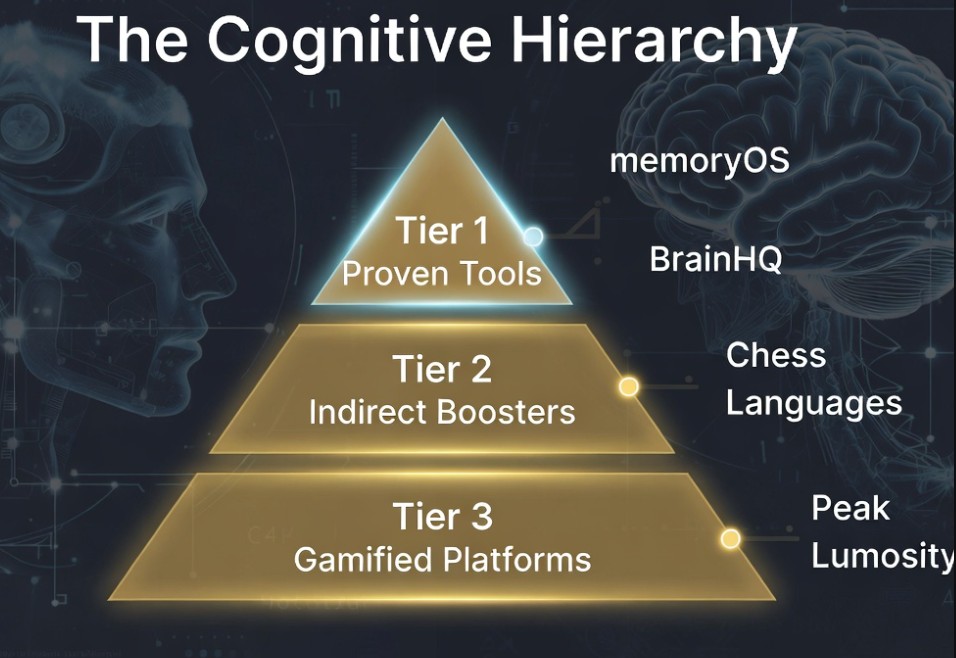
It would be useful to categorize this wide range of apps into three types according to their scientific base: direct cognitive training tools, indirect cognitive enhancing apps, and somewhat questionable games. It should be understood that each group affects the brain differently, impacting its memory, attention, and reasoning through different methods.
Keep in mind that when selecting an application, it might be helpful first to determine your current working memory capacity with a memory test.
Tier 1: Proven Cognitive Tools
In Tier 1, we have software solutions based on established principles of cognitive science, like structured recall, adjustable challenge, and neuroplasticity training techniques.
For example, memoryOS is a spatial memory application that works with structural memory encoding rather than rote learning. It builds up the structure of knowledge using memory palaces.
BrainHQ, created by experts in the field of neuroscience, aims to develop processing speed, attention control, and memory reinforcement with its exercises. The advantage of BrainHQ is in tangible results gained from training particular cognitive abilities.
Cognition at Brilliance is achieved through mathematical problem-solving, logical reasoning, and scientific knowledge acquisition. While not a memorization app per se, Brilliance enhances your reasoning and analytical skills, increasing cognitive flexibility and structure.
In combination, these apps create the most research-driven category of apps to make you smarter because their aim is cognitive improvement, not engagement.
Tier 2: Indirect Improvement Tools
The next category of applications does not focus on cognitive improvement; however, they are still helpful tools in the quest for becoming smarter.
Language learning apps are included here. They help acquire better vocabulary, recognize patterns, and create stronger memories. Reading applications improve reading comprehension, concentration, and semantic structuring thanks to narrative structures. Chess applications enhance strategic thinking, planning, and working memory through patterns.
Such tools provide regular mental strain that helps adapt the brain through neuroplasticity. The influence is cumulative rather than instant, and is based on constant involvement.
Tier 3: Controversial Gamified Platforms
The third group includes popular applications with cognitive improvement claims that have been subject to criticism in scientific literature.
Lumosity, Peak, and Elevate are applications that include structured games that focus on memory, attention, or language ability development. Although these apps focus mainly on user engagement and retention rates, their influence on cognitive functions has been subject to much debate. Users do show progress in task-related performance; however, its transfer to general cognitive ability is questionable.
While such apps are useful, one should understand the difference between improvement in games and improvement in cognitive abilities.
In the end, the success of cognitive tools relies on their ability to impact fundamental learning processes, including retrieval, adaptation, and encoding. The most effective apps to make you smarter are those that are more than just entertaining—they actively mold the way the brain encodes and retrieves knowledge.
How Real Cognitive Growth Happens
Learning and development do not occur through passive exposure but rather through purposeful adaptation and reinforcement. Simply put, brains do not become stronger through mere exposure to information but rather through the combination of encoding and retrieval in the context of repetition.
From a neurological perspective, the memory process follows a clear pattern. The first step involves encoding, wherein the brain transforms sensory data into neural activity. Second, consolidation occurs by repeated stimulation of neural connections. Lastly, retrieval strengthens connections and makes them accessible in the future. Without retrieval, memories fade; without encoding, retrieval is ineffective.
This is where the difference between memory systems and games for entertainment purposes is key. The majority of brain training games use short-term motivational systems where the user earns points, streaks, and other forms of feedback based on completing a task. Although the short-term stimulation from these games may encourage concentration, they don’t lead to permanent changes.
Unlike brain games, scientifically driven programs like memoryOS have been designed using cognitive neuroscience methods. The memoryOS app uses a system of organized information, structured encoding, and spatial organization, unlike brain games, which offer random stimulation. This approach allows information to be encoded and organized in cognitive structures.
As the brain gets involved in working within certain structures, it starts improving its efficiency. Ultimately, this results in increased information access speed, better working memory, and resistance to forgetting. In other words, the learning process becomes faster, less tiring, and more effective overall.
Entertainment applications, on the other hand, do not follow the principles of repetition and structure. While such programs might be highly motivating and stimulating, and induce cognitive activity in a person, there is little evidence showing any systematic encoding and retrieval in the brain in such cases. In other words, the brain is activated but isn’t organized.
The distinction is particularly evident when considering long-term effects. For example, the users of structured brain systems tend to show better performance in stressful tasks involving recall, such as exams. The positive effects come from practice and organization of the information, in particular, rather than simply being exposed to it. In turn, users of entertaining brain training games might become more familiar with the tasks, but will be unlikely to transfer these skills to practical usage.
Cognitive load balancing plays a vital role in understanding the difference. While structured brain training systems spread mental effort over time and allow the brain to process information even when you are not actively training, entertaining brain training games do not offer this balance.
For true cognitive development to occur, however, it requires commitment to the fundamental structure of memory. The memoryOS system takes into account the necessity for repetition, encoding, and retrieval as an ongoing cycle. It guarantees that learning will be cumulative in nature. It is precisely this difference that separates tools that merely fill the mind from those that actually rewire it.
From this standpoint, the best cognitive enhancement tools complement and support the natural brain functioning rather than compete with it. Through the proper process of repetition, encoding, and retrieval, the mind doesn’t just learn more but actually becomes smarter about learning.
Conclusion
The development of cognitive skills is no longer a matter of sporadic activities such as reading or completing puzzles, but rather how frequently the mind is pushed to work through mental exercises. According to modern neuroplasticity research, attention, memory, and reasoning depend on repetitions of encoding and retrieval cycles, which means that there is a big difference between entertainment and structured brain training games.
Regardless of category, an evident trend has been noticed: tools that structure information, promote active recall, and adapt to individual achievements tend to produce greater cognitive results compared to applications only targeting attention stimulation. The memoryOS platform provides a perfect example of a system designed to function as a structured learning experience for the brain.
Finally, the most effective apps to increase your intelligence are not necessarily the ones that are most fun; rather, they should be able to continuously push your boundaries of how you store and retrieve data. With proper cognitive training, your brain becomes faster, more flexible, and better at processing complex data. Being intelligent is not something static; instead, it’s a system that changes according to how you train it.