Average Human Reaction Time: Norms by Age, for Gamers, and How to Improve It
Table of Contents
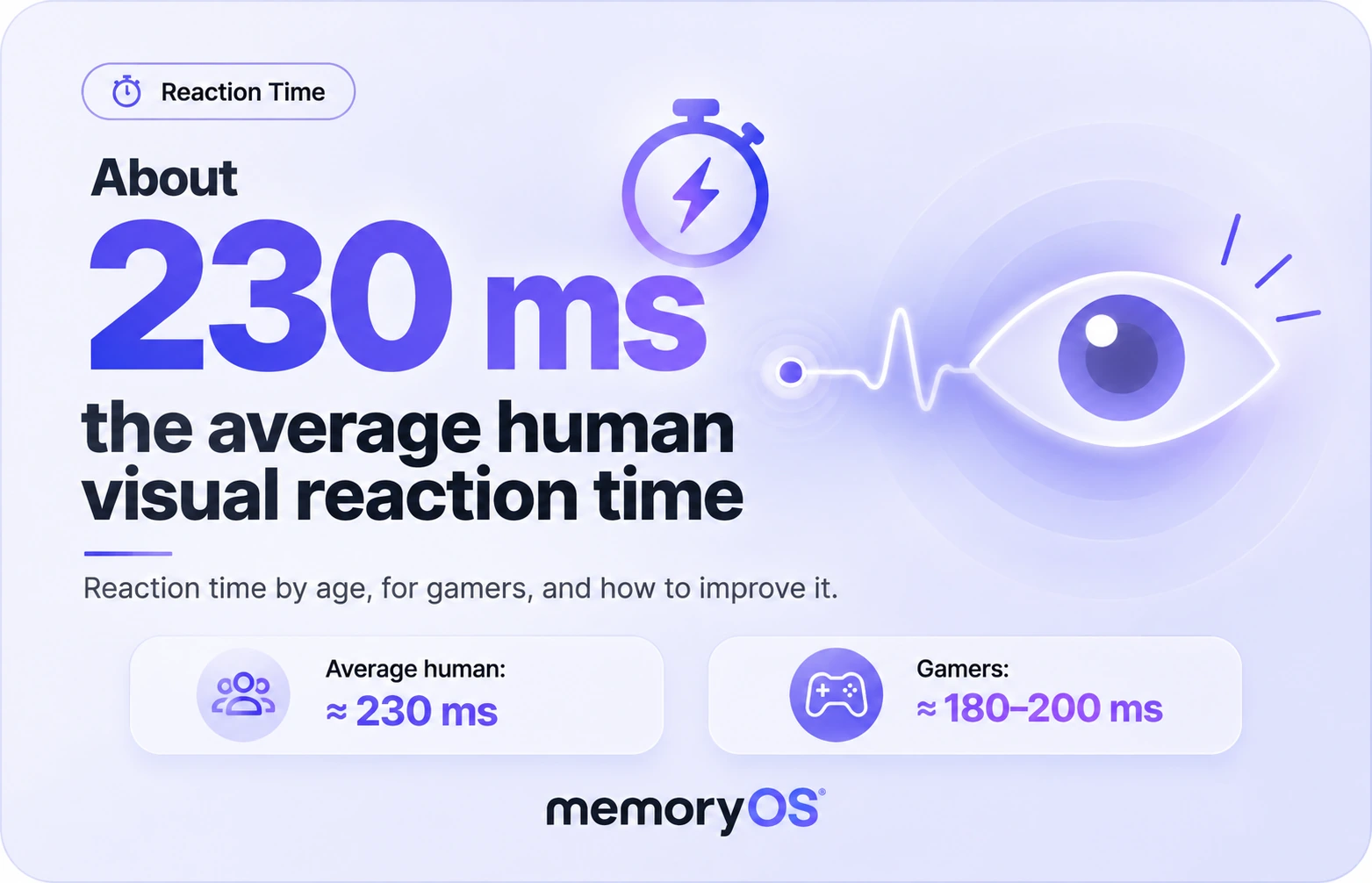
The average human reaction time is about 230 milliseconds (ms) for a simple visual reaction task, based on a 2015 study by Woods et al. involving adults aged 18 to 65. Online tests may yield higher results because latency in display and input devices can affect the measured reaction time.
This is a helpful indicator, but it is not an absolute value that applies to all types of reaction time tests. The outcome will depend on what needs to be detected, how one responds, and how the test measures the time between the stimulus and the reaction. Age is also important, although the difference across adulthood is smaller than you might expect.
What Is the Average Human Reaction Time?
Reaction time is the interval between the appearance of a stimulus and the start of your reaction to it. Reaction-time tests can be as simple as showing a light on a screen and telling you to push a button as soon as you see it. Several factors contribute to how quickly you react, including stimulus perception, decision-making, and response execution.
This is why reaction time measures something more than just how “fast” your brain functions. According to Woods et al., the time used for the detection of stimuli was approximately 131 ms. The rest of the time (around 100 ms) was attributed to the process of movement required to make the responses.
This same research also reported a gradual increase in visual simple reaction time with age. Those between 18 and 24 years had an average reaction time of 217.9 ms, while those between 59 and 65 years had 239.1 ms. This results in an approximate increase of 0.55 ms per year.
Reaction time steadily increased with age, and the researchers found that this increase could largely be attributed to slower motor output.
Visual vs. Auditory Reaction Time
Humans tend to respond to sudden auditory stimuli faster than visual stimuli, though this varies by testing environment. Reaction time is not just about how fast a stimulus reaches our senses, but also how long it takes our body to process this stimulus and prepare a reaction.
This becomes especially relevant when making comparisons between the results of different tests. A person who responds to an auditory stimulus at 150 milliseconds is not necessarily much faster than someone who reacts to a visual signal in 220 ms. The tests use different types of stimuli, which can affect reaction times.
So when you come across an average human reaction time online, it is worth checking what kind of reaction was actually measured. The type of stimulus and the way the test is set up can both affect the result.
Average Reaction Time by Age
The most effective way to interpret reaction time by age is by comparing the average measurements rather than interpreting one value as the standard for all individuals. Woods et al. provided separate findings for seven age groups, so we can better understand the trend in visual reaction time during adulthood.
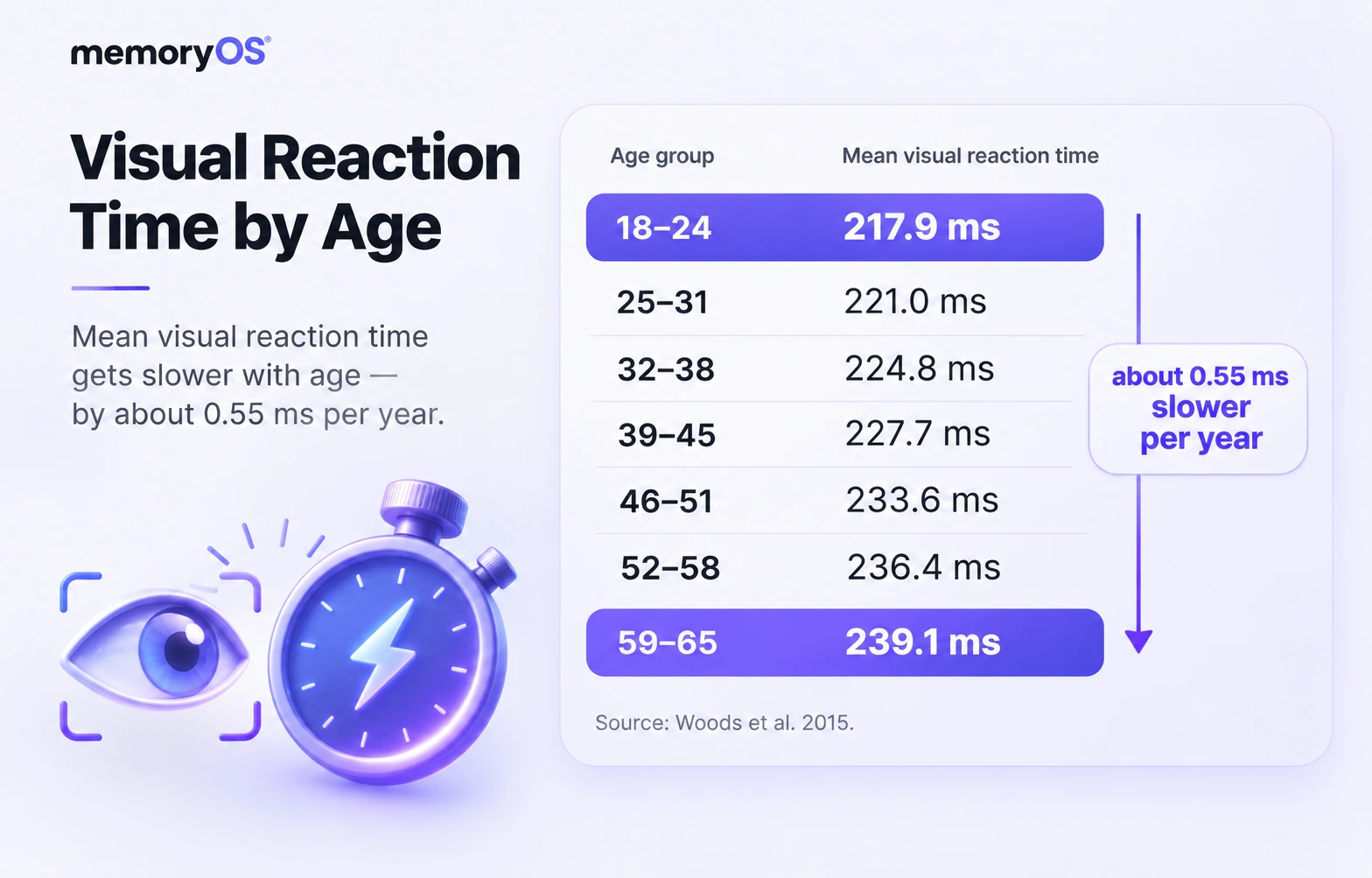
The reaction times presented above are the average simple reaction times from the experiment and not universal numbers for all people of those ages. The researchers have mentioned that delays due to hardware and software could affect the reaction time, and the results from another reaction time test may not be directly comparable.
Young Adults: 18–24
The youngest age group examined in this research had reaction times of 217.9 ms. This figure can be used to indicate an average performance standard for young adults, but it should not be considered a target that every individual within this age bracket must achieve.
Adults in Their 30s and 40s
The study’s 32–38 group averaged 224.8 ms, while the 39–45 group averaged 227.7 ms. The difference between these two groups is only a few milliseconds, illustrating just how minor the differences can be among neighboring age groups in adulthood.
Older Adults: 59–65
Individuals belonging to the 59- to 65-year-old age group demonstrated a mean visual reaction time of 239.1 ms compared with 217.9 ms in the 18–24 group. Notably, Woods et al. observed that slowing due to age primarily resulted from slower motor response but not detection.
Gamer Reaction Time: What Counts as Fast?
While fast response can be useful in gaming, speed alone isn’t all that contributes to making someone an excellent gamer. You have to notice a change, identify what matters, choose a response, and execute it without losing accuracy. This makes a gamer’s reaction time more valuable in relation to a broader skill set.
Research on action video games provides some useful context. In their study, Dye, Green, and Bavelier discovered that individuals who had played action games responded faster than those who had never played video games in experimental tasks without compromising on accuracy. In this study, it was found that video game players responded 11% faster in 89 experimental conditions. However, these findings should not be considered universal for all types of games.
Pro Players vs. the General Population
It may seem natural to assume that pro gamers have very fast reaction times. According to a 2009 review by Dye, Green, and Bavelier, expert video-game players showed faster reactions in several tasks. However, the tasks were different from the typical online reaction time task or the tasks used in esports games.
This is important because gaming requires more than just quick button presses. It also involves following moving objects, dividing attention between multiple sources of information, recognising recurring patterns, and responding to events. A player can therefore be effective in a game without being among the fastest individuals at a basic visual test.
The useful takeaway is that gaming ability can be linked with quick perceptual reactions; however, there isn’t one set “pro player reaction time” that works for all games. What is an average human reaction time to a visual stimulus? It’s just a benchmark, not an esports player ranking criterion.
What Is a Good Reaction Time for Gaming?
There is no universal threshold for “good” reaction time in games. With the help of a reaction time test, you can assess your skills, but the measurement is highly dependent on the stimulus, equipment, and means of reaction.
Different game genres also have different demands; competitive shooters generally need quick visual reactions, whereas strategy and tactical games may give players more time.
Thus, a gamer’s reaction time can be better characterized as task-dependent performance.
What Determines Reaction Time?
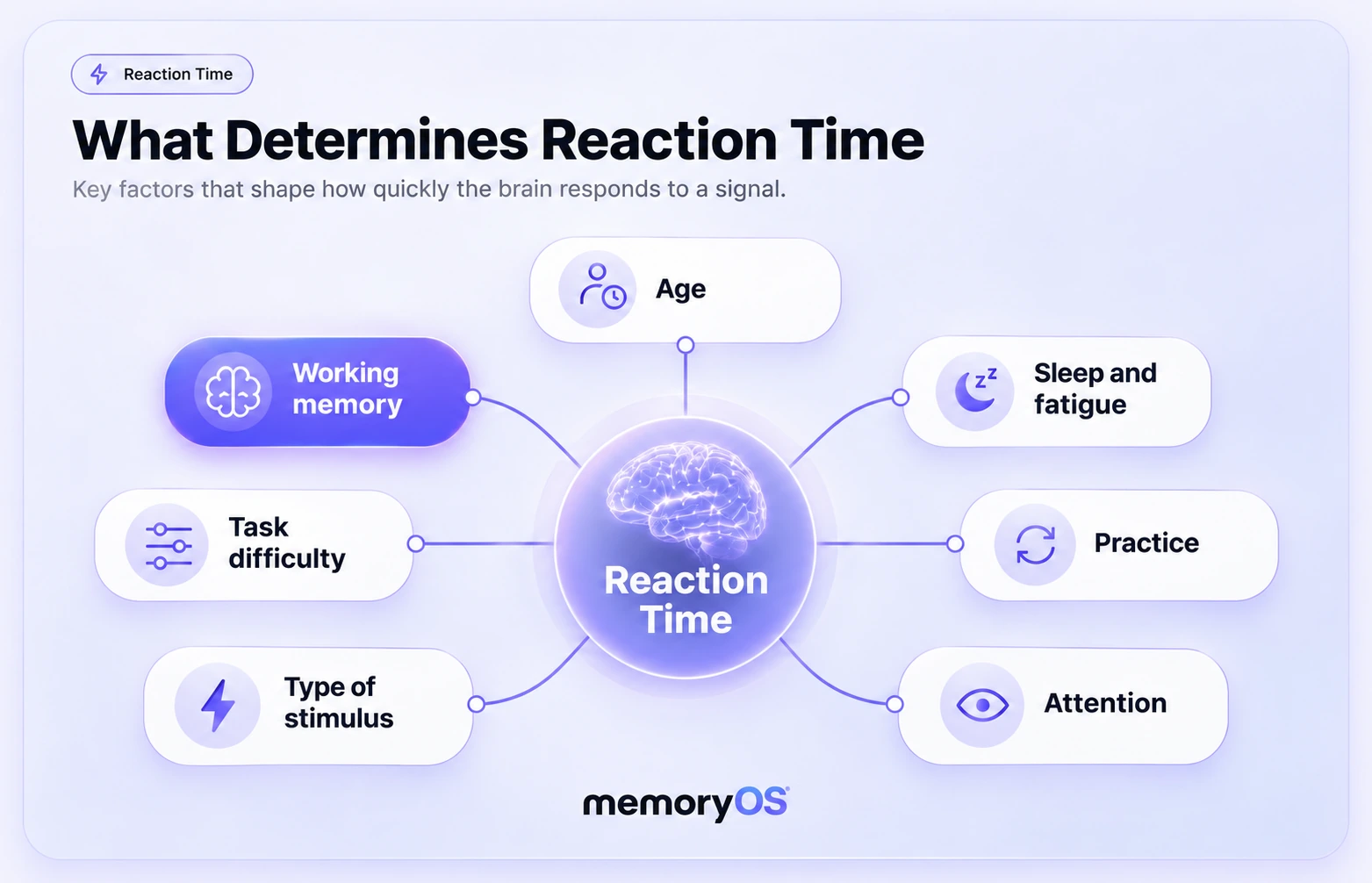
As you can see from the age statistics above, reaction time by age is not fixed; however, age is just one factor. You can get a different result every day despite the fact that your skills did not improve at all. Factors such as sleep, attention, training, nature of the stimulus, and task difficulty can affect your reaction time.
Age and Fatigue
Age-related slowing is gradual, as demonstrated by the Woods et al. data; however, temporary fatigue may affect one’s performance without being influenced by age. It is especially true for sleep loss, which is relevant in the context of reaction-time tasks that require attention.
Practice and Attention
Practice will improve efficiency in handling a task if the task has become familiar enough. You will know what cues to look out for, what areas of attention should be directed, and what sort of response is required. This may help cut down on the time taken to figure out the situation before responding.
The studies about action games can be useful because the observed effect was not restricted to any particular type of activity. According to Dye, Green, and Bavelier, those who regularly played action games showed quick reactions in several experimental tasks while maintaining an acceptable level of accuracy. Their review also found that reaction times improved after people practiced with action games.
This does not imply, however, that any sort of reaction practice will instantly make every type of response quicker.
Link to Working Memory
There is a link between reaction time and working memory, but the link must be explained properly. For tasks that demand retaining information in your mind while reacting to something new, your reaction will not simply be based on stimulus detection.
For instance, in a game, you will detect your opponent, recall the position of another opponent, and then use the two pieces of information to make the right decision. Working memory is responsible for keeping useful information in mind when your attention changes and new information is detected. Readers who want to explore this system further can test their working memory.
This does not mean that working memory training has been confirmed to directly increase reaction times. It would be more accurate to say that working memory is one of the cognitive systems that play a role in tasks that require the storage and processing of information while responding. This is another reason why general cognitive training should not be considered a direct reaction-time intervention.
Working memory is one of many cognitive skills involved in learning and memory. If you want some additional practice in this area, you can try memory games, which target different aspects of memory. For more background on how cognitive practice relates to changes in the brain, exercise and neuroplasticity provides a useful starting point.
The memoryOS app takes a broader approach to memory training, combining memory techniques such as the memory palace with spaced repetition and other forms of practice. Its approach is based on the methods used by Jonas von Essen, a two-time World Memory Champion who has competed at the highest level of competitive memory.
How to Improve Reaction Time
If your goal is to learn how to improve reaction time, you should first analyze what might cause your poor performance, rather than look for complicated exercises right away. There is no one exercise that will beat fatigue or poor attention.
Remembering that a higher score on a test does not necessarily indicate good performance in the situation is important too. A low reaction time score indicates that your performance speed in the particular test has improved. However, it does not indicate that every decision and action will be quick.
Sleep
Sleep is one of the simplest factors to control since being tired can impact attention and processing speed.
The 2010 meta-analysis by Lim & Dinges, based on 70 studies containing 147 cognitive tests, revealed that short-term sleep deprivation had an impact on various cognitive functions, such as simple attention and processing speed. The results were not identical for all tasks, but overall, the research demonstrates why sleep deprivation is a poor condition in which to judge your best reaction speed.
For reaction time practice, this means that testing oneself after having a good rest provides better results than setting a personal best score when not having slept well.
Practice Drills
With practice, a response will become more familiar to you and thus take less time for consideration. Simple practices can be effective if they resemble the kind of reactions that you are working on improving.
For instance, you could practice reacting to a moving visual target, searching for a target among others, and responding to a cue amid distractions. The task should remain consistent if you want to measure improvement. It will be difficult to measure improvement if you keep altering the conditions under which the task is performed.
Fewer Distractions
The reaction task becomes more difficult when attention is split. There can be notifications, side conversations, multiple windows open, or any form of visual distraction.
This does not imply that you must have a silent environment in all your gaming sessions. Instead, the effective way would be to ensure that you do not have any distractions that are not related to the game when measuring or practicing your reaction speed. That gives your attention fewer competing signals to process.
If you want to learn how to improve reaction time, you might consider cognitive training as a complementary method, not as a direct method for improving your simple reaction time. Working memory exercises might help you train working memory skills, but that does not necessarily mean that they will make your reaction times faster. The most effective strategy would be to combine targeted training with adequate sleep and reduced distractions.
Want to put these practice principles into a more structured routine?
FAQ
What is a good reaction time?
While there is no specific benchmark that can be considered to constitute good reaction time, 230 ms may serve as a benchmark in case of a simple visual task.
Does reaction time decline with age?
As one ages, it is possible to have a slowed reaction time; however, this increase occurs gradually. In the Woods et al. study, mean visual reaction time increased from about 218 ms at ages 18–24 to 239 ms at ages 59–65.
Can you train your reaction time?
Practice does have an effect on reaction times, particularly if you practice the same kind of reaction. Action-game research has shown quicker reaction times after certain practices, but this effect varies across tasks.
How is reaction time measured?
Reaction time is defined as the time between a stimulus and your reaction, which is measured in milliseconds. The outcome may be influenced by the nature of the stimulus, how you respond, and the equipment used.
Is auditory reaction time faster than visual?
People generally respond faster to sudden sounds than to visual signals because auditory stimuli can be detected more quickly.
What is the average reaction time in milliseconds?
When it comes to simple visual reaction tasks, an adult average of 230 milliseconds is often referenced. The result may differ due to age, test parameters, and equipment.
Reaction time is just one of the factors in the speed of processing and reacting to stimuli. If you plan to train your cognitive abilities that influence memory, attention, and performance, you can use memoryOS for a structured approach.