
Concrete Thinking vs. Abstract Thinking: What’s the Difference and Which Do You Use?
Table of Contents
Concrete thinking focuses on specific facts, observable details, and present situations, while abstract thinking involves an understanding of broader concepts and possibilities that are not necessarily observable. Most individuals use both types of thinking, though there may be some differences in how they use them in relation to different tasks. Knowing how you think will help you understand how you solve problems, make decisions, and learn new information.
What Is Concrete Thinking?
Concrete thinking depends on facts that can be verified. An individual with concrete reasoning needs to know precisely what occurred, what evidence backs up a particular claim, and what should be done next. When analyzing some news reports, an individual focuses on dates, numbers, and actual statements before interpreting the data.
Such a strategy can be very helpful for procedures, fact-checking, or learning new skills. Concrete thinker meaning is quite straightforward, and it refers to someone whose reasoning is mainly dependent on specifics and practical experiences. This type of thinking can help make well-considered decisions.
What Is Abstract Thinking?
Abstract thinking allows one to see connections between things that seem to have no connection at all and identify patterns that may not be immediately obvious. For example, you could observe that some songs take you back to a certain part of your life and discover the relationship between music and memory.
This type of reasoning can also help interpret metaphors, develop theories, and think about possible consequences. Abstract thought can be useful when the evidence does not give a clear solution to the problem at hand, and the problem needs to be interpreted in a larger sense.
Abstract thinker meaning is fairly easy to understand: it refers to a person who usually tries to find underlying principles, connections, or explanations. But just identifying a general pattern does not necessarily mean that the interpretation is correct.
Concrete vs. Abstract Thinking: Comparison Table
The distinction between the two types of thinking is easier to see in everyday decisions. As explained by Trope and Liberman (2010), people may focus on the bigger picture or on specific details depending on their perception of the situation. The following table illustrates the practical application of the two types of thinking to real-life situations.
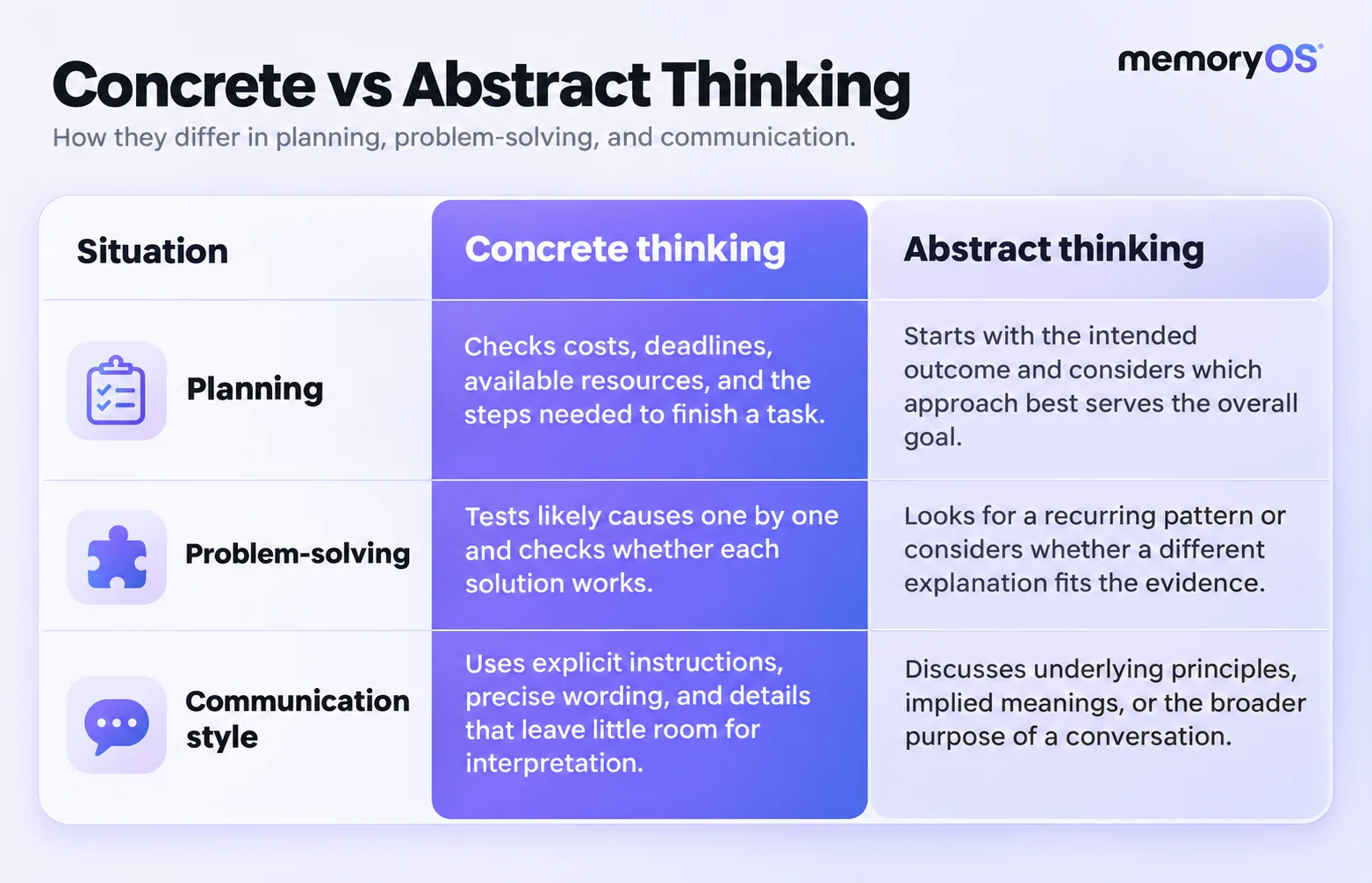
Recognising how you tend to think can help you choose learning strategies that fit the task. For example, if you find it easy to learn a new skill through instruction, concrete thinking will help you concentrate on each step. On the other hand, if you find it easier to comprehend the logic behind the procedure before trying it out, abstract reasoning will help you see the bigger picture. Concrete and abstract reasoning are both useful in learning and problem-solving.
These two types of thinking are not personality traits; there is no good or bad one. You could concentrate on the individual steps involved in using a new device but search for patterns when comparing different concepts. The important thing is being able to know when to concentrate on the smaller things and when to look at the big picture.
Consider these examples of concrete and abstract thinking. Select which one you tend to use more in actual situations.
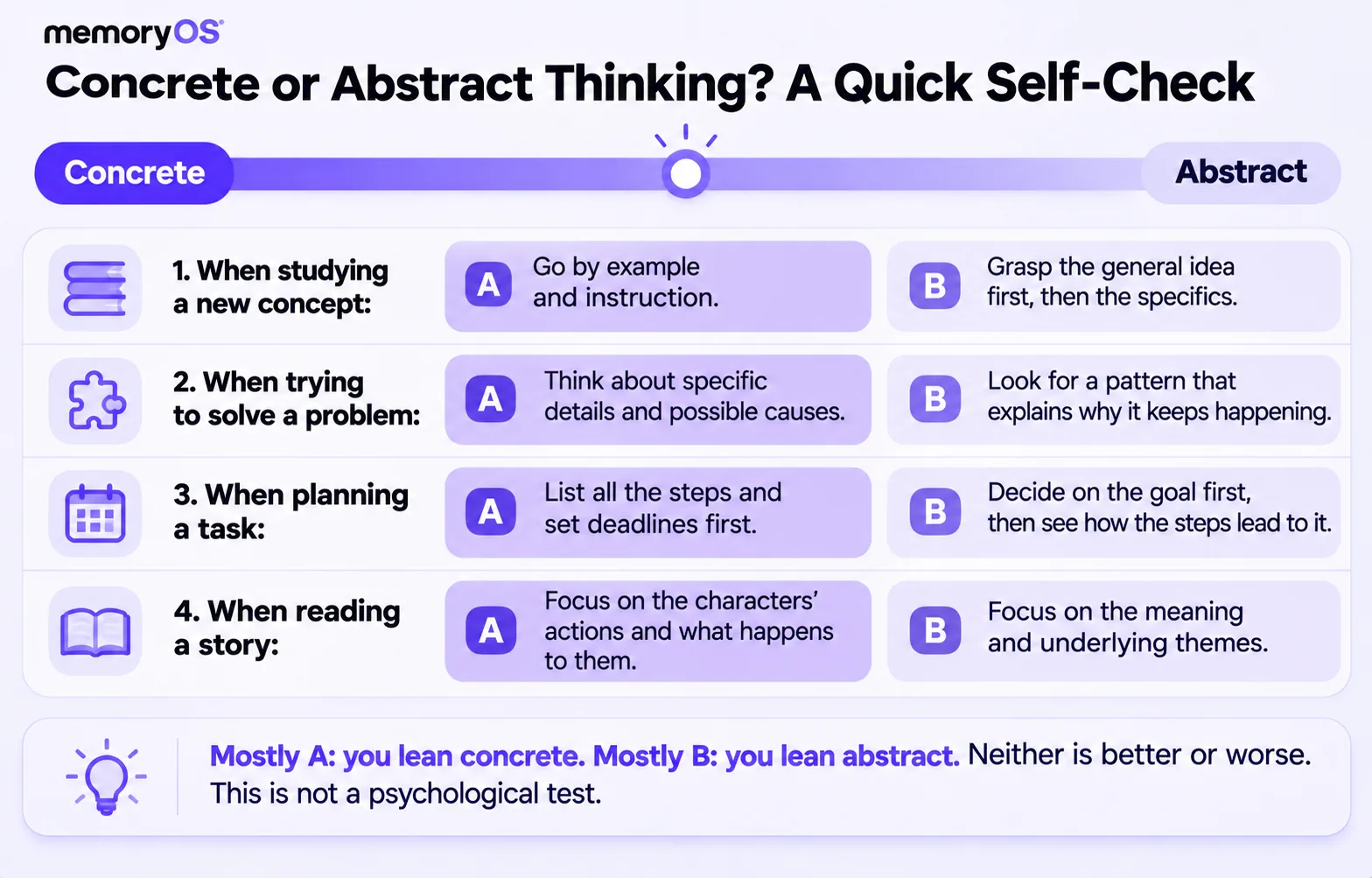
When studying a new concept: Would you rather go by example and instruction, or grasp the general idea first before going into the specifics?
When trying to solve a problem: Would you rather think about specific details and possible causes of the problem, or try to find a pattern that could explain why the problem occurs repeatedly?
When planning a task: Would you rather first list all the steps and set deadlines, or decide on the goal first and see how the steps will help you reach your goal?
When reading a story: Would you rather concentrate on actions of the characters and what happens to them, or on the meaning and underlying themes of the story?
If you chose the first option more frequently, you probably are more of a concrete thinker. The second option means that you are probably an abstract thinker. Neither is better or worse than the other – both are completely normal.
Remember that this is not a psychological test, and your answers would vary from task to task.
Concrete and Abstract Thinking in Theories of Intelligence
Intelligence has many components; therefore, one’s thinking style does not indicate a level of intelligence. An individual may be very good at analyzing basic concepts but may have difficulties with implementing them in practice. Another individual may deal with current issues very effectively while finding it difficult to engage in theoretical reasoning. Neither example, by itself, provides a complete picture of cognitive ability.
Some theories of intelligence distinguish between abilities related to solving novel problems via reasoning and abilities gained through learning. Such differences provide an explanation for the variation in performance between tasks. Thus, solving a new puzzle requires a different approach from applying familiar knowledge in a known task.
Concrete and abstract thought both may make use of various capacities depending on the situation at hand. To grasp the connection between cognitive skills and intelligence more broadly, one must go beyond a single mode of thinking.
Concrete Thinking and Health Conditions
Concrete thinking is a normal way of processing information that everyone uses to some extent. This thinking type has also been studied in relation to cognitive patterns that people with specific conditions show, such as autism and schizophrenia.
Research by Ropar and Peebles (2007) examined how children with autism sorted objects into categories, including how they used concrete features such as colour and size. A small study by Kim et al. (2018) also explored the tendency towards concrete thinking in individuals with schizophrenia during a simulated shopping task.
This information does not imply that every individual diagnosed with either of these conditions thinks the same way. In the case of ongoing problems with reasoning or communication, consult with a health care professional rather than relying on a description of concrete thinking.
Can Abstract Thinking Be Strengthened?
There are some aspects of abstract reasoning that can be enhanced. It is possible to get better at spotting patterns, considering alternative explanations, and applying specific knowledge to general principles. This depends on the specific skill being trained and the difficulty level of the exercise, as well as how often one practices. This does not mean that all skills of reasoning will develop equally or that an exercise will make one smarter overall.
One way to practice is by looking beyond the obvious. For example, while reading an article, think about how the information might help you understand a broader concept. Also, ask whether the information has enough proof to draw that conclusion. The latter is important because recognizing patterns is useful only if one can differentiate between relevant and random connections.
Abstract thought can also be developed by coming up with different solutions to a single problem. Some of the ways through which you can develop your abstract thought include solving puzzles, comparing theories from different subjects, and seeing how a single rule can be applied differently.
Explore ways of learning abstract thinking skills in case you need to know about other techniques of developing such skills. Your mission is to develop the ability to approach some problems flexibly. Whereas some problems demand careful focus on details, there are those that need a step back and think big. The ability to determine which form of thinking will fit the problem is also another big achievement.
Memory Palace and Working-Memory Exercises
Memory exercises provide opportunities to train organizing the information and recognizing the relationship between the facts, but the impact of memory exercises on abstract reasoning must not be overstated.
The research conducted by Clark and Paivio in 1991 illustrates the relationship between concreteness and imagery in learning and memory. Concrete words usually help form mental images in the mind compared to abstract words; hence, they are easily remembered. This knowledge provides a chance for learning; choose any abstract word, come up with an example, and relate it to some picture in the mind. The mental image thus formed can be used as a means of memorizing the abstract idea, but memorizing does not imply understanding.
To practice this method, explore the memory palace method. This is the method that requires placing the information into familiar locations on the mental route. Thus, try to construct a route with places that are already familiar to you. Mentally put an idea at each place and define its meaning. Adding such spatial dimensions makes recalling easier.
As an example, if you want to memorize the abstract term inflation, think of how the prices of the things inside your kitchen grow larger each time you see them. Such an out-of-the-box visualization can help you remember the term and understand its meaning.
Working memory exercises can help you develop skills in storing and manipulating information during a particular activity. You can also look at other memory games in order to train your ability to keep information in your mind while using it. While doing this, do not forget about concentrating on the logic of these tasks rather than scoring points.
Such games will be useful for training your memory and will provide you with an opportunity to manipulate the information. To develop abstract thinking, practice tasks that require analyzing patterns, comparing them, and verifying them against facts.
Want to put these ideas into a more structured routine?
FAQ
What is the difference between concrete and abstract thinking?
Concrete thinking is about concentrating on particular facts and details, whereas abstract thought includes comprehension of wider concepts, patterns, and meanings.
Am I a concrete or abstract thinker?
If you prefer direct instructions and examples, you may be considered a concrete thinker; however, depending on the situation, you may prefer to think otherwise. It is important that you observe yourself when faced with new situations to determine your type of thinking.
Can abstract thinking be learned?
Yes, this thinking type may be practised through identifying patterns, questioning your first interpretation, and linking an example with bigger concepts. With regular practice, one can become more comfortable analyzing various explanations.
What are examples of concrete and abstract thinking?
The process of cooking a dish based on a recipe demonstrates concrete thought, while thinking about the reason for mixing specific ingredients in cooking shows abstract thought.
What does a concrete thinker mean?
A concrete thinker is an individual who tends to rely on perceptible facts, direct experience, and details when interpreting data.
What does an abstract thinker mean?
An abstract thinker is defined as an individual who has the habit of paying attention to principles, relationships, and patterns instead of facts. This can prove useful in the comprehension of concepts and explanations.
Knowing your information processing style, it would be easy for you to find out new strategies for studying and remembering things.