
How Can I Use Online Resources to Improve My Knowledge?
Table of Contents
Online learning has never been more accessible. Yet, many of us tend to observe a gap between what we consume and what we remember. Information flows through our attention every day, and only a small part of it can be encoded for long-term use.
This issue raises a practical question: how to use online resources to improve knowledge and understand it deeply. In this case, the matter is not quantity, but quality of information processing.
The Real Problem with Online Learning: Consumption vs Retention
The core problem with learning is not access but retention. The way the human brain retains information is not merely by viewing it or listening to it. Encoding happens through focusing on the importance and structure of information.
When you use online learning resources, your brain mostly stays in alert mode, simply noticing new information. This system is meant for short-term detection, like quickly scanning content on learning websites, rather than storing it for long-term memory.
Activities such as passive scrolling, video hopping, and note stockpiling appear productive, but they avoid processes involved in recall. From a cognitive psychology viewpoint, this instills familiarity without encoding. It leads to recognition without retrieval, which is short-lived as soon as attention is directed elsewhere.
Being exposed to it is not the same as having usable knowledge, which requires organization and retrieval. To improve knowledge online, learning technology needs to cooperate with memory architecture. The best memory app will only be successful if it turns exposure into recall.
Using Online Resources the Right Way: A Practical Learning Framework
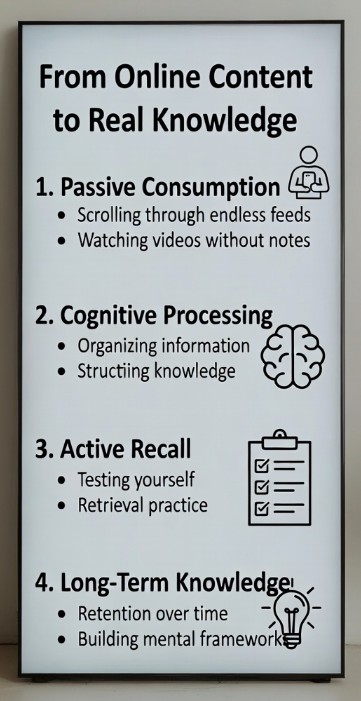
Courses, articles, and videos are used effectively as inputs, not outputs. Completing a module or viewing a lecture does not indicate learning. It is more about information presentation. Understanding how to use online resources to improve knowledge starts with knowing the distinction between exposure and results, where exposure is actually the starting point and not the endpoint.
The brain can retain information when it is challenged to interact with this information. Passive viewing minimally engages the memory systems, whereas active learning engages the mind in processing, analyzing, and recalling information. It is this processing that enhances memory retention.
How Memory Systems Turn Online Information into Long-Term Knowledge
Our brains have a great capacity to store information that is encoded for a purpose. Thus, without a system for storage and retrieval, learning collapses into short-term exposure. It is important to use the proven techniques that can ensure deliberate encoding.
The mind palace method provides a useful key to how this can be achieved, utilizing spatial and visual reminders. This is where the best memory app, memoryOS, stands apart from traditional brain games. Such apps as memoryOS provide a program of structured recall, spaced repetition, and use of visuospatial memory to construct a long-term mental structure.
Traditional activities such as crossword puzzles encourage recognition, but they do not activate complex recall. The memoryOS app is all about how knowledge is structured rather than how it is exercised. This is what makes online information knowledge that persists within mental frameworks.
From Learning to Recall: Practicing Knowledge with Games and Tests
Recall practice is more effective than rereading in the sense that it makes the brain actively recognize information. Remembering through activities and tools, such as working memory games, helps to achieve this in a targeted manner.
Another cognitive solution is number-based memorization training. It refines the skill by honing attention, sequence, and control. As the skill of recalling becomes an ingrained one, individuals indeed enhance their knowledge and learn how to leverage the use of online resources.
Finally, the best study patterns entail short intervals rather than lengthy study periods. The mind learns by repeated phases of engagement and rest. Online learning resources bring the greatest benefit during a balanced learning process.