
Spaced Repetition Explained: How to Remember Anything Forever
Table of Contents
Forgetting is not an error of the memory system; it is the default mode of brain operation. Every bit of information, whether a single word or a more abstract idea, starts losing its power the minute it is processed unless consciously recalled. It is not a cognitive weakness but rather an important process by which the brain decides what is important enough to remember.
The spaced repetition system takes advantage of this process by disrupting the natural forgetting process of memories in carefully calculated intervals. Rather than letting information slip through the cracks of the brain, the system refreshes that information right when it reaches the point of forgetting. By doing so, it enhances the synapses in charge of that information, making it less likely for those neural paths to be forgotten in the future.
The true secret behind the success of spaced repetition, however, lies not in the act of repetition, but in its timing. The mind has a tendency to respond more to effortful recall than to simple review. So every act of successfully recalling something becomes a mark of significance for the mind.
Cognitive science studies have shown that, according to forgetting curves, retention can be greatly improved through the use of timed intervals for reviewing material. In other words, learning is no longer an isolated process, but a self-correcting one.
Understanding this mechanism shows how we gain knowledge: memory is not stored once; it is a system that continuously rebuilds itself.
The Science of Spaced Repetition
Efficiency in memory training is not achieved through intensity, but rather through timing. Human memory can be understood through predictable biological rhythms, and this understanding is the basis of spaced repetition.
Information, once acquired, is stored in a vulnerable form in neural pathways that have yet to solidify. If the memories are left unattended, they quickly fade away since the brain will favor the processing of new information over any dormant memories.
Ebbinghaus’ forgetting curve illustrates how our memory works in a very clear manner. We do not forget information in a linear way. It happens very abruptly and then starts to stabilize slowly.
After a few hours of acquiring new information, part of it is already lost if not recalled. Nevertheless, each repeated attempt changes the shape of the forgetting curve, making the forgetting process slower and increasing the period during which memories can be retained.
The point about “what is spaced repetition” is not only its definition, but also a behavioral principle. This technique involves consciously choosing times to do your reviewing right at the moment when forgetting is about to happen. Instead of relearning information, your brain will activate already partially weakened connections and improve synaptic efficiency.
The concept of the spacing effect will help us understand better how it works. Neuroscientific studies have shown that distributed learning stimulates greater encoding than repetition does.
At each interval, we face a gap in our memory, which requires effort to encode data. It is this memory effort rather than repetition that helps create lasting memories.
The spaced repetition method makes the whole learning process more predictable and efficient by making our brain learn to recognize patterns and focus on necessary information.
Why Traditional SRS Apps Fail
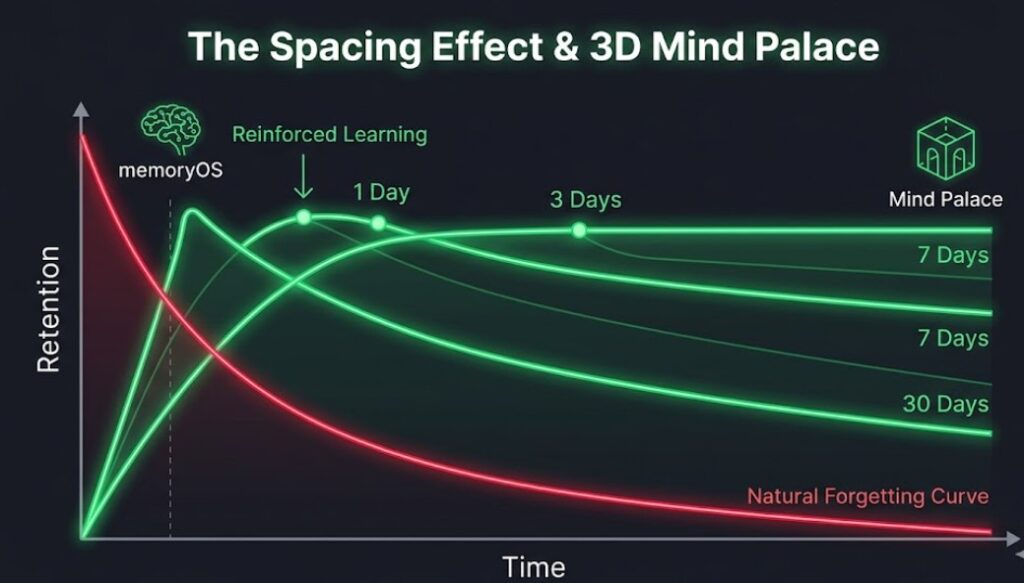
Although theoretically based on solid science principles, there are scenarios when spaced learning does not achieve meaningful cognitive depth. The problem here is not in the idea, but in its practical application through current methods.
Boring Leitner systems
Most of the apps out there continue using the simple principle of Leitner-based learning, where flashcards are sorted between the same set of boxes depending on whether answers were correct. Even though this system worked well before, it cannot meet current cognitive needs due to its inflexibility and lack of complexity. This reveals another limitation of spaced repetition, as overly rigid review schemes may hinder learning.
Lack of engagement
Learning requires attention, but most SRS programs minimize interaction by relying on button-click recall. As a result, after prolonged periods of this behavior, engagement drops. Learners persist out of habit or necessity rather than intellectual curiosity since they find no significant variation and no contextual cues. Thus, retention proves unreliable and relies almost entirely on the practice itself, which is why people may opt for other solutions among the best brain training games apps in 2026.
No spatial encoding
The most vital disadvantage stems from the inability to utilize spatial memory encoding. Conventional SRS methods assume that information comes as sequential facts. In reality, however, the brain encodes knowledge in contextually based relational networks. Hence, without the utilization of spatial coding techniques, retrieval proves limited and highly dependent on external cues.
Therefore, even the most efficiently designed SRS programs fail to deliver their full potential if they neglect natural memory organization techniques.
memoryOS Next-Gen SRS
Traditional learning applications consider memory as a repetition activity. However, cognition is far from being an independent entity, with the brain creating meaning through its structure, associations, and spatial connections.
This is what makes the next-generation learning app, memoryOS, so groundbreaking by incorporating all of these cognitive techniques. While most learning apps are centered around a single approach to memorization, such as the spaced repetition method, memoryOS combines three cognitive practices: spaced repetition, mnemonics, and 3D spatial memory.
The key feature of this new-generation SRS is a hybrid algorithm that is based on reinforcement time intervals and structured mental spaces. Learners do not use standalone flashcards anymore; instead, they place all data in a 3D Sherlock-style Mind Palace, with different ideas being associated with specific spatial locations.
The platform consists of over 130 micro-lessons intended to shape complex content into smaller cognitive chunks. Each chunk will be built with an aim of triggering active recall to ensure that learners construct knowledge rather than just memorizing it passively, thus ensuring neural connections are formed in a more efficient manner than with traditional methods of repetition.
Cognitively, this system of study represents a move away from linear memorization toward cognitive exercises. Mnemonic devices improve encoding efficacy, while spatial mapping makes sure that data is stored using relational maps and not simple sequential chains. This makes the process much more effective in cases where learners have to process a large amount of interconnected information.
The memoryOS app is one of the best memory apps for adults in 2026 due to its innovative approach to memory improvement, which reflects current trends in educational technologies. The combination of spaced repetition techniques and cognitive structures ensures an effective process of memorization through the process of reinforcing knowledge and organizing it in space.
Thus, memory is no longer considered a means of passive information storage, but rather a system actively created by a person.
How to Use Spaced Repetition Properly
Good practice does not depend on the specific technique, but rather on its consistent and efficient application. Spaced repetition can become truly effective only through its organization according to certain temporal, cognitive, and organizational criteria. Otherwise, even the most complex techniques would become ineffective after some time.
Daily cycles
The process of memory consolidation relies greatly on the distribution of repetitive patterns over time. Daily cycles help reinforce the new material before it fades below the level of recall.
For instance, repeating the same foreign vocabulary learned in the morning after an evening review will be far more beneficial than prolonged studying without breaks. This is due to the fact that our brain loves recently activated information.
However, daily cycles are not about repetition overload. They are about controlled exposure. A well-designed spaced repetition routine limits cognitive fatigue while ensuring that memory traces remain active. Over time, this creates a rhythm where learning and forgetting are continuously balanced, preventing both overload and decay.
Interval logic
The effectiveness of spaced repetition depends on how intervals are structured. If reviews are too frequent, the brain does not engage in meaningful recall; if they are too distant, information is lost. Optimal intervals gradually expand as memory strength increases, allowing the brain to transition from effortful recall to automatic retrieval.
For instance, a new concept might be reviewed after one day, then after three days, then seven, and later at longer intervals. Each successful recall signals increased stability, which extends the next review window. This adaptive spacing reflects how synaptic strengthening actually occurs in the hippocampus and cortex during memory consolidation.
Subject mapping
Not all subjects are treated identically from a cognitive perspective. Subject mapping refers to the process of categorizing learning materials before using repetition. Thus, for instance, a different kind of map is needed for medical terminology, rules of law, or language grammar.
Rather than studying fragmented pieces of information, learners build interconnected clusters that complement each other in terms of meaning and structure. In addition, combining such an approach with spaced repetitions allows making sure that every cycle reinforces not just single items but whole knowledge structures.
This way, the process of mastering a certain subject turns into creating an internal model, rather than merely memorizing a list of unrelated things. The existence of a certain structure makes it easier for a learner to predict connections, avoid overload, and retrieve information under stress.
With the integration of daily repetitions, intervals, and maps, spaced repetition acquires the status of a full cognitive toolset.
Jonas von Essen Method
In today’s competitive field of memory sports, Jonas von Essen is known worldwide as a two-time World Memory Champion who uses traditional mnemonic approaches in combination with rigorous training.
The method of Jonas von Essen does not lie in innate memory abilities; rather, it consists of techniques that enable him to process raw information by turning it into visual and spatially arranged mental images. The central principle of his work process is the use of the memory palace, which helps encode a vast amount of information.
The technique of von Essen differs from rote learning because information should be consciously turned into a visual image and then placed in a particular memory space. So, recalling occurs through navigation in the memory structure created within the memory palace, and it becomes less stressful and more accurate in competitive conditions.
One of the main principles of his technique is using the Person-Action-Object (PAO) concept, whereby information compression occurs not through isolated pieces but rather through interaction. This minimizes the burden on cognitive resources while maximizing the capacity to hold information in associative form. Ultimately, such associations become permanent memory aids that enhance recall, even when time is limited.
Jonas von Essen’s memory technique is frequently discussed in relation to cognitive training since it shows how memory efficiency depends on the degree of structure in a task rather than on the amount of effort. As for the process of memory formation, Jonas von Essen’s technique is characterized by three distinct stages: visual encoding, spatial storage, and mental navigation.
Currently, the technique goes far beyond the mere competition application. The use of his strategies has found application in educational software like memoryOS, which combines the elements of spatially organized environments and reinforcement cycles that mimic optimal conditions for super-high recall performance.
This example of applying strategies of high-level memorizing proves an important concept: memory is not trained just through repetition, but through proper cognitive structure design.
In this regard, the strategy used by Jonas von Essen is not merely a case of gaining a competitive advantage; it serves as a framework for using memory structures to improve the learning process.
Conclusion
Encoding is not an innate skill but rather a deliberate process that relies on factors such as time, structuring, and cognition. While the spaced repetition method capitalizes on the natural way of forgetting, its full potential can be unlocked only through structure and encoding.
The development of learning aids has evolved from traditional techniques to highly innovative systems like memoryOS, reflecting a movement towards cognitive design.
Strategies employed by professional memory champions, like Jonas von Essen, prove a fundamental concept: good memory does not result from hard work but from good structure.