Best Brain Training Games & Apps in 2026: Ranked by Science
Table of Contents
Memory isn’t just about repetition—it’s powered by networks of neurons communicating through synapses. This communication helps us recall information efficiently, solve problems, and stay concentrated in high-pressure situations.
Over time, cognitive decline and mental exhaustion can cause these neural pathways to weaken. It can make simple tasks increasingly difficult. The idea behind brain training apps is to train these neural circuits.
However, the question is how to find the right app that will provide the right training. While a random app may offer a series of brain exercises, it may not provide the right training for cognitive enhancement.
Scientific research has shown that for cognitive enhancement to be effective, the exercises must be adapted to your current skill level, track your progress over time, and engage multiple cognitive domains.
The app comparison will help you determine the right app for cognitive growth, rather than just entertaining your brain. Some of the top apps for cognitive enhancement in 2026 are memoryOS, Lumosity, Peak, and Cognifit.
Let’s analyze the best brain training apps on the market, how they’re scientifically valid, and how to apply this information to help you make informed decisions about training apps. Curious how your memory measures up right now? Take a quick memory test game before diving into the app comparison below.
Do Brain Training Apps Actually Work? The Science
The debate about whether brain training apps actually help optimize cognitive performance remains contentious.
While some training apps are nothing more than entertainment, the brain science is clear: decades of research have shown that the brain is capable of neuroplasticity through training. This means that the neural networks in the brain can be physically changed by engaging in cognitive activities.
Scientific reviews offer clarity. A seminal meta-analysis by Daniel J. Simons et al. (2016) reviewed dozens of studies that assessed the effectiveness of brain-training programs. The review concluded that cognitive performance can benefit from casual training for trained tasks. However, evidence for cognitive transfer to everyday memory, reasoning, and attention is limited and not consistent.
So, it’s not simply a matter of repetition; it’s a matter of how well the training transfers to the real-world settings.
How do you find apps that really deliver results? Well, one way to do so is to look at the brain training evidence: Look for apps that have been actively tested in scientific studies.
Features such as tracking progress, adaptive challenges, and engaging in multiple cognitive tasks are essential. This is how we can tell which memory app actually works. A credible app converts short-term engagement into real cognitive development.
For adults looking to stay cognitively sharp, the stakes are high. Regular use of the best brain training games in 2026 can help adults build working memory, stay focused under pressure, and even shape cognitive resilience.
Apps such as memoryOS, Lumosity, Peak, and Elevate have been created with this in mind. They incorporate motivational elements to keep users engaged.
Ultimately, brain training is most effective when it’s intentional, structured, and measurable. A great brain training app offers a roadmap to improving memory, solving problems, and gaining confidence in your cognitive abilities.
By understanding the science of neuroplasticity and cognition, you can select an app that will elevate your mind, not just create the illusion of improvement.
A 5-Point Framework for Ranking These Apps
Choosing the best brain training app is more than just popularity or aesthetics. With numerous apps to choose from, adults who want to stay mentally sharp need a clear methodology. Important criteria are designed to be measurable, user-friendly, and scientifically sound.
- Evidence Base
Top apps are backed by peer-reviewed studies and supported by cognitive science. An app that has an evidence base shows that it actually enhances memory, attention, or thinking skills, rather than just being fun or interesting. Otherwise, an app may not be effective.
- Adaptive Difficulty
Cognitive growth happens when there are challenges that you adapt to your growing skill level. Apps with an adaptive difficulty level make sure that the exercises are neither too easy nor too hard. This keeps your brain at an optimal training level.
- Cognitive Transfer
There must be cognitive improvements that transfer beyond the application. Real brain games for adults not only boost working memory, attention, and cognitive skills, but they also offer a memory and cognitive boost outside the application environment. This means that your training will have a real-life impact on cognitive robustness, attention, and working memory.
- User Experience and Engagement
A consistent user interface is essential to cognitive transfer. Ease of use, clear instructions, and motivational features such as streaks, rewards, or gamification are important.
- Peer Review and Feedback
Last but not least, it is vital to examine feedback, peer reviews, and endorsements. Apps that have been reviewed and vetted by independent sources can be trusted more. Peer reviews help separate apps that promise cognitive benefits from those that provide fleeting interest or hype but lack real value.
By using these five criteria, the top apps on the list provide measurable cognitive benefits. The evaluation system enables adults to make the most of their time, using apps that work, boost their self-esteem, and provide cognitive training as a daily habit.
Top 7 Brain Training Apps in 2026 (Ranked)
When it comes to training your mind in 2026, not all apps are created equal. Cognitive science tells us that to train your mind effectively, there is a need for neuroplasticity & brain training.
With 5-point evaluation criteria for brain training apps, let’s analyze the best apps for adults.
memoryOS
The memoryOS app takes the top spot because of its holistic and evidence-supported approach to cognitive development.
Each exercise adapts to the user’s skill level. It improves working memory and reasoning skills in real-life situations. The memory palace technique ensures that users improve spatial memory as well.
The application provides detailed statistics on performance. It makes it easy for users to track their progress. The methodologies used are mostly peer-reviewed, which makes this application scientifically sound and reliable.
Lumosity
The Lumosity app has a wide range of fun brain games designed to build memory, attention, and processing speed skills. The app uses adaptive difficulty.
However, the company’s claims of cognitive decline prevention were challenged by the FTC, for which a $2M settlement was reached in 2016 for unsubstantiated claims.
While the app is fun and excellent for motivation, the transfer of cognitive benefits is limited. Therefore, the app is most suitable for those looking for light cognitive stimulation.
BrainHQ
The BrainHQ app is backed by scientific research and is designed by neuroscientists to build attention, memory, and processing speed skills.
The exercises are designed to be challenging using adaptive difficulty, with excellent insights provided through metrics to understand improvements.
While some may find the interface less intuitive, the visual app design is updated.
The scientific validation of the app’s design is excellent for adults looking for a more structured cognitive training experience with repetitive exercises to build cognitive skills.
Peak
Peak has a strong focus on gamification, with daily challenges available for memory, problem-solving, and language skills.
The app has an adaptive level of difficulty, which keeps the challenges at a suitable level, as well as reminders to maintain consistent practice.
The disadvantage is that the app sometimes prioritizes engagement over transfer.
Elevate
Elevate is centered on practical skills, which include reading, math, writing, memory, and attention. The adaptive difficulty level ensures users remain engaged, and daily routines promote constant improvement.
The heavy use of language in some exercises might not be advantageous, especially for users interested in numeric and memory skills. However, the focus on practical application and engagement makes it a good addition to memory skills apps.
Brilliant
Brilliant emphasizes logic, math, and science skills, which indirectly help users develop their memory. The interactive lessons promote cognitive skills.
The main drawback of Brilliant is the lack of memory skills, which makes it unsuitable as a primary tool. Brilliant can be used as a secondary tool in combination with memory skills apps like memoryOS and BrainHQ.
Anki
Anki uses spaced repetition to optimize memory retention. This makes it effective for learning languages, professional material, or facts. Anki’s methodology is robust, but the interface is technical, which makes it less appealing to casual users.
Anki is effective for memorization but does not have adaptive problem-solving or attention training. Therefore, using apps like memoryOS or Peak, which are dynamic, would be necessary for cognitive development.
The ranking shows that not all cognitive and neuroplasticity apps produce similar results. The memoryOS app is unique as a holistic tool that uses science to support cognitive development. Other apps are effective at motivation, gamification, or skill development.
Understanding how each tool relates to evaluation criteria helps us choose tools that will strengthen memory rather than provide temporary stimulation.
Table 1: Overall Rankings
| Rank | App | Evidence Base | Adaptive Difficulty | Cognitive Transfer | UX/Engagement | Overall Score |
|---|---|---|---|---|---|---|
| 🥇 1 | memoryOS | ⭐⭐⭐⭐⭐ | ⭐⭐⭐⭐⭐ | ⭐⭐⭐⭐⭐ | ⭐⭐⭐⭐⭐ | 5.0/5.0 |
| 🥈 2 | BrainHQ | ⭐⭐⭐⭐⭐ | ⭐⭐⭐⭐⭐ | ⭐⭐⭐⭐ | ⭐⭐⭐⭐ | 4.5/5.0 |
| 🥉 3 | Peak | ⭐⭐⭐⭐ | ⭐⭐⭐⭐⭐ | ⭐⭐⭐ | ⭐⭐⭐⭐⭐ | 4.2/5.0 |
| 4 | Elevate | ⭐⭐⭐⭐ | ⭐⭐⭐⭐⭐ | ⭐⭐⭐⭐ | ⭐⭐⭐⭐ | 4.0/5.0 |
| 5 | Lumosity | ⭐⭐⭐ | ⭐⭐⭐⭐ | ⭐⭐ | ⭐⭐⭐⭐⭐ | 3.5/5.0 |
| 6 | Anki | ⭐⭐⭐⭐⭐ | ⭐⭐ | ⭐⭐⭐⭐ | ⭐⭐ | 3.2/5.0 |
| 7 | Brilliant | ⭐⭐⭐ | ⭐⭐⭐⭐ | ⭐⭐⭐ | ⭐⭐⭐⭐ | 3.0/5.0 |
Brain Training Games vs. Apps: What are the Major Differences?
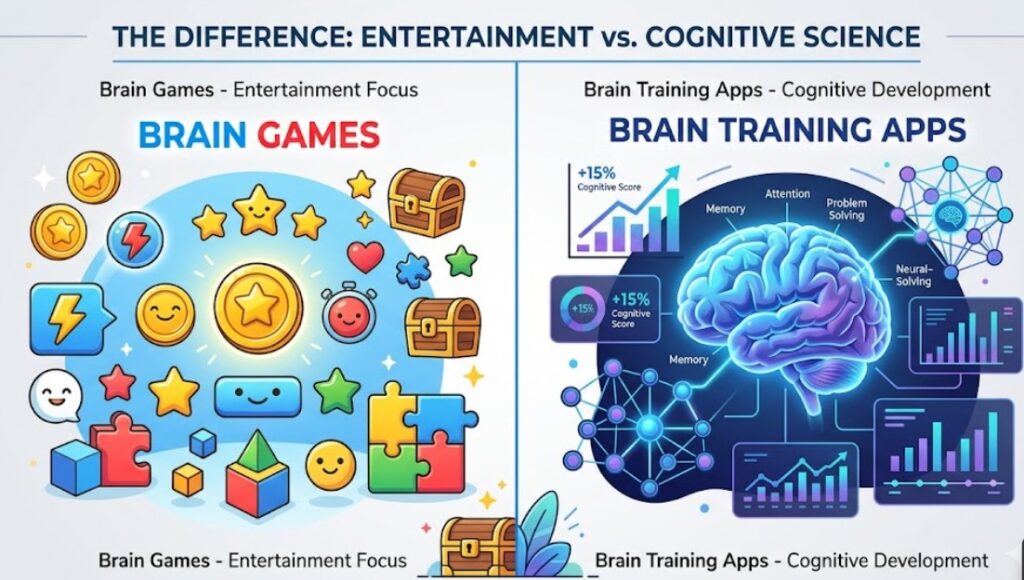
Not all cognitive training is created equal. The difference between brain training games and apps is that games are often designed with entertainment as the primary objective, while apps are designed to help you achieve cognitive training objectives using various programs that are scientifically proven to be effective.
Another difference between brain training games and apps is that passive training, which involves watching patterns or playing games, is not effective for cognitive development. On the other hand, apps are designed to be active training tools that challenge you at every turn, always ensuring that you are in your optimal learning zone.
Similarly, user experience is not the same in either case. Games, on one hand, give users immediate rewards and short-term gratification, which may not be enough to address long-term neuroplasticity.
Apps, on the other hand, design the learning process in a manner that ensures memory retention and mental flexibility over time. Therefore, when adults want to improve their brains, they should choose apps to ensure that they are investing their time in something that actually works.
Overall, the distinction between brain training games and apps enables users to make the right choice. While games may be fun, they are not enough to deliver serious brain improvement; therefore, users need to invest in apps to deliver the right results with brain exercises that actually work.
Which App Is Best for Your Goal? (By Use Case)
The best brain training apps depend on what you want to achieve. Do you want to improve memory focus, fasten processing speed, or become more resilient in cognitive functioning?
If you are an adult in the 28-50 age range, you want to know that the time you invest in brain training yields significant benefits. Let’s examine which app is best suited to which goal.
Do you want to improve your memory focus? Apps such as memoryOS or Anki are best suited to improving encoding and concentration.
Do you want to improve processing speed? Apps such as BrainHQ and Peak are best suited to enhancing processing speed.
The reason for this is that cognitive benefits are not universal. So, if you are looking to improve your mental abilities as a whole, apps that have a combination of attention, thinking, and memory exercises, such as memoryOS, are a good choice.
By considering your needs and goals, you can design your training sessions to be as efficient as possible. This means that any time you spend on an app will be directly linked to real-world cognitive performance. The right app is not necessarily the most popular; it must suit your mental objectives as well as your desire to grow.
5 Red Flags: Brain Training Apps to Avoid
Since not all brain training apps are equally effective in enhancing brain function, it is important to be aware of the potential pitfalls to avoid wasting precious time.
Here are 5 red flags to watch out for:
- Misleading Claims
It is important to watch out for brain training apps making exaggerated claims about brain improvement. Smart brain & cognitive enhancement apps require time and effort to deliver results. According to research conducted by NIH/NIA, aging brains require constant mental stimulation, but this is not something an app promises to deliver instantly.
- Unvalidated Apps
Steer clear of apps that have no backing in terms of research or scientific support. While unvalidated apps may be entertaining, exercises conducted on them may not result in any real gains. Without working memory test results or performance tracking, users may not be able to measure real gains.
- Marketing vs Science
Be cautious, as some apps may focus on marketing and flashy graphics rather than science and methodology. Users should be able to identify marketing vs science and choose apps with cognitive brain training games supported by neuropsychology principles and research.
- Overemphasis on Gamification
Although incentives, streaks, and points can help keep users engaged, apps that place too much emphasis on gamification rather than skill development will not help users develop actual improvements in memory, attention, or reasoning.
- Limited Domains of Training
Apps that only train users in one area, such as only having word game training without any attention or memory training, do not provide well-rounded cognitive training.
The best brain games app should have a variety of domains in training, such as memory, attention, problem-solving, and speed. The best memory apps combine these components into a single app to maximize the benefits of training.
By being aware of these red flags, adults can invest in platforms that are actually improving their cognition. The objective is not to have fun but to actually see an improvement in mental abilities in day-to-day life. To see that improvement for yourself, our number memory test and sequence memory game are two quick, free ways to track your progress.
FAQ
Do brain training games really boost intelligence?
Research findings are mixed. Generally, most brain training games offer improvements in specific skills that are trained, but not real-world transfer. The most effective games are those that utilize spaced repetition and adaptive difficulty, especially working memory training.
How many minutes of brain training per day is effective?
The optimal amount of time to be spent on brain training games is 15-25 minutes a day, 5 days a week. This has been shown to be effective over a period of time, rather than spending more time sporadically on training games.
Which brain training app has the best scientific proof?
BrainHQ has the best scientific proof in peer-reviewed studies, while memoryOS uses a combination of memory palace and spaced repetition techniques that have both been academically proven.
Is brain training beneficial in the prevention of dementia?
The scientific data is very promising, although there is no conclusive proof. Studies funded by the National Institutes of Health show that benefits can last up to 10 years. However, no app is yet FDA-approved to prevent dementia.
At what age should one start brain training?
Adults of all ages can benefit. Young adults can improve their speed and working memory. Older adults can delay the onset of age-related decline. The National Institutes of Health recommends starting early, before the decline occurs.
Are free brain training apps just as good as paid ones?
Free brain training apps tend to have fewer academically proven exercises and less advanced algorithms. They also tend to have less impressive results. Paid brain training apps such as BrainHQ and memoryOS tend to have more impressive results.
Try memoryOS – Science-Backed Brain Training
Are you ready to turn your efforts into real brain growth? The memoryOS app offers AI-based training, memory training, and a real Memory Palace to help you improve your memory, attention, and thinking skills effectively. Try your free trial of memoryOS today at memoryos.com. Make 2026 the year you sharpen your mind with the best brain training software.