
Which Memory Improvement App Actually Works for Professionals?
Table of Contents
Which memory improvement app actually works for professionals when the workload keeps expanding is a question many professionals and learners ask themselves today. The developers of cognitive tools approached the challenge from a scientific perspective. They rely on how memory forms, how attention and emotional cues strengthen recall, and how the brain links new facts to existing knowledge.
Techniques such as spaced repetition, active recall, and the mind palace transform isolated facts into meaningful mental networks. Effective apps take into account cognitive load, complex material, and real-world workflows.
The result is a tool that does more than repeat exercises. It reinforces the learning process, allowing information to settle naturally. Difficult concepts become accessible. Mental clutter is reduced. Guiding the brain to store knowledge efficiently, the learner becomes an architect of memory able to recall with precision and clarity.
Does Anything Really Work to Improve Memory? Debunking Brain Games
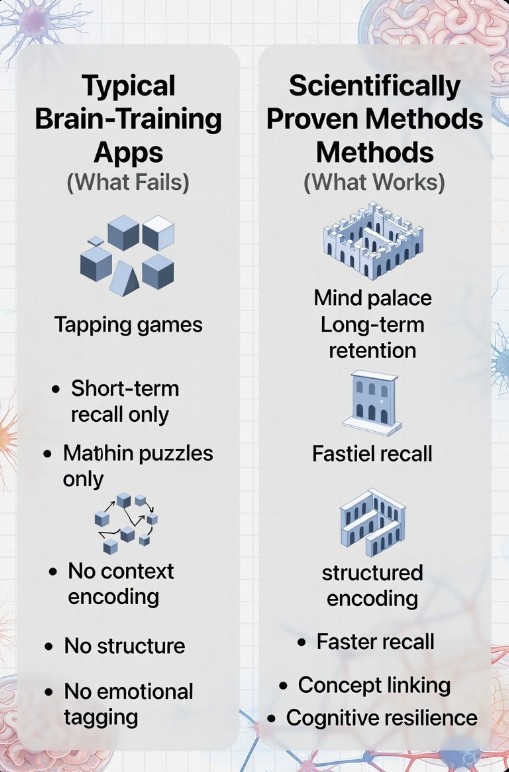
Most popular brain-training apps are designed with repetitive games of matching patterns, tapping sequences, or timed challenges in mind. Fun as they can be, these exercises rarely help to really tune the way the brain encodes meaningful information.
That brings up an important question: Does anything really work to improve memory? Memory is not about speed or reaction; it is about structure, context, and connections. Games that ignore these principles may temporarily help, but do not support lasting recall or complex learning.
Real improvement requires a technique-focused approach. Methods like the mind palace leverage vivid imagery, spatial organization, and emotional tagging to reinforce the process of storing and retrieving knowledge.
Scientific investigations support these methods. Structured, meaningful encoding strengthens retention and may confer long-term neuroprotective benefits.
The Professional’s Challenge: Why Traditional Flashcards Fail Complex Data Retention
Dense reports, regulations, client requirements, and negotiation strategies are all forms of complex professional data that call for more than superficial memorization. Traditional flashcards can clearly help drill facts through repetition, but the brain reacts to flashcards in a specific way: they stimulate recognition and recall by perceiving visual stimuli and strengthening short-term associations. This can be useful for simple lists or definitions.
However, flashcards impact the memorization system in a very restricted way. Rarely do they enable connections between concepts, context-based reasoning, or emotional tagging, and these are exactly what would make information stick. Even spaced repetition tools such as Anki very often do not help with multi-layered material. Repeated exposure alone does not build structured pathways for complex concepts.
To do so, more structured memory training is needed. The incorporation of mind palaces, chaining of narratives, or spatial mapping into learning patterns develops an integrated mental schema. These apps achieve this feature through a game-like approach. They link information into meaningful sequences, not random recall.
The Proven Solution: Structured Memory Training with MemoryOS
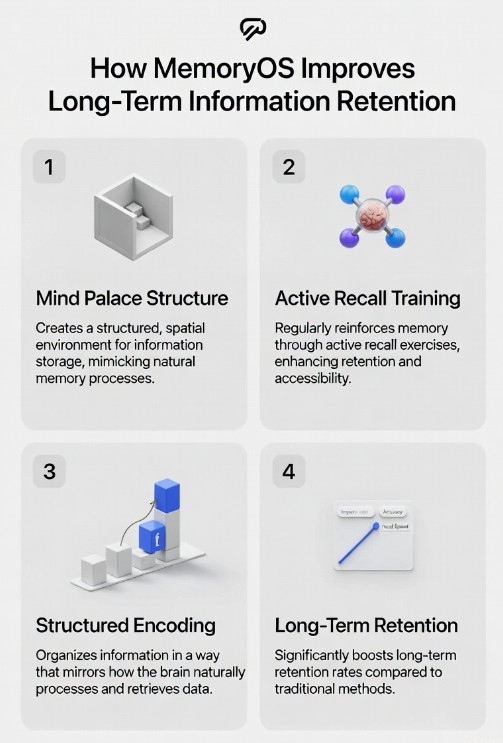
Do memory apps actually work? The answer lies in method, not shallow tricks. Thus, memoryOS was built on structured memory training that helps you turn random knowledge into strong mental networks. At the heart of everything is Sherlock’s mind palace. Rich 3D imagery and spatial order help your brain remember things efficiently.
MemoryOS differs from simple recall apps because it doesn’t utilize simple rote repetition. It instead walks users through rich, interactive sequences that enhance how their brains store and retrieve information.
MemoryOS enables individuals to learn how to remember using interactive, short lessons that involve mapping complex professional information to a clear mental structure. The app ensures memories are accurate and cognitively resilient over time by placing knowledge in spatial, narrative, and emotional contexts. It offers real cognitive enhancement.
Quantifiable Outcomes: Long-Term Information Retention
The true measure of any cognitive tool is its effect on long-term information retention. MemoryOS has been subjected to tests in dense, complex material scenarios. Metrics indicate a clear gain in accuracy and speed of recall after structured use of the app. By guiding learners through mind palace sequences, interactive bite-sized lessons, and vivid 3D imagery, the platform thwarts forgetting and strengthens neural pathways.
Tests taken before and after the training show something simple but important: people remember more, and they can pull up what they learned faster—especially when they’re under pressure. Studies back this up, showing that methods built on real memory structure usually beat plain repetition or quick brain-game style exercises.
Final Thoughts
When someone needs to learn complicated material fast, the approach they choose matters just as much as the time they spend on it. MemoryOS leans on actual techniques and research instead of gimmicks, and that’s why the results are easy to notice in everyday use. The exercises aren’t complicated, but they help individuals build solid mental “anchors” that make information stick.
For anyone trying to turn new knowledge into something they can rely on long-term, MemoryOS works well as the best memory app. It’s straightforward, engaging, and built around methods that help you learn in a way that feels natural rather than forced.