The Ultimate Guide to the Memory Palace Technique
Table of Contents
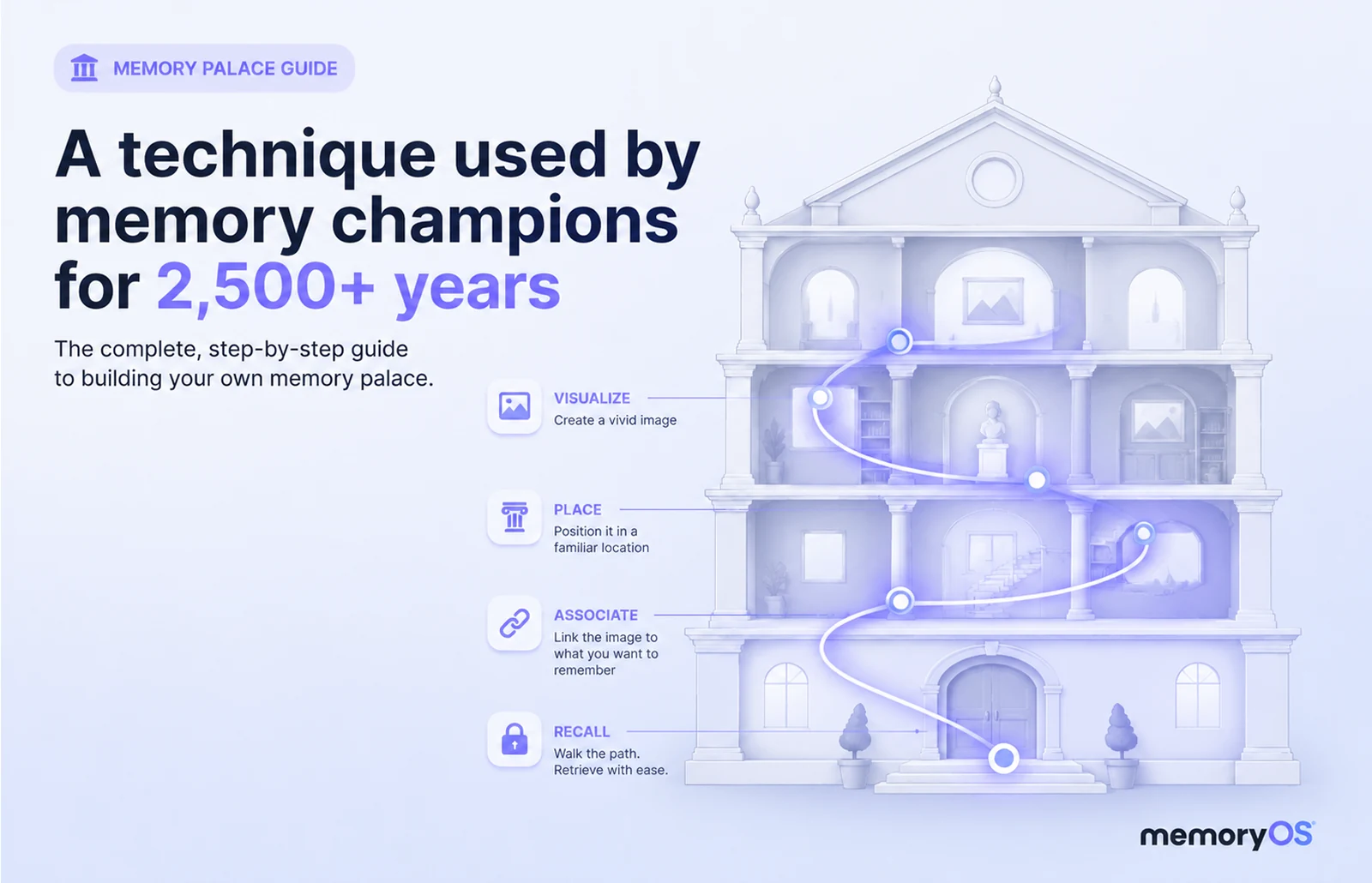
If you can picture a familiar place clearly, you already have the basic tool behind the memory palace technique. Your house, the way to your workplace, or even the way through the supermarket can become your landmarks. Instead of memorizing facts in a row and not making any association between them, you memorize each of them along your path and rely on this path as a memory aid.
The main idea is quite simple. Its implementation is somewhat complex. The memory palace should have the appropriate route, locations, and imagery that would help you remember the information. With all these elements ready at hand, you can use the method to memorize whatever information you need.
This guide looks at the principles behind the technique, how to construct a palace from scratch, and some of the common obstacles to effective memory. It also explores some of the applications of spatial memory in students and memory champions, as well as how memoryOS applies this concept to a digital space.
What Is the Memory Palace Technique?
The memory palace is a way of attaching information to places you can picture in your mind. The key is the connection between a piece of information and a particular spot in a familiar environment.
Think about walking around your home. You know the location of your front door. Most likely, there is one location where you keep your keys. You know the exact location of your kitchen table and in what direction you move when you go to your bedroom. You do not have to memorize anything purposefully. You just know where everything is.
That existing sense of place can be used as a framework for new information.
Now let’s consider a scenario where you have five dates from history to memorize. It becomes quite challenging to distinguish them from one another. Now assume that we associate each date with one landmark on a route through our house. We do not have to think about remembering five digits, but we have to move through each landmark on the route that represents the date.
The picture you choose need not be beautiful or very realistic at all; it must provide you with an interesting object to associate with. A mental note saying “1848” is easy to overlook. But imagine a big clock showing the time “18:48” and occupying a space right in front of your kitchen door. The more unusual the scene, the more likely it is to become a useful cue.
This is precisely what a memory palace helps you with: a familiar layout of the place with some information linked to it. Once constructed properly, it can be used for information encoding. The memory palace will help you when you want to deliver a speech, memorize names, or remember numbers.
How to Build a Memory Palace Step by Step
Building a memory palace starts with something much less complicated than the name might suggest: a place you already know.
A simple apartment could be enough. All that is needed is a consistent path and some loci that are easy to visualize.
It does not require an imaginary castle, a fantastical land, or some kind of extraordinary natural memory ability.
For an illustration of this process, consider a medical student memorizing the cranial nerves and what they do. This particular example is a little bit specific, but the process itself is quite general.
Choose a Familiar Place
Begin at a place that you are familiar with. It would make sense for you to choose home because of the way it is set up.
Imagine you are entering your apartment and walking around in it. Maybe you enter the apartment, then go to the kitchen, living room, and bedroom. You should be able to picture the space with your eyes closed and have a reasonably clear sense of where you are.
Pick a Clear Route
After you pick the space, figure out how you will navigate through it.
Here’s an illustration:
front door → hallway mirror → kitchen sink → dining table → sofa → bedroom desk
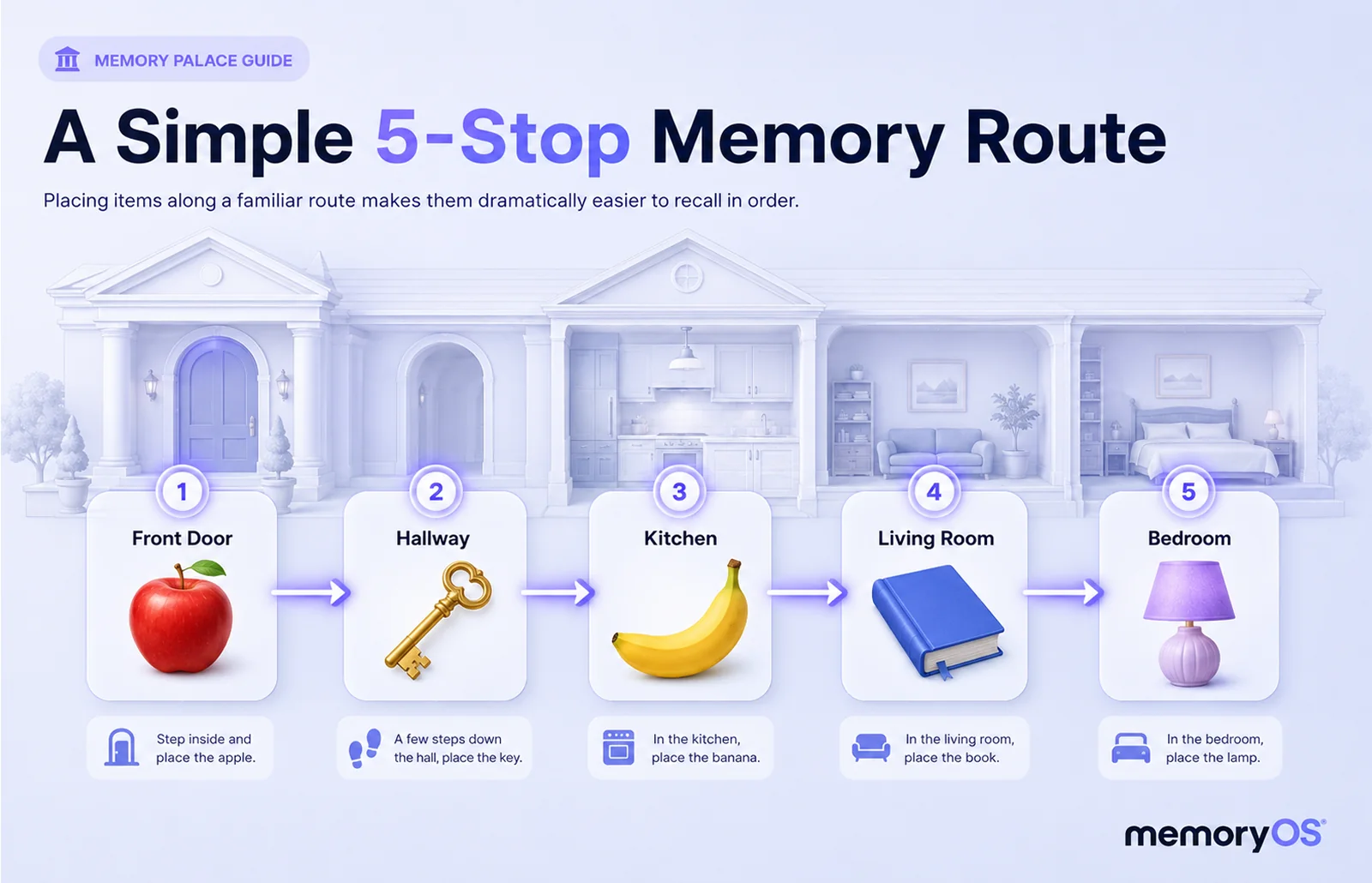
You decide on your own what way you will follow. The only thing you need to do is to choose a path and follow it all the time in one direction.
Why is it so necessary? Because ultimately, the path itself becomes part of the process of retrieving the information. From the front door to the mirror; from the mirror to the sink; from the sink to the table. You do not have to recreate the path each time.
Choose Your Memory Locations
The next step is choosing the points where information will be placed on the route. They are called loci – the individual locations that make up the palace.
These points should be easily recognizable. While in our case the locus can be the front door of the route, it can also be anything else from the doorknob to the door pattern. The main thing is that it should be distinct.
For the example of a medical student, one locus may contain one cranial nerve. There is no need to use all possible surfaces of the building. Additional places will just complicate the palace.
Create Vivid Mental Images
This is where most people think of the memory palace: visualization of the information. In the case of the optic nerve, which receives visual data from the eye, think about the huge eye placed at the front door.
Visualization of the information does not equal understanding, but it simply makes the information easier to retrieve later. The method is useful for categorization of drugs, diagnosis, anatomy, and procedures. If visualization of the information is hard to achieve, think about the actions, objects, or interactions related to it.
Place the Images Along Your Route
Give each image one specific location. Then, make the interaction between this image and location difficult to ignore.
The giant eye at the front door, for instance, could be pushing against the door while you try to get inside. At the mirror, another eye might spin rapidly as it follows your reflection. At the kitchen sink, the next concept could involve an exaggerated scene with the eyes, tongue, facial muscles, or whatever visual cue best fits the information you are learning.
You are looking for a connection that stands out, not one that is dull.
If the interaction between the image and the location is successful, the pathway begins to work as a series of cue points. Arriving at each point causes the recollection of the image, which then triggers the memory, followed by proceeding to the next point.
Readers who have any interest in the fictitious application of the concept should be aware that Sherlock’s mind palace is a good cultural example. In reality, the process is not nearly as dramatic as portrayed by Sherlock Holmes. No special imaginative trip into another world is required. A simple kitchen is enough.
Walk Through Your Memory Palace
Once the images are in place, walk through the route in your mind.
Try not to turn this into another exercise in rereading. Let the locations do some of the work. You enter through the front door and encounter the giant eye. You move to the mirror and find the next image there. From the mirror, you continue to the kitchen sink and retrieve the following item.
If you get stuck, the location where you stopped gives you useful information. You can go back to that point, strengthen the image, and try again. There is no need to start the entire list from the beginning every time one item refuses to come to mind.
Practise and Refine Your Palace
Your first attempt is unlikely to be perfect, and it does not need to be.
An image that seemed memorable yesterday may turn out to be surprisingly hard to retrieve. Two locations may feel too similar. You may discover that your route has too many stops and becomes confusing halfway through.
Fix those problems rather than forcing yourself to work around them. Make a weak image stronger or more active. Replace a location that is difficult to distinguish. Shorten the route if necessary.
Once the material has become familiar, test yourself without looking at your notes. You can then return to it later using spaced repetition, giving yourself repeated opportunities to retrieve the information rather than relying on one long study session.
Research on memory training has shown that practice can help improve memory performance. In a 2017 study, Dresler et al. found that six weeks of mnemonic training using the method of loci improved memory performance, with some benefits still evident four months later.
How to Memorise Information With a Memory Palace
Choosing the route is only the beginning. The more important question is what you actually put into it.
The use of a memory palace is more useful for retrieving the information stored in it rather than using it to store all the information you get from your notes. Some pieces of information need a very powerful visual image, while others should not be there at all. How much you try to fit into the palace also affects how easy it will be to use later.
Turn Facts Into Memorable Images
Begin with the material itself.
When learning a definition, a formula, or a process, understand what you are supposed to learn before you create the visual representation of it. Your weird mental image will help you recall this information, but it won’t help you understand the meaning of something that you did not know before.
With factual information, find the element that provides you with the most vivid visual link and exaggerate it.
Let’s say that you have to remember the function of the hippocampus. To do this, you could visualize a gigantic seahorse somewhere on your journey path. This visualization is easy to create because of the origin of the name “hippocampus” – in Greek it means a sea horse.
Linking Multiple Items Along a Route
When dealing with a longer list, some moderation is required.
The goal of getting everything in one place will only confuse the person in their attempt to remember the scenario.
The main idea needs to be located in the location; the rest is provided by the actions and the visual input. In the case of material that has a particular structure, the route carries the general outline, and the characteristics of the images are the additional hints.
If a medical student learns how to perform a particular clinical procedure, then the successive locations correspond to the main steps. Within each scene, a few well-selected items stand for actions or decision points.
There is yet another solution if the topic is especially big – use multiple routes. So the anatomy gets its place, the pharmacology its own, and the exam topics get another one.
Recalling Information in the Right Order
The real test comes when the notes are no longer in front of you.
Walk through the palace and try to recall each item before checking whether you got it right.
In the case of a speech, a presentation, a process, or an ordered list, the route gives you a sequence to follow. In the case where order is not important, you do not have to begin with the first point. You can go straight to where the information is located.
Instead of re-encoding something difficult, it can be gone back over in gradually increasing time frames. The use of a memory palace with spaced repetition helps you access cues for remembering the data.
It happens more or less automatically after some time: understanding, deciding which bits of information should be encoded, giving it an appropriate form that can be remembered, and retrieving this information without looking at the text.
Memory Palace Mistakes to Avoid
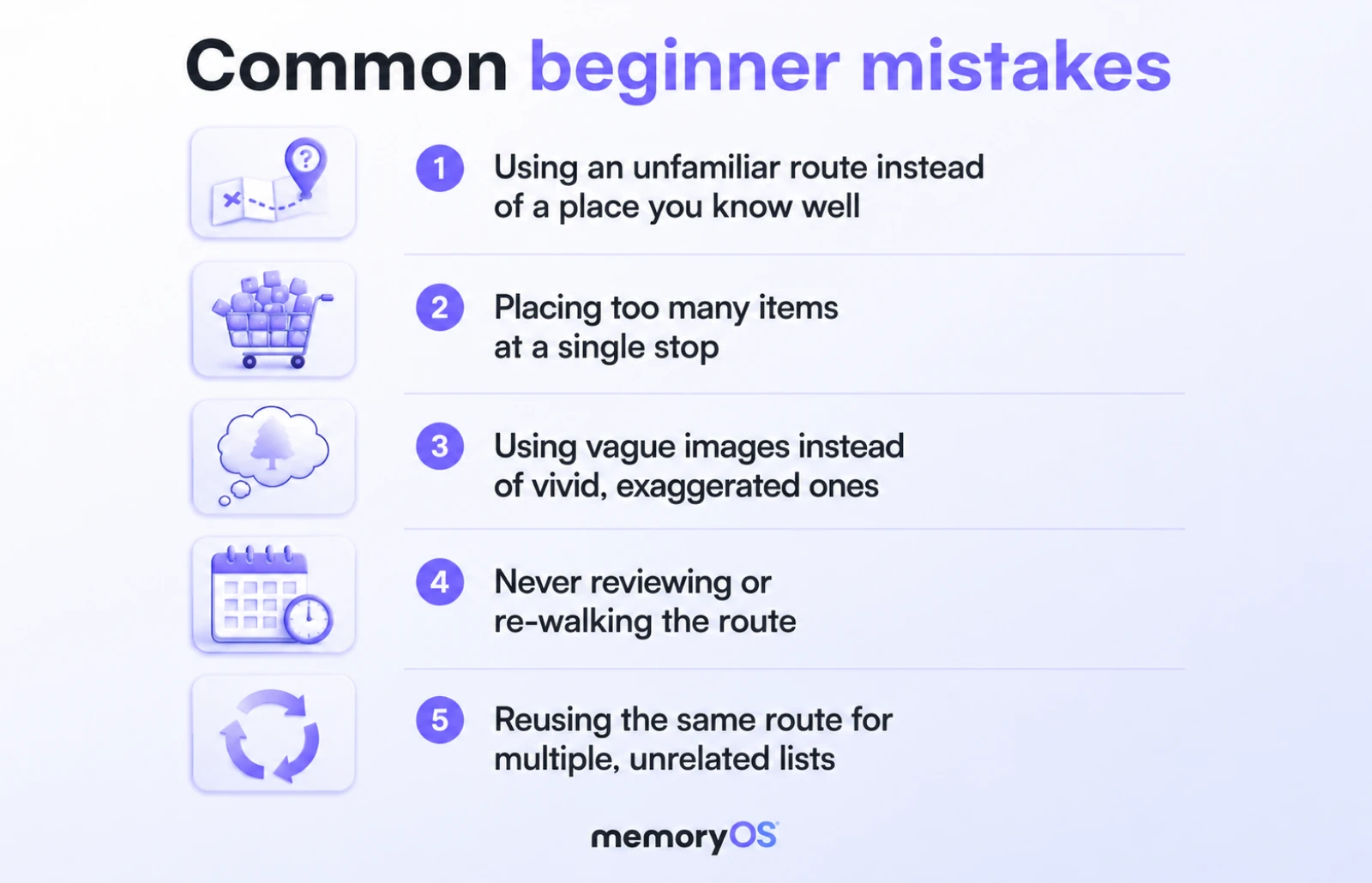
Memorisation without comprehension. While a memory palace can help locate information, it cannot make something difficult easier to understand.
Making every image ordinary. A textbook lying on a desk is unlikely to leave much of an impression. Important images usually benefit from exaggeration, movement, unusual combinations, or something else that makes them difficult to overlook.
Overloading a single location. There is not enough space in one mental picture to accommodate a whole paragraph of information. Make sure that the general idea is clear and any complex information can be dispersed into other locations if necessary.
Changing the route all the time. When a single location has a different meaning each time you go to the palace, it becomes useless as a retrieval device. Stick to the set path of your palace; otherwise, create a new one if you have a different scheme.
Not checking recall. It is different when you recognize the answer from the notes than when you generate it without help. Try walking through the palace with information hidden and check how much you remember. The gaps can show you where the associations are weak and need more work.
Who Uses the Memory Palace Technique?
The memory palace technique is probably best known because of memory competitions. However, everyone who wishes to remember something without referring to any written notes can benefit from the technique.
Let’s start with the most striking examples of memory techniques, which can be seen in the field of memory athletics. The competition can include hundreds of numbers, faces and names, random words or card sequences. The contestants apply various systems based on visualization, associations, and locations. The palace technique provides some kind of path for memorizing information.
The medical students’ case is a much different problem altogether. It isn’t only the amount of information that causes trouble for the learner but also the need to maintain a connection between various types of information – from anatomy to drug categories, clinical criteria, pathways, and procedure sequences. After all those hours of reading and researching, the individual elements start merging into one big blob, and that’s where the memory palace comes in to make it easier for the student to retrieve the information.
Another application of the method is language learning. Not all new words appear as well-connected vocabulary. A known route can help group new words or phrases, especially where the newly learned word is hard to connect with the native language of the learner.
Preparation for exams can also follow the same pattern. For instance, one route can be composed of dates from a history class while another may consist of formulas. Another may be used to denote the steps of a process. The segmentation becomes a tool by itself. Rather than dealing with one big pool of information, there are now several smaller routes to go through.
The technique also has a long history among professional memory practitioners. Jonas von Essen, a memory athlete and multiple-time world champion, is a particularly relevant example. As Jonas puts it:
“It is really quite simple. Anyone can learn memorising techniques.”
Jonas von Essen, Origins, Charles Darwin University
This can make one feel better about themselves as a beginner. The first attempt at a memory palace may feel slow. There is nothing unusual about that. You are learning how to link new information to a path that did not have any use for it before. With time, the locations become more familiar, and making the associations becomes easier.
There is no standard format that everybody should use. The memory competitor can develop very specialized routes with massive amounts of data. The student who is preparing for an exam will require only six to seven spots. The person delivering a lecture may use a simple route just to make sure that all the points are arranged well, without memorizing the whole lecture word by word.
The scenarios are different, but the concept is still the same. Where it is difficult to retrieve data on their own, give it an existing structure. The spatial memory provides the structure; the images make the connections, and practice makes the route easy.
How memoryOS Helps You Build a Memory Palace
Creating a memory palace usually requires personal input, such as choosing a location, developing a path, identifying appropriate stopping places within the chosen path, developing associations, and identifying what was stored there. Thus, the process can become a real obstacle to achieving learning results.
However, the concept is approached differently with memoryOS because the actual environment is placed in a virtual world. Instead of using a real setting, memoryOS provides a structured virtual environment where information can be linked to specific locations and objects. You can then revisit the same virtual palace to retrieve the information you have stored there.
This is important since the physical world is just the framework. What makes the information within a palace useful is the links between a place and the information stored within. In the virtual world, it becomes easier to organize, review, and practice the associations without having to mentally create the same framework.
It eliminates frustration involved in the initial few tries. The digital space also enables you to organize training sessions better. A system designed for memorization may save you some organizational work. Instead of determining each time where the new information should go, you will have more time to do the actual review.
Users can use a memory palace as a technique for cognitive improvement and not just for learning. The principle does not change – you associate information with certain places and then use these places to retrieve it.
That is worth keeping in mind when looking through lists of the best memory apps for adults in 2026. Not every app that promises better memory is teaching a spatial technique. Some pay attention to flashcards, quizzes, tests, reminders, or quick brain games. These techniques are quite helpful but address different needs.
The memoryOS application is based on the concept of active memory practice. The difference is that it does not require passive recall of information; rather, it provides the user with an environment where they can interact with information.
That does not mean a virtual palace makes memorisation automatic. You still have to concentrate and make connections. The good thing about it is that the structure is much more convenient to follow.
FAQ
Is the memory palace technique suitable for beginners?
Absolutely. You can start with a route through your own home. It does not require an exceptional memory. The good thing about starting small is that it allows you to practice constructing and navigating the route mentally.
How long does it take to build a memory palace?
Creating a simple one takes just minutes. Knowing the area means that a lot of the hard work is already done since you are already acquainted with the locations, landmarks, and route. The part that requires much practice is that of storing information in it and retrieving it effortlessly.
How much information can you store in a memory palace?
There is no universal number of items that will apply to all individuals. If at any point you find yourself having to pack too many facts in one place, then it’s an indication to either move on to another route or distribute them.
Can I use the same memory palace more than once?
Sure, but just be mindful of the places you repeat. When your anatomy notes from yesterday and your pharmacology notes from today are both tied to the same kitchen table, they may start to compete with each other. It might actually be easier to give each topic its own path.
Does the memory palace technique improve memory permanently?
It does not mean that you will increase the storage of your memory forever. Instead, what you actually learn is a strategy for remembering better. Using this approach regularly will make it easier and faster. It is a skill that you acquire, not an improvement in memory abilities.
Try the Memory Palace Technique Yourself
Write down five to ten points; for example, studying key terms or presentation notes. Select a known path; link every point with an appropriate landmark; and put your notes away.
Visualize walking down the path in your mind and try to recall as much as possible. If there is any point missing, go back to the place where it was placed and reinforce the mind map.
You can try out your memory without having to create a whole new route. A small memory test will do as a starting point, but sequence memory would be most useful if you wish to practice memorizing things in the right sequence.
The method of loci is ultimately a skill. You learn it by encoding information, recalling it, noticing what failed, and adjusting the associations. Your first attempt may feel surprisingly slow. That is normal. The point of the exercise is to experience how much easier information can become to retrieve when it has a deliberate structure.
Start with five items. Build the route. Close your notes. Then see what comes back.