The Hippocampus’s Role in Learning: A Scientific Look at Spatial Memories
Table of Contents
The first step in learning how to optimize memory using memory improvement techniques is to understand how memory functions at a neural level. The brain is an active part of the process of encoding, organizing, and consolidating information, and much of this process is related to the limbic system function.
The limbic system, which is a part of our emotional processing and motivation, is what determines which information is important to retain and which is not.
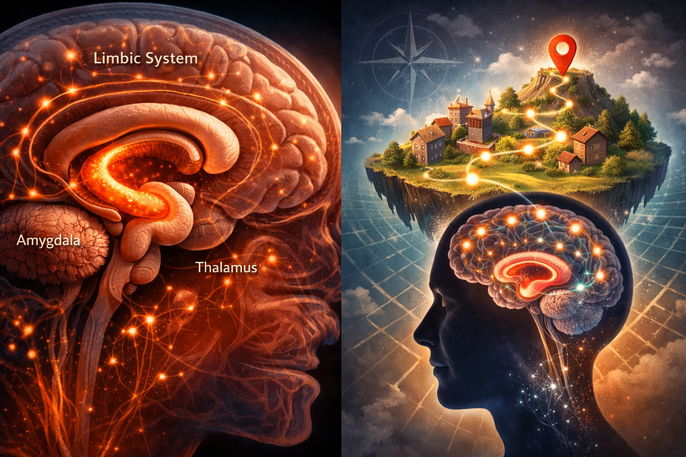
The hippocampus’s role in learning is significant. Hippocampus is a flexible brain area within the limbic system where facts, context, and raw sensory impressions all come together.
It’s especially good at creating spatial maps of our experience, organizing memories into patterns that mirror how we interpret the world.
Those maps create multiple routes back to a recollection — handy when there is a need to encode and recall dozens of facts and details. Such spatial mapping is a learning tool that helps reach academic growth.
Neuroplasticity sharpens the process: because the brain can rewire itself, the hippocampus shifts, reshapes, and forges new links through repetition and active engagement.
Once you grasp these dynamics, you can set up efficient study routines and more reliably lock in long‑term memories.
Understanding The Hippocampus and Limbic System Function
People often call the hippocampus the brain’s memory hub because it gathers data from our lives and helps convert fleeting experiences into things we can recall and use later.
Located inside the limbic system, it’s always interacting with nearby regions that steer emotion, motivation, and behaviour — so making a memory isn’t a dry filing task but a fluid, context-sensitive act.
Emotions in this process mark what matters. That little emotional spark helps the hippocampus cling to a detail; dull, neutral facts usually wash away. Which is why an emotional hook changes how well we learn.
The hippocampus doesn’t merely stockpile facts, either. It integrates new information into the existing network, tying what happens now to what came before, so memories sit inside a meaningful story instead of floating as disconnected bits.
In short, memory is optimized when learning is active, meaningful, and contextual. The hippocampus and the limbic system are tasked with not only storing information but also connecting it into a network of knowledge that can be used when accuracy, speed, and understanding are of the utmost importance.
Neural Mapping: The Role of the Hippocampus in Learning
The Hippocampus
The brain’s memory architect — orchestrating learning, spatial navigation, and the consolidation of experience into long-term knowledge.
in adult dentate gyrus
The hippocampus is where experiences are consolidated into long-term memories. When we learn something new, it enters short-term memory, which is the “workspace” of the brain. Without the hippocampus’s proper encoding, these experiences are quickly erased, making it impossible to recall information learned even moments before.
This process of moving information from short-term to long-term memory is the foundation of all cognitive functions, from learning in the classroom to problem-solving in the workplace.
Knowing how the hippocampus is involved in learning, it becomes clear that memory is not a fixed but rather a dynamic process. The hippocampus is involved in organizing information by relating it to context, space, and prior knowledge.
Organized learning enables multiple pathways for recall, thus making memories more resistant to interference and forgetting. In essence, the hippocampus is the memory architect, constructing robust networks from fleeting information.
The positive side is that this can all be optimized. Spaced repetition, connections, and engaging content are all ways to optimize hippocampal learning. Active recall, imagery, and contextual learning help create stronger and more interconnected networks, which in turn make it easier and faster to consolidate and recall data.
Spatial Navigation: The “Internal GPS” and Place Cells
The hippocampus is more than a memory storage system; it is a mapping system that allows us to navigate our physical and conceptual worlds. At the center of this is a type of cell called place cells, which are activated when we are in a certain place or when we simply imagine ourselves in this place.
This cognitive tendency means that our brains have an internal GPS system—a cognitive map that indexes our experiences in an organized way. Without this ability of our cognitive system, facts and details would be chaotically encoded in our memory without the possibility of rapid and efficient retrieval.
Thus, these maps are used to organize knowledge, ideas, and even sequences of events, providing multiple retrieval cues for long-term memory.
This mapping of space is linked with the limbic system function, especially the emotional and motivational pathways. Emotionally charged or interesting memories are dominant and can be mapped in a robust and long-lasting manner in space.
When learners associate information with interesting mental locations, the hippocampus and the limbic system function enhance both encoding and retrieval. Methods like Sherlock’s mind palace utilize this principle, where abstract ideas are located in mental locations so that the brain can access them efficiently.
Technology has begun to leverage these natural processes. Gamified learning apps to boost memory offer interactive environments that simulate the exploration of space, walking the user through increasingly challenging levels that engage spatial, visual, and emotional pathways at the same time.
By translating abstract information into concrete, game-like experiences, these apps engage the same hippocampal pathways as spatial exploration, building cognitive maps that are memorable and retrievable. The brain perceives gamified learning as exploration, not memorization, which drives motivation and enhances long-term retention.
Spatial encoding further increases neuroplasticity, which enables the hippocampus to rewire and solidify new pathways as the cognitive maps grow.
Neuroplasticity and Growth: The Role of the Hippocampus in Learning and Adaptation
One of the most fascinating things about the hippocampus is its ability to perform adult neurogenesis, which is the production of new neurons even in adulthood. This allows the hippocampus to restructure in response to experience, learning, and stimulation.
This, in turn, means that regardless of the type of training, everyone has the ability to actively learn and effectively perceive new information if they keep their brain in good shape.
Thus, instead of being a passive storage structure, the hippocampus is an active area that alters its own structure to encode, store, and retrieve information more efficiently.
Neuroplasticity is the key to unlocking each and every step of memory creation. As new information is introduced, new neurons in the hippocampus start to develop new connections between the new information and the already established pathways.
With repetition, meaningful context, and use, these connections can be strengthened to the point where new information can be converted from a weak, short-term memory into a strong, long-term memory.
The more these pathways are used, the stronger they will become, and this will bring improvements in retention and retrieval. Essentially, the hippocampus will get stronger with use, and learning will be the catalyst for this growth.
The implications for cognitive enhancement are staggering. Methods that focus on the hippocampus through visualization, spatial learning, and memory techniques will promote the growth of a more complex neural network. These methods will not only help improve memory but will also increase the brain’s ability to consolidate complex information from multiple sources.
For example, gamified learning exercises that challenge spatial reasoning, pattern recognition, or memory sequences can simultaneously target multiple hippocampal pathways.
Adult neurogenesis is also linked to adaptability. The hippocampus has the ability to update previously stored memories by incorporating new information or rearranging the connections when faced with new contexts. This makes the memory system adaptable and dynamic.
It is also important to note that environmental and lifestyle factors affect the development of the hippocampus. Exercise, adequate sleep, and mentally stimulating activities all promote neurogenesis, while stress, lack of sleep, and a sedentary lifestyle can bring harmful effects on it.
Emotional experience also has a crucial role in this process, as experiences that are meaningful or pleasurable increase activity in the hippocampus, solidifying the changes at the synaptic level that are necessary for learning. This is directly related to the hippocampus’s role in learning, as it is most efficient when information is encoded in an emotionally or contextually meaningful way.
In addition, neuroplasticity allows for mastery via challenge. As learners gradually raise the bar through challenging concepts, multi-faceted problems, or immersive simulations, they drive structural changes in the hippocampus. This adaptive change not only improves memory but also increases cognitive flexibility, problem-solving, and attentional control.
Thus, the hippocampus serves as a memory engine and a cognitive growth center, constantly adapting to the needs of learning by reorganizing itself.
Contemporary Issues: Digital Amnesia and Cognitive Load
In the current era, where our smartphones have become external hard drives, the memory functions of the brain are under unprecedented pressure. Digital amnesia is a condition where we are prone to forgetting information that we store in digital devices. We rely on such devices so they remember and recall information for us.
Studies show that such dependencies can hamper internal encoding and reduce deep processing, effectively outsourcing memory functions rather than using the brain’s neural networks for long-term learning.
This has a very specific implication for the hippocampus’s role in learning and cognitive optimization. When we are constantly outsourcing information about facts, dates, directions, or even tasks to external devices, the brain uses fewer resources to encode information internally.
This does not mean that technology is somehow detrimental to our cognitive abilities—having information at our fingertips has certainly opened up new chances for learning—but it does mean that the way in which memories are made is very different.
Human memory thrives on effortful engagement. When information is constantly outsourced to devices, the neural circuits that underpin attention, encoding, and recall—particularly in the hippocampus—receive far less activation. This makes memory feel weaker, not because the brain is less capable, but because it is not being exercised.
The largest challenge to cognition at present is the cognitive load, or the brain’s processing power. Notifications, multitasking, and context switching are attention disruptors that interfere with memory encoding. Each time the brain switches, it must refocus, which consumes precious attention resources and prevents the deeper processing necessary for information to be encoded and kept in long-term storage.
The application of digital technology also impacts the limbic system function, which plays a critical role in determining what information is stored and what information is discarded. The application of dopamine feedback loops, such as likes or quick rewards, also impacts the brain to focus on shallow interaction rather than meaningful encoding, which further deteriorates the quality of memory formation.
Technology does not have to be at odds with cognitive well-being. There are applications that support active engagement and active encoding. The memoryOS app is one such example. It is a gamified memory training platform that applies evidence-based practices with interactive lessons to support active recall and encode information in the natural encoding patterns of the brain.
The problem of digital amnesia is not only the presence of technology in the learning space but also how it is used. If technology is perceived as a replacement for the internal memory processes, then the hippocampus will be inactive, and the memory pathways will be disrupted.
A better approach to using technology would be to perceive it as an extension that encourages active encoding. By integrating deliberate practice, focus management, and technology that encourages internal memory processes, students will be able to function well in the digital space without undermining their capacity to remember, reason, and apply knowledge at a higher level.
FAQ
How can I strengthen the hippocampus for better learning?
The hippocampus is a structure that needs active engagement. Methods such as visualization, spatial mapping, and mnemonic devices provide multiple paths for retrieval and strengthen memory.
How can technology enhance memory without leading to digital amnesia?
Mind palace activities, spaced repetition, and game-like apps activate hippocampal connections, making technology an ally instead of a barrier.
How does multitasking impair memory retention, and how can I overcome it?
Multitasking overloads the brain, shattering concentration and clouding memory. To enhance memory, concentrate on one task at a time, relate information to a meaningful context, and hold review sessions.