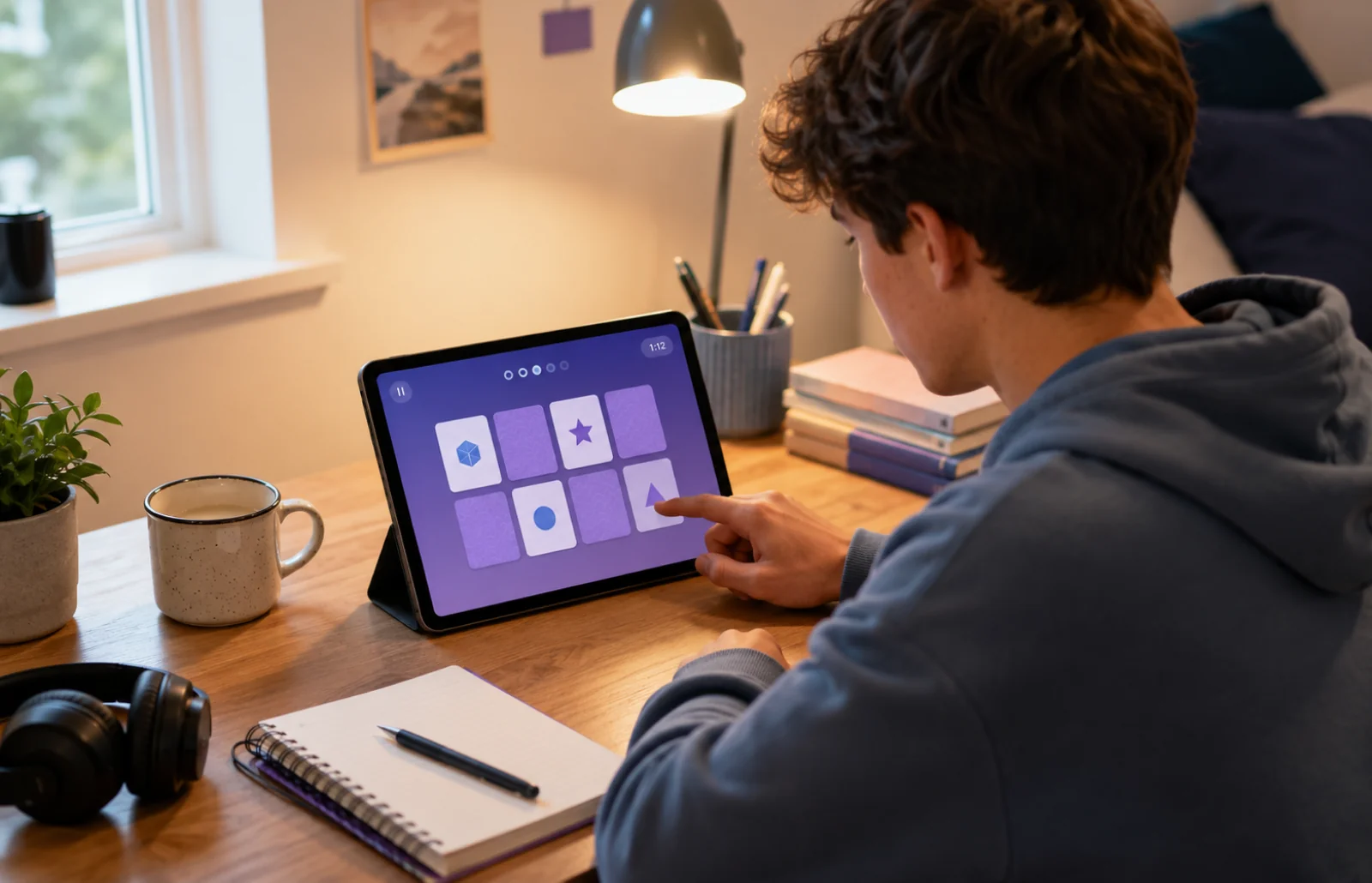
Working Memory and Attention Games for Adults With ADHD: What the Research Shows
Table of Contents
Working memory games for ADHD are among the best-studied forms of brain training; however, the scientific evidence base is much smaller than many marketing campaigns suggest. Research shows that people can become better at performing these exercises with practice. Yet, very little evidence exists to suggest that they have an impact on symptoms of ADHD.
To understand how these games work, it is necessary to understand what working memory is. Working memory is the capacity to hold information in mind and manipulate it simultaneously. You use it while following instructions, reading an email while composing a response, and maintaining a flow of thought despite distractions. Working memory is especially relevant to ADHD because difficulties with it may lead to attention issues and problems with completing tasks.
If you are comparing specific apps like EndeavorRx or BrainHQ, see our review of brain games for ADHD.
What Research Says About Working Memory Training in ADHD
The most comprehensive data are available in a 2023 meta-analysis in the journal Molecular Psychiatry. It combined data from 36 randomized controlled trials on computerized cognitive training for individuals with ADHD, of which 17 examined the effect of working memory training.
Improvements in working memory were found with small to moderate effects for verbal working memory (SMD 0.38) and for visuospatial working memory (SMD 0.49). However, it is at this point where things get more complicated because ratings from people who were likely unaware of which participants had received the training showed no improvement in overall ADHD symptoms or hyperactivity and impulsivity. There was only a slight improvement in inattention (SMD 0.17). The pooled trials include children and adolescents as well as adults, so these numbers are best treated as a general picture rather than an adult-only result.
For adults specifically, a randomized trial of Cogmed training tested people aged 18 to 63 with ADHD against a low-intensity placebo version of the training. The training group showed more significant results for verbal and visuospatial working memory; moreover, those changes were persistent for six months. While such results can be considered quite important, they did not transfer to any other cognitive domain. According to the authors, the results do not support the notion that such programs enhance attention or quality of life for adults.
This is important because working memory training should be treated more like practice than treatment. Training should present your brain with one specific challenge at a time: to hold something in mind, update it, and respond to it, all while there are distractions competing for attention. Getting better in this type of training is an accomplishment, but there is no guarantee that you will improve in real-world situations.
Which Types of Games Train ADHD-Relevant Skills?
Not all games marketed as “brain training” do the same kind of thinking tasks. The key issue is the difficulty offered by a particular game, not how clever the game may look.
Working Memory Games for ADHD
In working memory training, participants are supposed to maintain information in their mind while simultaneously manipulating it. In this game, participants see a series of letters, numbers, spatial locations, or sounds; they have to remember it and then manipulate it in some way, for example, repeat it back in a different order.
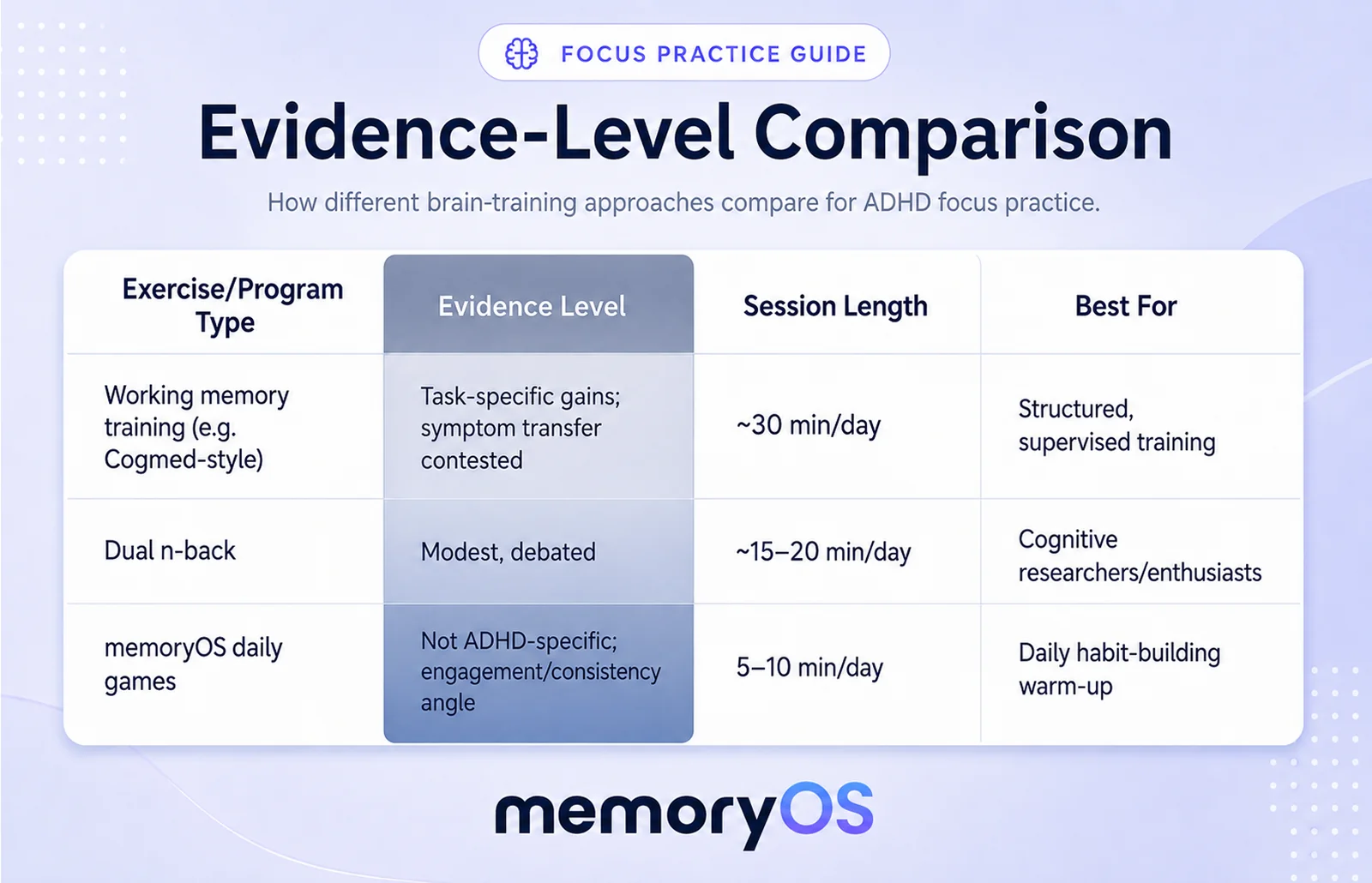
This type of structured program is most frequently evaluated in ADHD treatment trials such as the Cogmed study above. The best argument in its favor is its ability to train one specific skill, rather than modify neural activity.
Dual N-Back: A Popular Working Memory Game
One of the best-known research tasks in this area is dual n-back, due to the fact that it requires processing two streams of information at once. The participant is tracking two sequences, for example, the location of a square on a board and a letter pronounced aloud, and determines whether each new element matches the one presented several steps earlier. As your skill level improves, the number of steps grows, making the activity even more difficult.
In one study of young adults, training consisted of 20 blocks of dual n-back, about 30 minutes a day, for 20 days within a month. Adaptive training improved the conflict effect in an attention test among adults with ADHD, regardless of whether they were taking medication. This improvement was not observed in the control group.
A 2025 randomized study tested whether dual n-back training could improve other measures of working memory. It included 106 young adults: 33 with ADHD who were not taking medication, 42 with ADHD who were, and 45 controls. Participants completed at least 18 daily training sessions within a month using either adaptive dual n-back or a fixed dual 1-back version. The adaptive group made larger gains on the WAIS-IV Working Memory Index, particularly on Digit Span Backward. The effect was much smaller on the Corsi block task, which measures visuospatial memory.
That pattern is worth paying attention to. Dual n-back training can assist in improving performance in specific working memory training exercises. There have been studies that show improvement in attention as well. However, dual n-back training cannot be used to treat ADHD.
For other evidence-informed options, see our list of the best brain games to improve memory.
Attention Training Games for ADHD
Attention training works on a different skill. Instead of holding and updating information, these tasks ask you to stay alert, respond to the right cue, and ignore distractions. Common formats are Go/No-Go tasks, continuous performance tests, and Stroop-style games where you filter out irrelevant information. Thus, attention training games for ADHD train specific attention processes.
What Working Memory and Attention Training Can Improve
The most obvious advantage is the ability that the game requires: the encoding of sequences, maintaining several items in memory, or responding to a target despite the presence of distractions.
Consider the example of reading an e-mail while retaining the main point in your memory to formulate a response to it or listening to directions while retaining step number one in mind. The game cannot create these scenarios for you, but it will provide a systematic way to train one aspect of them.
Not every gain transfers. The ability to memorize a long sequence of information does not ensure that you will memorize everything you need on a daily basis, and high scores on an attention-related task cannot make a boring and lengthy task easier. Motivation, environment, sleep, and stress count as much as cognitive ability.
The game itself also plays an important role. Matching games involve the use of visual perception and short-term memory. A game that requires you to remember the information and change it in some way trains your working memory. Understanding how working memory works helps you see what a game is actually training.
How to Choose Brain Exercises for Adults With ADHD
Good brain exercises for adults with ADHD start with a clear question: what is this game actually training? These points help.
- Pick activities that have a clear cognitive goal, like holding and manipulating information
- Pick games that adjust to your ability level, so it is still challenging but not frustrating
- Avoid apps that promise to increase IQ, productivity, and ADHD symptoms in one go
- Combine activities, like memory test games and working memory tasks, to maintain and manipulate information
- Pick an activity that you can actually stick with, because a good activity that you do just three times and then get bored with doesn’t accomplish much
If you need help selecting an app, our review of brain games for ADHD compares seven options.
Where memoryOS Fits Into ADHD Brain Training
memoryOS is a memory-training tool, not a solution for your ADHD problem. Its working memory test asks users to memorize a sequence of numbers/positions and recreate it based on certain rules, which get harder as you improve.
Moreover, memoryOS offers such exercises as sequence memory, number memory, and chimp memory tasks, so you have the possibility to work on different skills instead of constantly doing one task.
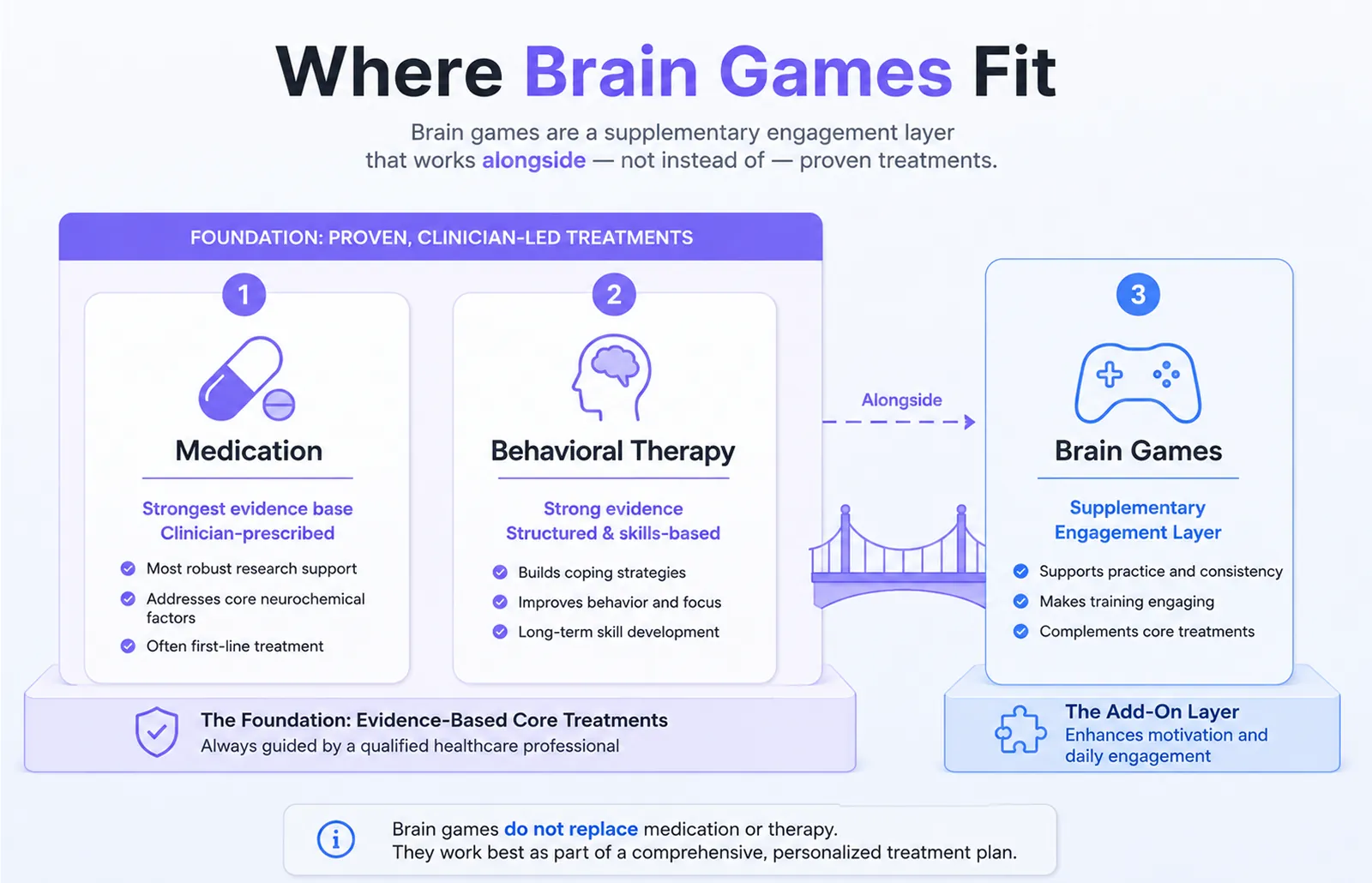
That does not mean these exercises treat ADHD or replace professional treatment. They are simply a way to practice a particular skill.
FAQ
Is working memory training effective for adults with ADHD?
It can improve working memory itself. In the adult Cogmed trial, the gains lasted six months, but they did not spread to other abilities, and the 2023 meta-analysis found no effect on overall ADHD symptoms.
What are the best attention games for adults with ADHD?
Try to look for games that train only one specific process, like sustained attention, working memory, or response inhibition. Examples of games include continuous performance tasks, n-back, and Go/No-Go. Adaptive levels and tracking progress increase motivation for training and gaining results.
Is there scientific evidence for brain games for ADHD?
There is evidence only for task-specific or closely related skills. Evidence from randomized trials and meta-analyses shows improvement in working memory, but very little evidence of broader improvement in ADHD symptoms and daily functioning.
How often should you do dual n-back training?
The studies followed a set time schedule. For example, adults with ADHD spent about 30 minutes per day over 20 days within a single month. That is what was tested, not a prescription, and there is no evidence that more is better.
Conclusion
Working memory games for ADHD are useful for developing abilities such as retaining information, updating it, and sustaining attention on the task. Practice of one activity improves your performance in this activity, and that is the most obvious benefit the studies confirm.
The high score in memory games is not an ADHD treatment and does not solve problems with planning and organization. You might get faster in remembering sequences but remain unable to manage your time.
Think of brain training as practicing one cognitive skill. It will be effective when you expect no more than what is supported by the evidence.