Best Anki Alternatives for Medical Students & MCAT Prep
Table of Contents
Studying medicine or MCAT prep may be seen as a second full-time job, and that’s why many students use a flashcard system. However, there are a number of cases in which Anki turns out to be a major headache rather than helping in achieving learning goals. To configure all the settings and plugins and establish the appropriate review intervals, it usually takes more than 8 hours. Even worse, after loading flashcard resources like AnKing, students see that their card count exceeds tens of thousands, which will require a lot of maintenance to work properly.
It is at this point that most medical students begin searching for Anki alternatives. The thing is that the problem of such students is not in memorizing things but in the complexity of the tool, time management issues, and the learning curve. As a result, students start struggling with Anki and its settings rather than with anatomy, physiology, or pharmacology.
To make the learning process easier and more efficient, let’s analyze the 7 top choices other than Anki. These alternatives will not only make your setup time shorter but will also enable you to practice spaced repetition while focusing solely on learning.
Why Medical Students Struggle with Anki (It’s Not You)
Many students’ frustrations with Anki have nothing to do with a lack of self-control or motivation. Rather, the Anki software poses multiple issues, which become apparent in stressful contexts like those in medical school or when preparing for the MCAT.
The first big issue lies in setup difficulties. Even before getting started studying with Anki, one would need to spend considerable amounts of time downloading decks, setting up various features, and downloading add-ons.
For instance, AnKing’s deck alone reportedly takes about 8+ hours to configure and get started with, as discussed on numerous forums among open-source groups of medical students. The idea of spending additional time on setting up before getting started studying can be frustrating indeed for a stressed-out individual.
This is why many students start looking for Anki alternatives for medical students. The issue at hand is not spaced repetition, but rather the difficulty of using spaced repetition with Anki.
The second problem is card management. As reviews accumulate, mature and immature cards pile up, creating a constant sense of backlog. Rather than making the learner feel accomplished, the system makes one realize that there is too much to be done, which is actually one of the main causes of abandoning Anki within the first two weeks of practice.
At last, there is an underlying problem associated with the way content is structured. Anki cards do not typically involve clinical reasoning; thus, they leave students with just information rather than skills in using this information in practical situations.
Consequently, many learners begin searching for techniques that involve spaced repetition for medical students that would retain the advantages of repetition while minimizing its organizational difficulties.
What to Look for in an Anki Alternative for Medicine
Knowing the reason why Anki is overwhelming for many students, the most obvious question to ask comes immediately after: What should a better system actually look like?? All apps that fall under the label “spaced repetition” are not designed to fit into medical education and its requirements.
The first thing that needs to be provided by the alternative study tool is content, ready to use straight out of the box. Students studying for USMLE Step 1 and Step 2 do not need to create thousands of cards from scratch; therefore, it is crucial to cover topics such as anatomy, pharmacology, pathology, and microbiology.
It is also essential that good medical flashcard apps have an effective algorithm of spaced repetition that does not increase cognitive load. Another very important element is usability, which requires having a nice interface on both iOS and Android platforms and enabling users to do their review quickly when studying on the go.
Among other elements to take into account when choosing a tool there is the ability to connect it to external study materials, such as videos and 3D models, clear price information, and possible student discounts.
7 Best Anki Alternatives for Medical Students (Ranked)
Listed below are seven tools that can be used as alternatives to Anki in medical education. They address different challenges associated with the process, from passively learning facts to structuring one’s clinical reasoning process; thus, what might be an ideal tool will differ from individual to individual depending on their stage in medical education.
Osmosis
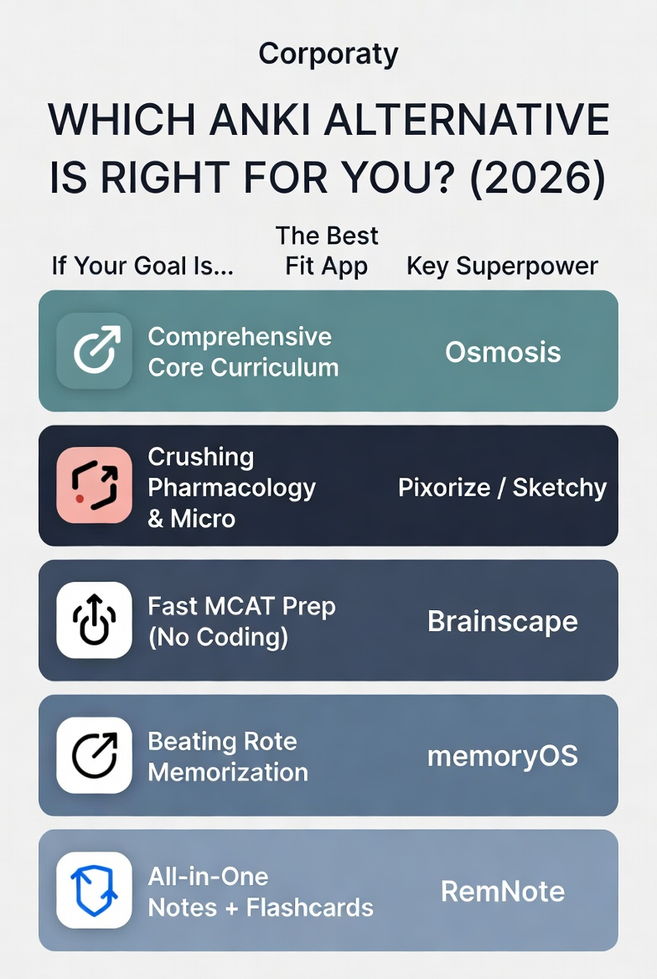
Osmosis is an educational platform focused on medicine with the use of videos, notes, and flashcards based on leading medical curricula. This is an extremely popular website for Step 1 and Step 2 USMLE exam preparation. The key advantage of this site is that it combines concise explanations with spaced repetition tools. However, the customization options of its flashcard system are limited compared to Anki. Subscription fees might pose an obstacle for some users. Still, for many students, Osmosis is one of the best Anki alternatives.
Pixorize
Pixorize is all about visual mnemonic learning, particularly useful for disciplines such as microbiology, biochemistry, and pharmacology. It is very good at helping you memorize visual associations that will serve you well when it comes to the USMLE exams. Its advantage lies in being clear and having powerful memory anchors, although it does not provide too much information to support reasoning skills. It is expensive but often deemed worth the price as one of the best Anki alternatives.
Sketchy Medical
Sketchy Medical is a tool that makes use of storytelling with illustrations to help learn microbiology, pharmacology, and pathology. It is hugely popular among med school students due to its ability to make abstract facts more visual and memorable. The only downside to using Sketchy Medical is its price and lack of applicability beyond its core disciplines.
Brainscape
Brainscape is a flashcard learning application that uses a technique called confidence-based repetition. This application enables users to gauge their familiarity with each flashcard and adjust review times according to personal knowledge acquisition levels. While the application covers diverse subjects such as medicine, user-generated flashcards are common, making the content inconsistent in quality. Brainscape is better organized than generic flashcards and less focused on medicine than dedicated learning apps.
memoryOS
The memoryOS app is a memory training app aimed at improving information retention through visualization techniques and spatial memory tricks. Unlike most other flashcard applications, memoryOS is concerned with developing memory skills instead of memorizing information. For this reason, memoryOS is especially useful for students overwhelmed by conventional passive review applications. This application does not serve as a replacement for a medical database but improves retention efficiency.
For more information about memory apps for professionals, check out which memory improvement app actually works and brings results.
The advantages of this program come down to its ability to reduce the number of cards needed and focus more on the cognitive functioning of one’s memory. Moreover, instead of using any pricing system, it focuses on improving cognitive functioning. For individuals who need to use the best Anki alternative without focusing on quantity but rather on skills, it offers a different approach to spaced learning.
Quizlet (Medical Decks)
This is a simple program used mostly by students from other courses of study, especially those studying medicine. Advantages include a large library of medical information from various users. Disadvantages include inconsistency in information quality and limited medical alignment. It is not designed for deep medical learning, such as USMLE training.
RemNote
RemNote offers note-taking integrated with spaced repetition and allows students to easily transform notes into flashcards. It is a helpful tool for incorporating learning and studying into a single process, but it requires some effort in the beginning. Moreover, it requires setting up, similar to Anki, and its medical content must be set up from scratch, which may take time.
Evidence Note
It has been found that spaced repetition is highly effective in improving knowledge retention in the context of medical studies, specifically in studying anatomy and physiology (Dobson, 2013). Nonetheless, it relies strongly on convenience and regularity, both of which are difficult to achieve through traditional Anki study methods.
Comparison Table: Medical Flashcard Apps Side by Side
With the multitude of options, it is helpful to know the differences among them at once. The following comparison focuses on practical issues that medical students might be interested in, such as content readiness, the scope of the exam, convenience, and price. You can use it as a quick screening tool for finding suitable medical flashcard apps for you.
| App Name | Pre-made Medical Content | USMLE Coverage | Typical Price | Mobile Experience | Spaced Repetition | Best For |
| Osmosis | Extensive | Step 1 / Step 2 | Subscription-based | Excellent | Yes | Structured medical learning |
| Pixorize | Extensive | Primarily Step 1 | Subscription-based | Good | Partial | Visual mnemonics & biochemistry |
| Sketchy Medical | Extensive | Step 1 / Step 2 | Subscription-based | Good | Limited built-in review | Visual storytelling for pharm & micro |
| Brainscape | Moderate | General premed & medical topics | Free + Premium | Good | Yes | Confidence-based flashcards |
| memoryOS | Moderate | General support | Subscription-based | Excellent | Yes | Memory training & spatial encoding |
| Quizlet | Extensive (user-generated) | General support | Free + Premium | Excellent | Basic/limited | Fast review & shared decks |
| RemNote | Limited by default | General support | Free + Premium | Fair to Good | Yes | Integrated notes + flashcards |
With respect to more organized and curriculum-specific learning, Osmosis and Sketchy are the top choices, whereas Pixorize shines with visual-based subjects such as microbiology and biochemistry. However, platforms such as Quizlet provide convenience, but at the cost of inconsistency in terms of exam-level material.
Generally speaking, most USMLE and MCAT flashcard apps are either content-rich applications or flexible platforms, where the best result can be achieved if both options are used together.
Best Apps by Medical Subject (Anatomy, Pharmacology, Pathology)
Learning about various subjects within medicine requires different approaches. That is precisely why the best method of searching for an Anki alternative USMLE solution does not consist of using one specific app. Instead, different applications can be matched according to individual needs depending on the subject.
Best for Anatomy
First of all, there is an evident connection between visualization and anatomy. As such, Complete Anatomy and memoryOS can be extremely helpful when dealing with anatomy since the former allows users to examine 3D images while the latter offers spatial memory techniques, such as the memory palace method, to learn anatomy better.
The use of visualization techniques works well because of the nature of the field. Namely, instead of remembering facts, students can visualize connections between anatomical structures.
Best For Pharmacology
Pharmacology will definitely benefit the most from visual encoding and association learning. Sketchy Pharm uses visual storytelling that links drugs, their mechanisms, and side effects, whereas Pixorize enhances understanding of biochemical pathways through visual representation. Visual aids like these decrease the need for rote memorization by making the mechanism easier to visualize.
Visualization plays a significant role in pharmacology since drug mechanisms can be complicated and hard to remember via text. Visualization aids in remembering these complex concepts as well as decreasing the chances of confusing similar mechanisms.
Best For Pathology
For pathology, both concepts and pattern recognition are required. Osmosis has proved very useful for this topic with its short explanatory videos, along with integrated flashcards that explain the mechanism of the disease process. Most students tend to use it in combination with Pathoma to better understand the concept.
Layered learning is key when it comes to pathology since first you learn how the disease mechanism works, and then it is reinforced via repetition and retrieval.
MCAT-Specific Flashcard Apps: What Works Best
Unlike the USMLE study, preparation for the MCAT tests does not require extensive clinical thinking and hospital-related topics, but rather an understanding of basic science subjects such as biology, chemistry, physics, and psychology. Therefore, the needs of the students preparing for the MCAT vary significantly in terms of speed and simplicity.
Among the best MCAT flashcard apps are Brainscape MCAT decks, as they utilize the technique of confidence-based repetition, helping students concentrate more on their weaknesses. One of the popular ways to learn is using Quizlet, with thousands of free MCAT flashcards made by previous MCAT test-takers. The memoryOS app focuses on using structured memory techniques like the memory palace to help students remember the MCAT concepts faster without having to use repetition.
As for Anki, although this tool is a good choice for preparing for the MCAT exam, it will need time to set up and maintain.
In most cases, AAMC official study materials ought to take precedence over the MCAT flashcards when preparing for the test. As such, the use of MCAT flashcard apps should come in as supplementary tools and not curriculum tools.
For better encoding and learning results, you can check the best flashcard apps for students that combine all the important features.
Should Med Students Still Use Anki in 2026?
Regardless of advances in technology, there is still a place for Anki in medicine, but its usefulness greatly depends on the user’s goals and available time.
Anki is best for individuals who can dedicate up to 8+ hours to the initial configuration of the app, fully customize it according to personal preferences, and build a deck from scratch.
However, many learners will have a more efficient experience by using Anki alternatives when time is scarce or they are more inclined to use premade learning tools. Programs such as Pathoma offer curricula already integrated in the platform, which saves time spent configuring and setting everything up. Another strong point in favor of other apps is that they incorporate visual content, such as videos, more effectively than Anki.
In general, although the popularity of Anki alternatives will only continue to grow in 2026, Anki still offers value to advanced users. However, for the majority of medical students, Anki alternatives work more efficiently.
FAQ
What is the best Anki alternative for medical students?
It is impossible to choose one program because each caters to a specific learning. Overall, Osmosis would be the most efficient since it has a solid, structured medical curriculum and accompanying explanations. Pixorize will work well with students who are predominantly visual learners and require good visual aids to understand such courses as biochemistry and microbiology. The memoryOS app is an excellent option for students who have trouble with memorization-heavy systems and want to build long-term retention.
Why do medical students give up on Anki?
Usually, medical students quit using Anki due to excessive workload rather than inefficiency. The main problems include long start-up times required, a growing number of cards to be reviewed every day, feeling overwhelmed, and the absence of clinical context while dealing with isolated facts rather than studying medicine as a discipline.
Is there a free Anki alternative for MCAT prep?
Yes, but with certain restrictions. Quizlet provides MCAT flashcards that have been created by other users for free, while there is also Brainscape, which provides free versions with some of its spaced repetition features included. However, these are not as good as the premium version or even curriculum-based apps.
Which app is best for memorizing anatomy?
It is recommended to understand anatomy with the help of visual perception because the human body is a complex entity, and its study is based on spatial perception. Complete Anatomy provides tools for exploring anatomy through 3D modeling, while memoryOS trains spatial memory with the help of the memory palace.
Do Anki alternatives work for USMLE Step 1?
Yes, there are many alternatives, which are effective when it comes to preparing for Step 1. Osmosis gives you full structured coverage of all core topics, Pixorize will give you a good foundation in biochemistry and microbiology by using visuals, and the question-based platforms such as UWorld help apply the information in practice. Generally, most people find it useful to utilize several study materials at once.
How much does it cost compared to Anki?
It depends on the Anki alternative. The price of alternatives varies between $ 10 and $ 50 per month, and Anki itself is purchased only once at around $25. On average, however, an Anki alternative will prove to be pricier, as it allows for more convenient use and maintenance, and thus saves your precious studying time.
Try memoryOS – SRS + Memory Palace for Medicine
Anki alternatives for medical students that you’ll find on the web will go beyond simple flashcard replacement solutions, addressing the issues of setup, excessive daily reviews, and missing structure. The right tool will be determined by both your preferred method of studying and the field you study.
Rather than forcing a single system on everyone, modern apps such as memoryOS offer an opportunity to combine spaced repetition with spatial learning to achieve better long-term results.
The memoryOS app utilizes both spaced repetition and the memory palace method – extremely efficient when studying anatomy, drug classes, biochemical pathways, etc. Try memoryOS FREE now https://memoryos.com and discover how spatial encoding can improve memory up to 40%!