Best MCAT Flashcards & Study Decks Compared by Features and Learning Effectiveness
Table of Contents
If you’re getting ready for the MCAT, you’ve likely heard this advice many times: learn more content, consume more videos, and take more notes. Yet, some students spend 300+ hours studying but end up looking at test questions they recognize and cannot answer due to a surprising lack of knowledge retrieval. In many cases, the problem isn’t that you didn’t see this information before; it’s that you couldn’t remember it efficiently.
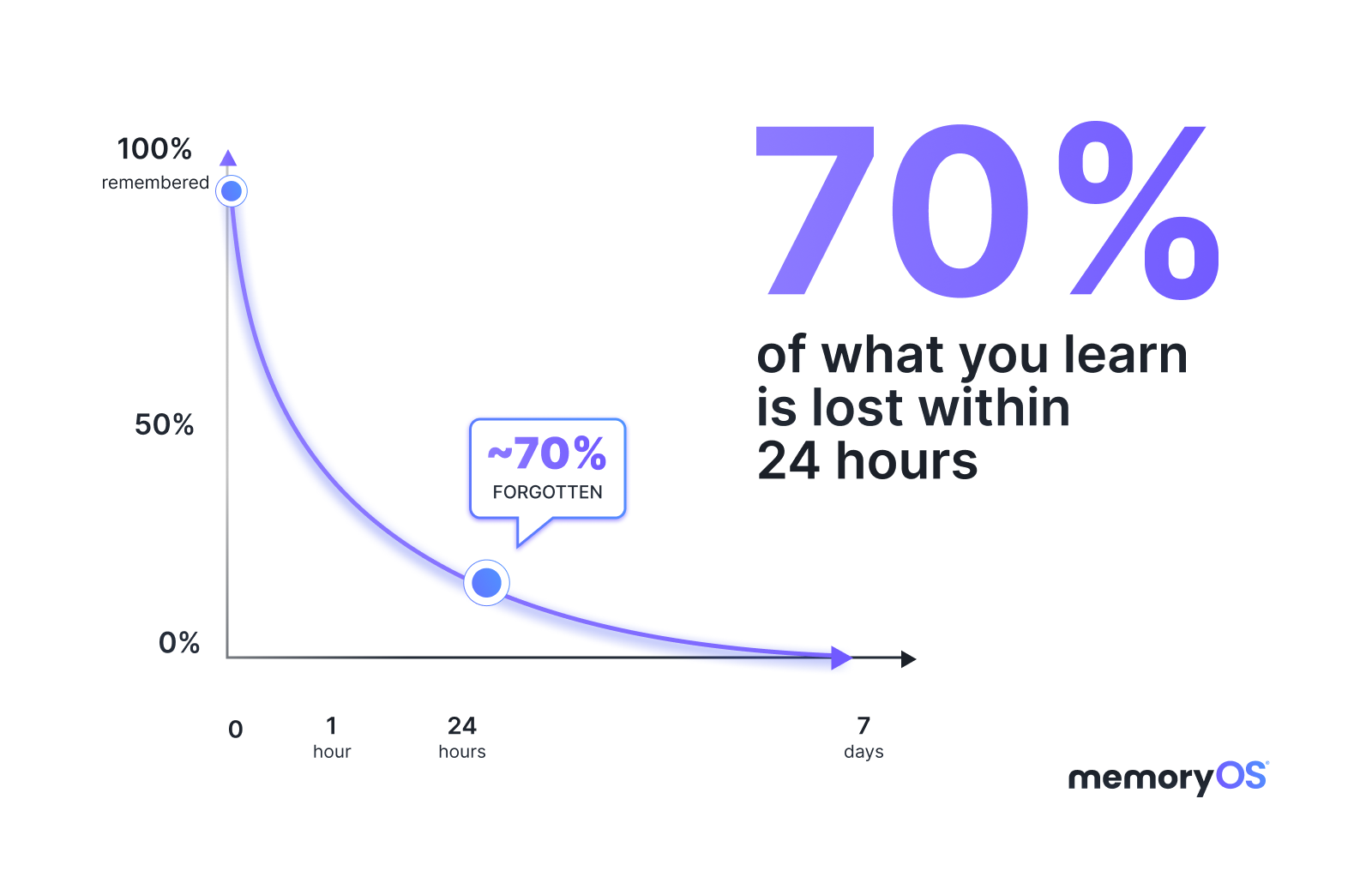
There is a strong connection between the phenomenon above and the so-called Ebbinghaus forgetting curve, which suggests that new material will be lost quickly unless there is a way to refresh your memory. Luckily, there are proven techniques like active recall with the help of flashcards. Moreover, anyone can learn how spaced repetition works to gain its benefits. It helps deal with the problem. However, not all flashcards are equal, and selecting the wrong deck can be counterproductive.
So let’s evaluate the best MCAT flashcards and study decks in 2026 based on a clear five-factor evaluation system. It is important not just to create a list of the most popular resources; rather, each one should be assessed according to its level of compatibility with AAMC, effectiveness of spaced repetition, visual memory support, mobile convenience, and overall value for money.
There are the top 9 well-known resources, like Anki, AAMC Official Flashcards, Quizlet, etc. To choose the most suitable one for yourself, it is important to consider and analyze all 9. For example, tools like memoryOS are worth special attention because it uses a combination of spaced repetition and the method of loci (memory palace) to solve recall problems from an entirely different perspective.
What Makes an MCAT Flashcard Deck Actually Work?
Most MCAT flashcards appear helpful at first glance; however, only a few can enhance memorization when taken under exam stress. It all boils down to whether the technique enables effective retrieval rather than mere exposure. Studies in cognitive science have shown that the use of spaced repetition together with active recall is the most reliable technique for improving memory formation.
In their research, Karpicke & Blunt (2011) showed that retrieval practice resulted in better long-term retention compared to rereading. Dobson (2013) also noted in his research that students who used active recall techniques scored almost 50% more in the anatomy test than those who did not. All this is consistent with the Ebbinghaus forgetting curve, whereby 70% of information learned is lost within 24 hours if no proper review techniques are applied.
The best means of preparing for the MCAT should be more complex and have at least five aspects optimized; these aspects include AAMC content matching, quality of active recall questions, visual and mnemonic coding, algorithmic spacing of reviews, and an organizational system according to MCAT subjects. Those who miss even one of the aspects tend to create temporary familiarity and not actual recall under pressure.
The 5 Criteria We Used to Rank Every Deck
For the purpose of selecting the best MCAT prep systems, we have assessed every choice based on a standard system that takes into consideration actual MCAT performance indicators rather than pure popularity.
AAMC Coverage Percentage: Similarity of the deck to the official AAMC MCAT breakdown in terms of the distribution of Biology/Biochemistry, Psychology/Sociology, Chemistry/Physics, and adjacent CARS topics (AAMC Content Outline).
Visual Encoding: Extent to which the information is being encoded via imagery or spatial associations instead of plain text memorization.
SRS Efficiency: Efficiency of the spaced repetition algorithm in organizing reviews for optimal memory consolidation.
Mobile User Experience: Convenience of using the system on an everyday basis under the conditions of typical student life (speed, UI, availability offline).
Price-To-Value Ratio: Ratio between the price and the actual increase in efficiency of learning compared to free options.
Every deck listed in this guide is rated according to five parameters to allow a fair comparison of platforms.
9 Best MCAT Flashcard Decks & Apps Compared
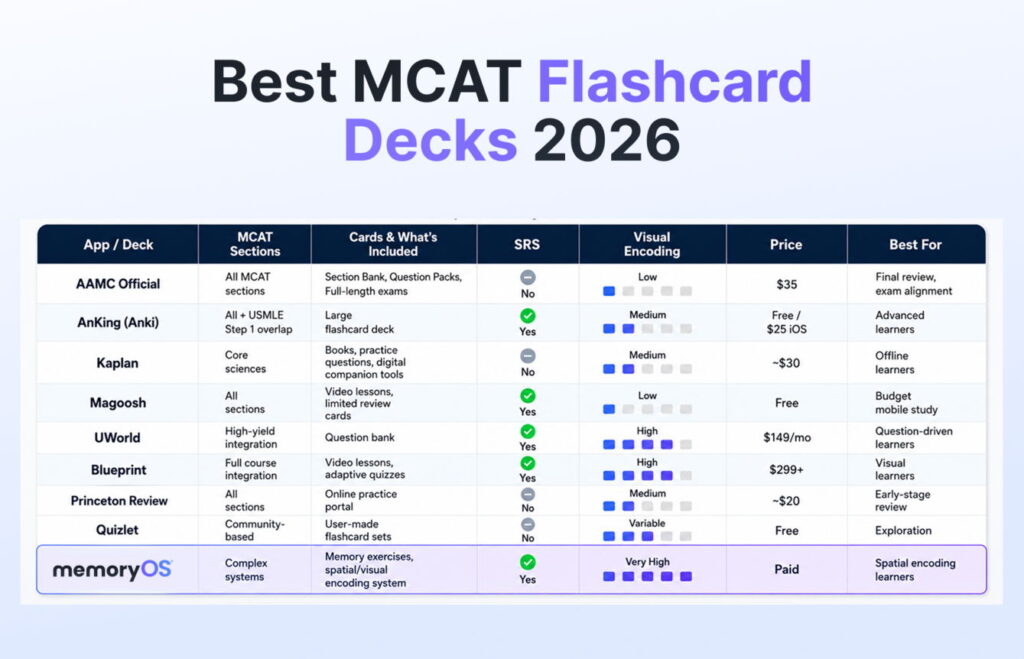
Not every MCAT prep student will find one perfect system of flashcards. In fact, the best MCAT flashcards can differ from person to person depending on whether one puts more emphasis on exam alignment, adaptive algorithms of repetition, or efficient long-term learning.
AAMC Official MCAT Flashcards — Best for Exam Alignment
AAMC Official MCAT Flashcards are the most reliable source since they are aligned with the official content blueprint released by AAMC. It means that the deck is built according to the real exam structure. The AAMC official deck consists of over 1,200 flashcards and covers such topics as biology, chemistry, psychology, and sociology.
Nevertheless, the deck is not equipped with a spaced repetition algorithm, making the flashcards less useful in terms of long-term optimization. This is why AAMC cards work well only during the last 4–6 weeks of preparation, when precision becomes more important than efficiency. There is a high demand for AAMC flashcards for the MCAT (about 1,600 searches per month).
Anki + AnKing Deck — Best for Self-Directed Power Users
The MCAT flashcards Anki system, especially the AnKing Deck, has gained huge popularity amongst pre-med and USMLE Step 1 students due to its flexibility and suitability for effective active recall. Containing over 30,000 community-curated flashcards, the AnKing system permits the creation of individual repetition sessions.
It has been noted that in the field of medical education, for maximum effectiveness, one should have a proper configuration. It takes about 8-12 hours for a beginner. The Anki MCAT method perfectly corresponds to studies related to retrieval-based learning, showing significant superiority of active recall over passive reading.
Kaplan MCAT Flashcards — Best Printed Deck
Kaplan MCAT Prep System is one of the best MCAT prep app systems for those students who enjoy traditional methods of preparation and prefer to learn via physical means. 500 printable flashcards on all basic MCAT sciences offered by the Kaplan MCAT prep system allow for an annotation learning approach.
However, it does not incorporate any adaptive repetition algorithm, which means that the system does not take into account the specifics of the process of memory decay. Thus, it works better for early-stage learning than for long-term retention.
Magoosh MCAT Flashcards App — Best Free Mobile App
Magoosh MCAT Flashcards App offers approximately 340 cards across all MCAT subject areas and incorporates an adaptive spaced repetition system for mobile users. This system promotes the process of retrieval via repeated exposure, which is the key principle of the MCAT preparation strategy.
UWorld MCAT Flashcards — Best for High-Yield Integration
The MCAT flashcard app by UWorld is tightly integrated into its question bank, connecting flashcards with questions that were answered incorrectly or represent high-yield topics for practice.
Thus, the MCAT flashcards app creates a closed loop of testing and repetition that is especially beneficial for those students who are already using UWorld resources. However, to use the service, one needs to pay for a subscription (approximately $149/month).
Blueprint MCAT Flashcards – Best For Visual Learners
Blueprint MCAT Flashcards includes over 1,600 expert-curated flashcards, which include high-yield topics related to the MCAT test. The best MCAT prep app experience includes the use of spaced repetition, tracking your progress, and creating personalized flashcards with explanations and visuals, which may be useful for visual learners. As opposed to many other premium tools for MCAT preparation, Blueprint’s flashcard set can be accessed for free via a Blueprint account.
Princeton Review MCAT Flashcards — Best for Subject Breadth
The Princeton Review system utilizes a structured approach to studying the MCAT content by means of a physical-digital format. The MCAT biology flashcards provided by this system are especially valuable at the beginning stage, since they include science questions and cover the most essential information across 500 flashcards. Nonetheless, similar to non-adaptive solutions, this system does not use forgetting curve algorithms in the process of repetitions.
Quizlet MCAT Community Decks – The Best Free Starting Point
Quizlet contains one of the biggest collections of user-generated MCAT study sets and is thus the best option to explore the topic. The MCAT flashcards free collection includes, for example, a set such as “Ultimate MCAT Flashcard Set”. However, uneven quality levels call for careful curation of the material used.
memoryOS — Best for Spatial Encoding of Complex Concepts
The memory palace in memoryOS, as one of the MCAT mnemonic devices, is designed using spatial encoding based on cognitive studies, such as those of Legge et al. (2012, Memory & Cognition), demonstrating the superiority of spatial memorization strategies over verbal repetition by 35%.
The technique uses knowledge obtained by Jonas von Essen, 5× World Memory Champion. It allows students to visualize abstract notions used in the MCAT exam and create mental palaces. Statistics indicate that the combination of spaced repetition with spatial encoding increases accuracy in free recall by about 40%.
MCAT Flashcard Comparison Table
The table below provides a comparison of different systems based on content, structure, and learning effectiveness. This will make it easy to determine which of the MCAT flashcard apps uses active recall or passive study.
| App/Deck | MCAT Sections Covered | Cards and What is Included | SRS | Visual Encoding | Price | Best For |
| AAMC Official | All MCAT sections | Section Bank, Question Packs, Full-length exams | No | Low | $35 | Final review, exam alignment |
| AnKing (Anki) | All + USMLE Step 1 overlap | Large flashcard deck | Yes | Medium | Free / $25 iOS | Advanced learners |
| Kaplan | Core sciences | Books, practice questions, digital companion tools | No | Medium | ~$30 | Offline learners |
| Magoosh | All sections | Video lessons, limited review cards | Yes | Low | Free | Budget mobile study |
| UWorld | High-yield integration | Question bank | Yes | High | $149/mo | Question-driven learners |
| Blueprint | Full course integration | Video lessons, adaptive quizzes | Yes | High | $299+ | Visual learners |
| Princeton Review | All sections | Online practice portal | No | Medium | ~$20 | Early-stage review |
| Quizlet | Community-based | User-made flashcard sets | No | Variable | Free | Exploration |
| memoryOS | Complex systems | Memory exercises, spatial/visual encoding system | Yes | Very High | Paid | Spatial encoding learners |
The majority of successful learners incorporate several strategies instead of using just one source. Specifically, the most effective methods of using flashcards for the MCAT include combining the AAMC preparation and spaced repetition system, such as Anki and Magoosh, since this combination prevents forgetting curve decay, which is well-proven in Khan Academy’s MCAT learning approach.
SRS vs Memory Palace — Which Approach Wins for MCAT?
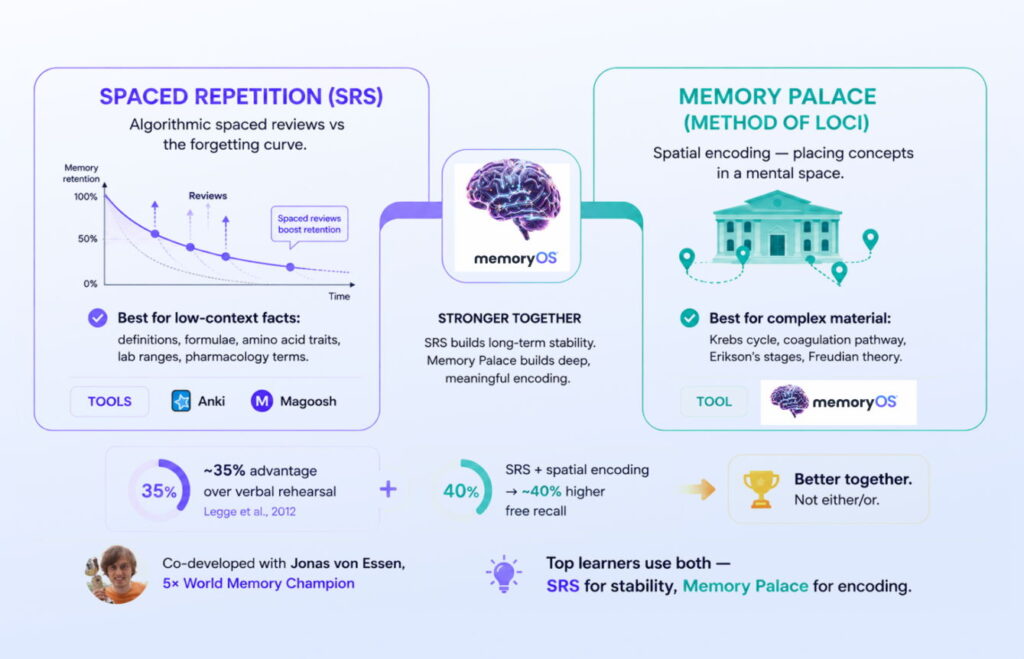
The contrast between algorithms based on repetition and those using spatial encoding is one of the key points in modern MCAT preparation. In fact, spaced repetition MCAT tactics and spatial memorization have distinct functions. While SRS works best for retaining information, spatial encoding is better for memorizing complicated multi-step information.
According to research published in Memory & Cognition (Legge et al., 2012), spatial encoding techniques, including the method of loci, have an advantage over verbal rehearsal of approximately 35% when applied to factual recall. That is evidence to support that memory palaces are more than simple mnemonic techniques – they are the cognitive system for organizing scientific material.
Jonas von Essen, 5x World Memory Champion and one of the developers of the methodology behind memoryOS, emphasizes that any high-performance memory system presupposes structured placing before repetition. The practical implication of this is the superiority of those who use both techniques.
When to Use SRS Alone
SRS works optimally on low-context information like definitions, formulae, or single information facts. This includes things like amino acid characteristics, standard laboratory ranges, and pharmacology terminologies, which are common in MCAT flashcards and Anki’s decks.
Before starting to make a system, there are ways to test your working memory capacity via diagnostic tests that will help determine how much information can be handled per session.
SRS methods, including Anki and Magoosh, work effectively in regular short intervals per day.
When Memory Palace Outperforms SRS
Whereas for more complex subjects such as biochemical cycles, processes of diseases, or even theories in psychology, the memory palace MCAT strategy performs better than simple repetition because they create spatial associations rather than linear ones.
For instance, the Krebs cycle or the coagulation pathway would be good examples where creating a spatial structure is useful. This is where the memory palace strategy and memoryOS come into play.
When the memory palace method is explained correctly, it becomes a great MCAT aid.
In practice, the best MCAT learners tend to use both techniques: SRS for stability and a memory palace for encoding.
Best MCAT Flashcards by Subject
There is no one-size-fits-all solution when it comes to MCAT domains, which is why choosing MCAT flashcards should depend on the structure of the discipline in question.
Biology & Biochemistry
Sections where Biology is predominant can use Anki (AnKing) and memoryOS to cover knowledge in depth and pathways, respectively. The AAMC MCAT Content Outline shows that Biology and Biochemistry account for 43% of exam content. Therefore, MCAT biology flashcards need rote memorization as well as systematic learning.
Chemistry & Physics
The nature of quantitative disciplines makes them learnable through practice rather than just visualizing information. The Kaplan and Magoosh systems are suitable for these subjects, as physics formulas need to be recalled procedurally, not conceptually. Some people use MCAT physics flashcards together with example problems.
Psychology & Sociology
Since psychology and sociology are highly dependent on definitions, a mixed approach such as combining AAMC Official decks with Quizlet community decks works well. But for conceptual understanding, for example, Erikson’s stages of development or Freudian theory, there is an added advantage of using a space map within memoryOS, particularly for MCAT psych flashcards.
How to Build an Efficient MCAT Flashcard Study System
An optimized MCAT studying process does not rely upon one deck; rather, it depends on the way the system is built. The best MCAT flashcards system is composed of four components: identifying weaknesses, selecting a main SRS program, adding the memory palace technique to hard subjects, and keeping up daily review sessions for 20 to 40 minutes.
The results of research conducted by Schmidmaier et al. (Medical Teacher, 2011) have shown that constant flashcard repetition leads to much greater long-term retention compared to intermittent studying sessions. Prior to optimizing the number of flashcards, it will be useful to test your working memory baseline to set the optimal number of flashcards. It normally varies between 20 and 50 cards per day.
FAQ
What are the best MCAT flashcards in 2026?
The choice of the best study apps for students depends on your study phase and preference. If you’re looking for the most aligned flashcards, then AAMC Official would be the best. For self-directed study purposes, AnKing is recommended. The best free MCAT flashcards are Magoosh Mobile SRS, while memoryOS introduces spatial encoding for improved recall.
Are Anki MCAT decks still worth it in 2026?
Yes, AnKing MCAT is one of the strongest flashcards that are available for free. The number of flashcards is more than 30,000. However, due to the time it takes to set up the deck, which ranges between 8 and 12 hours, students less than 6 months away from taking the MCAT might consider using other methods.
Is there a free MCAT flashcard app?
The best available free MCAT flashcards application is Magoosh MCAT Flashcards, containing approximately 340 cards and featuring built-in spaced repetition for iOS and Android devices. The other sources providing free flashcards are Quizlet and memoryOS (limited free trial).
How many MCAT flashcards should I make per day?
It is better to create 20-50 flashcards a day since the research conducted by Schmidmaier et al. (2011) shows that creating too many flashcards leads to decreased effectiveness in terms of retention without cognitive overload. Efficient learners focus more on encoding than on the number of created flashcards.
What is the difference between spaced repetition and the Memory Palace for the MCAT?
Spaced repetition MCAT approaches concentrate on the optimization of review timing to prevent forgetting curves. In turn, memory palace MCAT approaches increase the effectiveness of information processing via spatial associations. Spaced repetition keeps memory intact over time, whereas a memory palace enhances concept structure.
Start Encoding — Not Just Reviewing
There are many students who prepare themselves for the MCAT and devote countless hours to revising their knowledge, but fail to turn that knowledge into long-lasting memory. The problem lies not in a lack of effort but in the methods of encoding used. Here, in the field of the best MCAT flashcard systems, the issue usually comes to light.
The memoryOS app solves this problem using the combination of spaced repetition and spatial memory science, allowing students to encode abstract scientific knowledge into a mental structure. It is created with the help of Jonas von Essen – 5× World Memory Champion.
If you are ready to take your learning process to a higher level, you can try memoryOS for free and find out how spatial encoding works.