Best Place to Study: How Your Environment Affects Memory and Focus
Table of Contents
The best place to study does not have to be the quietest or the most comfortable place. Three key elements support focus and memorization: a level of noise you can work with, lighting that keeps you alert without straining your eyes, and an environment you can use consistently. The right option depends on the task, your level of distractibility, and how you stay focused.
What Matters Most in a Study Environment
A good study environment helps you focus on the subject matter rather than on the surroundings. It doesn’t mean that everybody requires absolute silence and the same desk every day. Instead, pay attention to how the environment influences your studying process.
Quiet vs. Ambient Noise
Noise can be the first factor to test. If conversations or sudden noises distract you from studying, then choose well-set quiet places to study. A library, empty room, or quiet place at home can be suitable for reading complex material, solving problems, or deep concentration.
Not everybody can work in complete silence. For some individuals, a low-level steady background noise can serve as stimulation without distracting their attention. The most important thing is to understand whether the sound constantly distracts your attention, or maybe you need some noise, like calming music or sounds of rain, to concentrate better.
Lighting
Lighting is important because it enables you to see your study material easily and helps you remain alert. Poor lighting makes it difficult for you to read, and light reflected by the screen or coming through the window may distract you.
Daylight is useful, but having a very bright window is not always helpful. Position yourself in such a way that light will fall directly onto your work area without creating any reflection on your screen. In the evenings, make sure there is enough artificial light for your page or keyboard.
The best time to study and memorize is another thing to consider. Choose a time of day and lighting conditions that will help you in your studies without making you feel uncomfortable or sleepy.
Consistency of Location
Sticking with the same location may help you get used to the surroundings, making the studying process easier for you. You may even find it easy to create a routine and develop cues for yourself to know when it is time to concentrate.
However, this does not mean that you always have to remain at the same place while studying. It may be helpful to recall facts in various surroundings, as there may come a point when you may have to use that knowledge elsewhere.
Best Place to Study: Study Spots by Type
The best place to study is determined by what you want to study and how much stimulation you need. A quiet library may be suitable for reading, but your own desk at home will be more convenient for reviewing. The table below provides a comparison of different places of studying based on their noise level, distractions, and memorization possibilities.
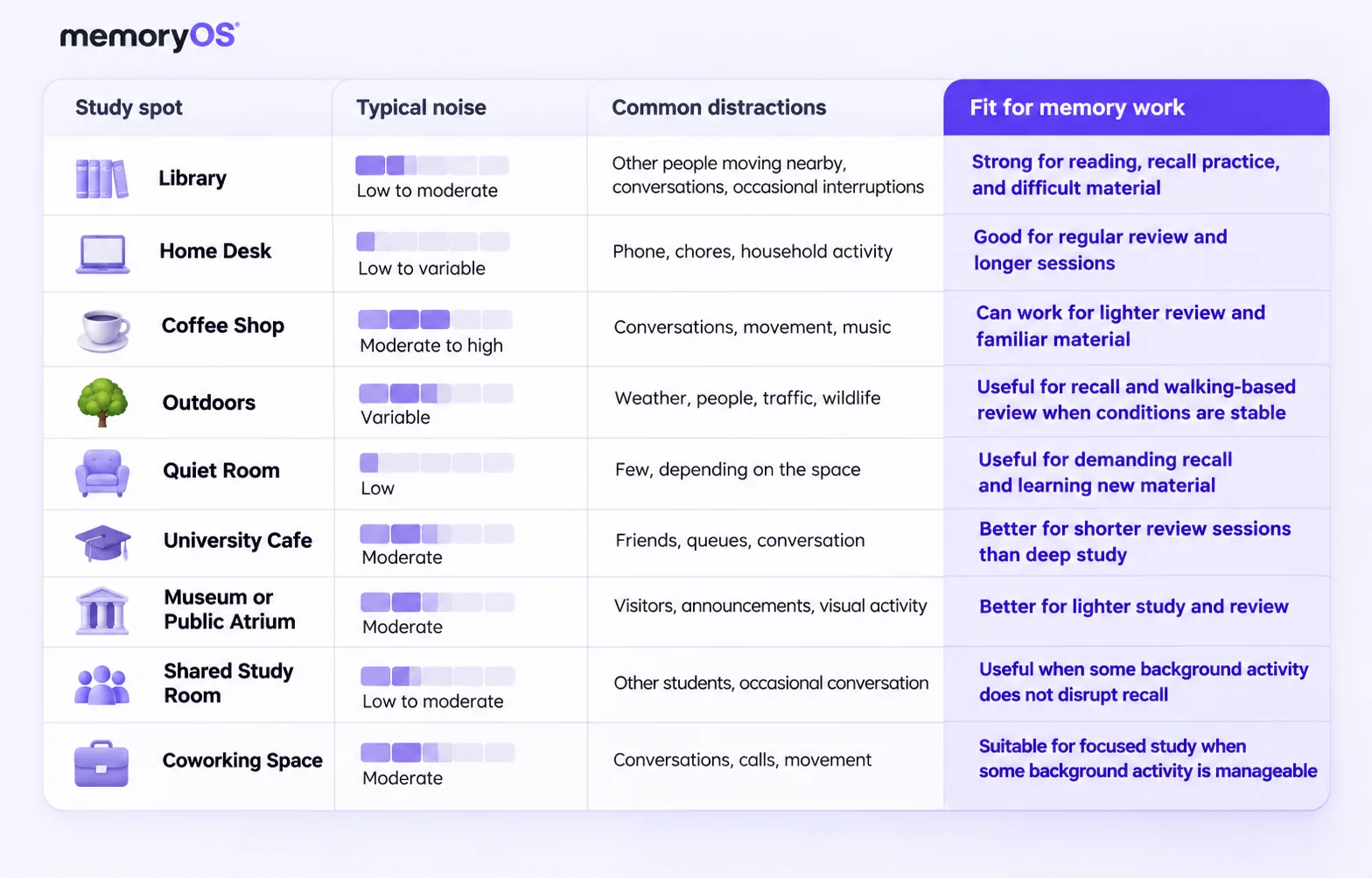
All of these spots can work, but they do not suit all kinds of learning. There are four specific environments that stand out as especially useful because they are common and relatively easy to access: the library, the home desk, the coffee shop, and the outdoor location. The trick is to get the location to fit the activity, rather than look for the universal best place to study.
Library
The library is especially suitable in situations where the nature of the content requires focused attention. The low level of noise and minimal social activity enables one to study technical content, analyze various concepts, or practice the retrieval of information without shifting attention all the time.
The library can also facilitate the use of memorization techniques that demand focus. You may learn some new information in the first place, then put the book away and practice retrieving that information instead of rereading the same pages again. This way, you can effectively use spaced repetition to retrieve the information at increasingly greater intervals.
Home Desk
The biggest benefit of a home desk is consistency in terms of memory work. When you keep coming back to the same spot for studying, less effort is required to get started.
This is especially effective when short bursts of study occur, including flashcard review, testing your knowledge of previous learning, or training your encoding with sequence memory tasks. Unfortunately, home space comes with distractions. A phone, a chore, or an irrelevant browser tab may disrupt the study session without any significant retrieval happening.
Coffee shop
The coffee shop could prove helpful where absolute silence is not required. The constant background noise can make the environment more relaxed, while changing the place would aid in breaking the monotony of the routine.
The location will be more suitable for light revisions or writing. However, discussions and sudden noises will keep distracting you constantly, making memorization a difficult task.
If you want to experiment with where to study for better focus, try to notice what actually occurs during your study session instead of making assumptions about the popular spot working for you. If you repeatedly listen to nearby conversations or lose the flow of work, the noise is probably working against the task.
Outdoors
Being outdoors may serve as an excellent contextual shift and can be useful in doing active recall. It is possible to go for a walk in the park while actively recalling a list of things or giving an explanation of some idea out loud.
The problem with this study environment for memory is that there are many unpredictable elements – weather conditions, traffic, people, temperature, noise, etc. These factors make the environment unsuitable for studying when one needs to concentrate for a longer period of time.
How to Find a Good Study Spot Near You
Start with places you can realistically use regularly.
Observe the level of noise, interruptions that could disrupt your concentration, and whether you can sit comfortably enough to get through the task.
From there, you can apply the same task in two or three different environments and measure what you remember from it afterward.
Does Where You Study Affect Memory?
Where you choose to study can affect your ability to recall what was learned, but the effect may be smaller and less reliable than it first appears.
Context-Dependent Memory: Godden & Baddeley (1975)
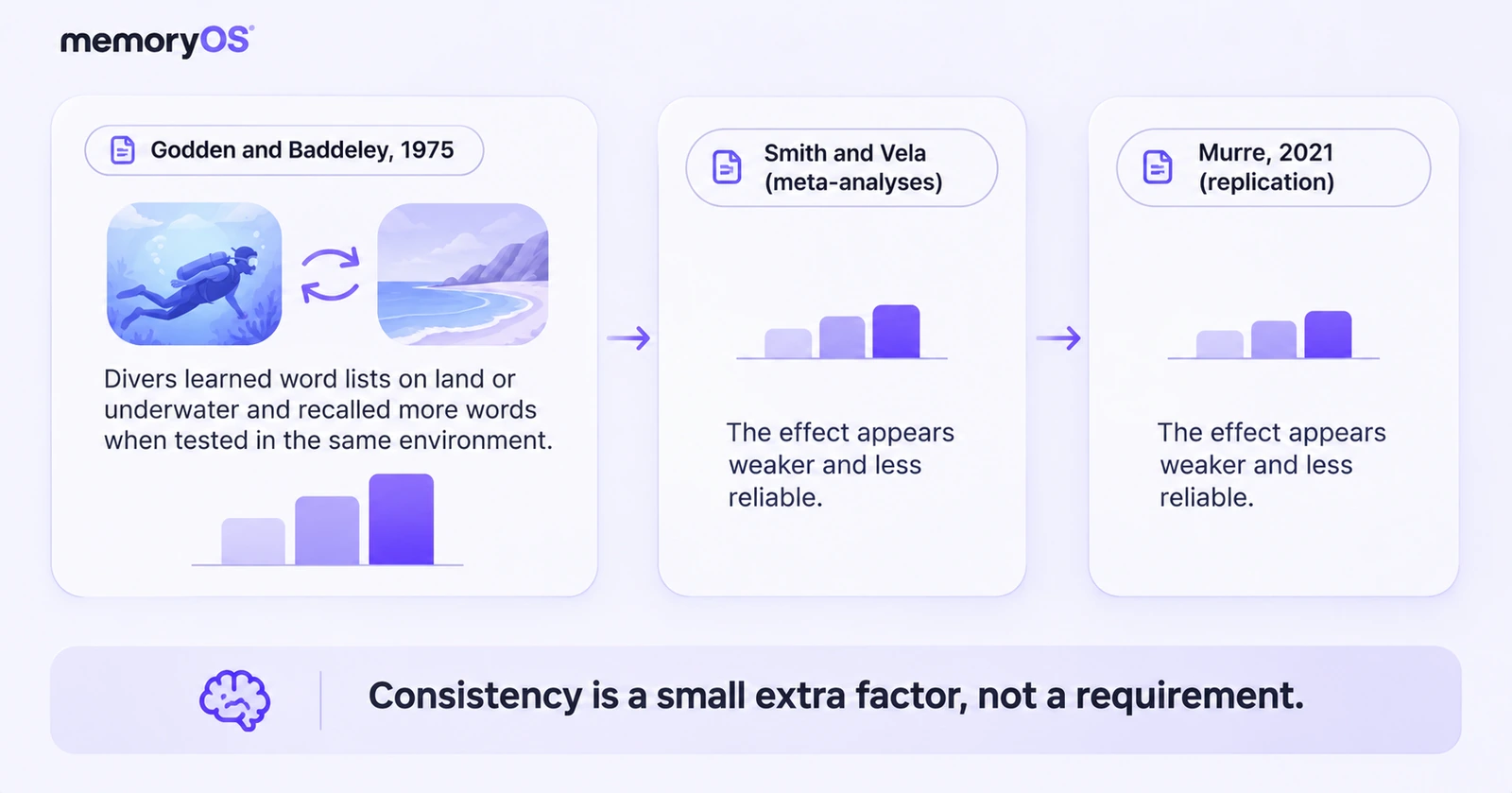
As the experiment carried out by Godden and Baddeley in 1975 demonstrates, the environment where you learn something can sometimes become part of the context associated with the learned information. In their study, divers learned lists of words either on land or underwater. The divers recalled more words when tested in the same environment where they had learned them compared to an unfamiliar environment. This suggests that the presence of environmental cues during recall can sometimes facilitate the retrieval of that information.
This is why a familiar studying environment can sometimes seem more comfortable. For instance, if you are used to revising the studied material in the same room, some features of that room can sometimes become associated with the routine and facilitate the recall of the material.
However, environmental cues are just a tiny part of the memory process. It is not necessary to find one perfect desk and stay there forever. A familiar corner in the library or one of your favorite study spots can be useful, but learning and recalling information is more important than staying in the same place.
What Later Research Shows
Meta-analyses by Smith & Vela and a 2021 replication study done by Murre suggest that the effect of studying and remembering in the same environment may actually be weaker and less reliable. This matters when choosing where to study for better focus. Having a set location for studying can be beneficial for some students, but it is not necessarily true that information will be harder to remember elsewhere.
Thus, although quiet places for study may make difficult tasks easier and a familiar environment can act as a small memory cue, neither should become a requirement. Consistency can serve as a small extra factor but not as a pivotal condition. The study environment for memory can help recall, but retrieval practice should carry most of the burden.
If you want to practise memory techniques without relying on one physical study environment, you can try memoryOS. Both proven memory techniques and spaced repetition are combined in the app, allowing you to practice recall in various settings.
Study Environment and the Memory Palace
The memory palace, or method of loci, uses context in a more deliberate way. Instead of depending on the room in which you study, the technique assigns information to specific locations and objects that can later serve as retrieval cues.
The environment in the memory palace is part of the mnemonic structure itself. A location gives you somewhere to place information, while the associations between that place and the information help you retrieve it later.
A digital approach takes the idea one step further. The memoryOS app uses a structured virtual environment in which information can be connected to particular locations and objects. With a virtual memory palace, you can return to the same virtual setting when reviewing those associations rather than rebuilding the framework mentally each time. You may also try playing memory games that allow you to train your memory more flexibly, without being restricted by a particular physical location.
This does not mean that the memory palace relies on the same mechanism described by research on context-dependent memory. In context-dependent memory, the surrounding environment can sometimes act as a retrieval cue simply because learning and recall happen in the same place. The method of loci works more deliberately: the learner creates specific locations and associations and uses them to organize and retrieve information.
How to Set Up a Good Study Spot
You do not need a special room to create a workable study environment. An average desk can be a great study spot if you remove everything that distracts you.
Checklist:
- Choose a location where noises are easily predictable and manageable.
- Put away your mobile phone or disable notifications.
- Ensure that only those items that are relevant to your activity are kept on your desk.
- Adjust lighting in a way that allows you to read comfortably without having to worry about glare from the computer screen.
- Ensure that both the chair and desk are comfortably arranged for your upcoming session.
- Have some water within your reach so that you do not need to take unnecessary breaks during your study session.
- Plan your activity to avoid disruption during your learning session.
- Always do a quick active revision after each session of studying rather than re-reading your notes.
- All you need to do is make starting your activity easy.
It is not about making everything perfect. It is about making it easy to start working and minimizing those minor distractions that take up your attention.
FAQ
What is the best place to study for a test?
The best place to study before taking an exam should allow you to concentrate for enough time to retrieve and practice the content actively. The best location may vary from person to person because some people get easily distracted in some environments.
Does where you study affect memory?
Studies have shown that the environment can act as a retrieval cue for context-dependent memory, but the effect is relatively small. How you learn the material and which learning strategies you use also play an important role.
Should you study in the same place every time?
Not necessarily. One’s familiar environment can be used as a small contextual clue, but changing environments when studying can help you practice retrieving information without relying on just one environment.
What are the best quiet places to study?
Places like libraries, silent rooms, or less visited zones of a university or workplace can offer a more predictable environment. The best choice would be where interruptions happen rarely and do not distract you.
Is a coffee shop good for studying?
A coffee shop would be suitable for light revision and writing if background noise does not bother you. However, where intensive memorization is needed, the constant movement and conversations may require a quieter place.
What is the best study spot for concentration?
The best study spot for concentration is a place where you can concentrate without reacting to distractions.
If you are still deciding on your best study spot for concentration, test the same learning task in a few realistic locations and see where you remember the material most effectively.