Educational Platforms in the USA: Learn Smarter and Track Knowledge
Table of Contents
Educational Information Platforms in the USA: How to Learn Smarter and Track Knowledge Effectively
Digital platforms are important for the US education system because they deliver content and help students improve their skills. The most common educational information platforms in the USA are digital courses, learning management systems, administrative dashboards, and career guidance or credential verification tools.
However, knowledge retention is still a concern. Learning is typically scattered and disjointed between different learning platforms, while tracking is based on immediate gains. Tools such as memoryOS help systematize learning, commit data to memory using mind palaces, mnemonics, and spacing repetition, thereby converting scattered learning engagements to meaningful gains in cognitive learning.
What Are Educational Information Platforms in the USA?
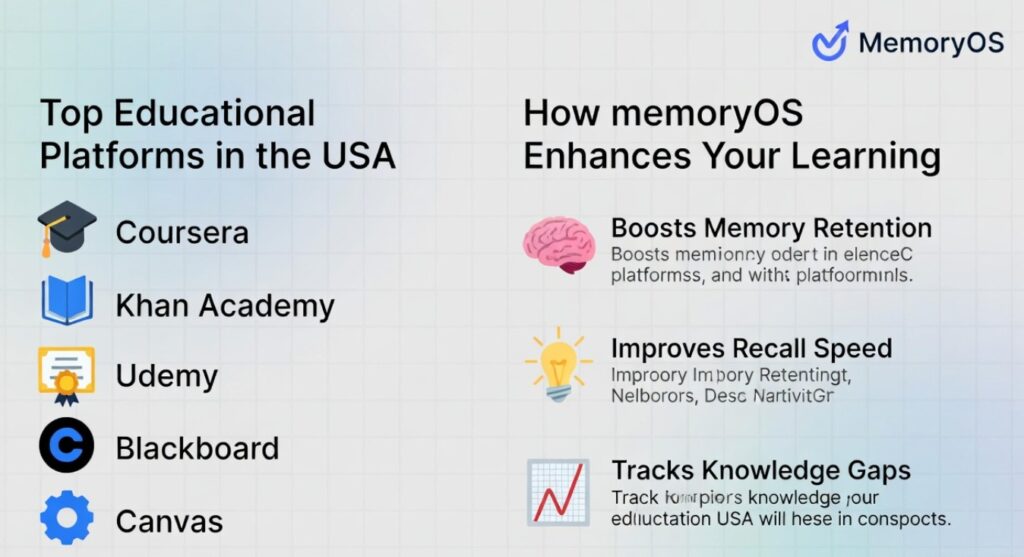
Online learning platforms, courses, and resource materials such as Coursera, Khan Academy, LinkedIn Learning, and Udemy offer educational content that can easily be accessed and used by students at any time and from any location. These educational information platforms in the USA facilitate learning and offer feedback on the progress.
What other platforms might be useful? Learning management systems, such as Blackboard and Canvas, are learning hubs where instructors engage with content and student activity to assess student participation. Another example is administrative tools such as PowerSchool and Infinite Campus, which compile student information, providing student learning analytics to teachers to assist in decision-making in education.
Career assessment resources and credential verification services, such as the National Student Clearinghouse and College Scorecard, assist students in tracking their credentials and verifying student outcomes.
Even with such a wide range of digital education tools, knowledge retention is a challenge. Even though such e-learning tools present organized knowledge and a form of progress monitoring, memory retention and practical usage of knowledge are difficult for students.
Strengths and Limitations
The strengths of these platforms are clear: it offers accessibility at scale, diversity of content, and built-in analytics to monitor activity and performance. Learners can engage in a range of subjects and receive immediate feedback on exercises, while educators and institutions enjoy detailed reports on engagement and achievement.
Still, there are some limitations. First of all, there is no strategic plan for memory improvement or consolidating learning in the long-term perspective. Insights generated by each platform rarely connect to a learner’s broader cognitive development. As a result, learners lack a comprehensive knowledge tracking system.
With mind palaces, mnemonics, spacing, and micro-lessons, memoryOS helps learners encode, retain, and recall information they gain from various learning sources. By integrating information from digital education tools, this tool converts fragmented learning outcomes to measurable cognitive development.
How memoryOS Enhances Learning Across Platforms
MemoryOS translates into a common space that brings together content from multiple online learning platforms and e-learning courses in a central location where one can access knowledge. Information on Coursera, Khan Academy, Udemy, and other educational information platforms in the USA is structured using the mind palace system, which enables one to recall the information accurately. This is reinforced by spaced repetition techniques, mnemonics, and gamification.
“Education platforms can deliver content, but memoryOS ensures you truly retain, recall, and track what you learn across every course and system.”
The integration of memoryOS and learning systems helps learners, scholars, and individuals recall knowledge from different sources.
Trends in US Education Platforms
The trends currently highlight adaptive learning AI, microcredentials, stackable certificates, and seamless integrations into educational dashboards like Blackboard, Canvas, and administrative tools. Few platforms will translate the data extracted from tracking participation and assignments into long-term cognitive gains. Complementing these emerging trends, memoryOS takes raw metrics and converts them into structured, retrievable knowledge.
| Platform Type | US Examples | Limitation | memoryOS Advantage |
| Digital courses | Coursera, Khan Academy, Udemy | Knowledge is often forgotten after the course ends | Mind Palaces + micro-lessons for retention |
| LMS | Blackboard, Canvas | Metrics are limited to assignments | Tracks mastery trends over time |
| Admin dashboards | PowerSchool, Infinite Campus | Data disconnected from cognitive skills | Converts metrics into actionable memory insights |
| Career / credential tools | College Scorecard, NSC | Hard to retain guidance for later use | Stores and organizes career info for recall |
By consolidating content, structuring knowledge, and providing insight across platforms, memoryOS ensures learning is not just recorded but retained, retrievable, and applicable, largely thanks to spatial-memory methods like Sherlock’s mind palace.