
How to Memorize a Speech: A Step-by-Step Method
Table of Contents
To learn how to memorize a speech, try the memory palace, also known as the method of loci. Memory athletes use this technique to associate ideas with known locations, thus creating a mental route to retrieve ideas in the proper sequence. Rather than memorize each sentence individually, you attach your major concepts with vivid visualizations along this mental pathway. These visual images will allow you to speak without constantly referring back to your written notes.
The Best Way to Memorize a Speech
Trying to memorize the whole speech at once would be difficult for your working memory. It will become easy to recall if the information is presented in chunks, and there is a connection between the chunks and a certain cue. The procedure involves making a list of important things that should be included in your speech. Once the list has been made, the next step would involve narrowing down the important points to key phrases.
The Memory Palace (Method of Loci) for Speeches
The idea of a memory palace involves linking different sections of your speech to a place you are familiar with, like your hallway, kitchen, or living room. Since you know the order of things within that place, you can use one location to remind yourself about the next point.
This method is learnable. A 2017 study by Dresler et al. discovered that individuals who had training in the method of loci for six weeks showed improvement in recalling word lists, and the effect persisted even after four months. While this experiment did not specifically assess the learning of speech, it demonstrates that one’s memory skills are learnable.
How to Memorize a Speech Step by Step
1. Break Up Your Speech into Main Points
Identify what your introduction, three to five body points, and conclusion will be. Title them briefly. If the topic of the speech is about sleep and memory, the points could be the definition of memory, purpose of sleep, memory consolidation, effects of lack of sleep, and significant findings, among others.
2. Select Key Phrases for Every Point
Shorten every point to just two or three phrases rather than memorising an entire paragraph. For example, in the case of memory consolidation, you could choose stabilising memories, connections strengthening, and long-term storage. Keep important figures, scientific terms, and quotations separately if you have to reproduce them word-for-word.
3. Select a Familiar Route
Select an area that is familiar to you, for example, your house. Choose a fixed path consisting of five different points: front door, hallway, kitchen, dinner table, and sofa. The same pattern should be followed every time so that this route assists in moving between sections. This is an effective way to memorize a speech fast without creating a new environment.
4. Turn Each Point into a Vivid Image
Form one distinct image for each main point in your speech. When dealing with memory consolidation, think about pictures of brain scans showing activity during sleep. To encode sleep deprivation effects, you can imagine a student sitting before a piece of paper filled with notes but struggling to recall what was read. Every picture symbolizes one main point that has to be explained further.
5. Assign Each Picture a Certain Spot
Give each picture its definite spot on your path. Consider the huge bed outside the front door and the crumpled books in the corridor. Do not allocate different and independent concepts in one and the same place. If there is more than one idea in one part, split it up into smaller pieces in neighboring stops.
6. Walk the Path and Name the Concepts
Close your notes and go mentally over the path. When you reach every stop, name out loud the concept that belongs there. In case you have forgotten something, go over your notes, strengthen your mental picture, and try again. That’s how you find out whether you can remember concepts and not only recognize them by reading.
7. Rehearse the Speech Aloud
Say the whole speech from beginning to end using the images as your mental cues. Make sure that the information comes out in order first; only after that should you perfect the wording of your sentences. This is an example of a public speaking memory technique that can help you encode the structure without sounding memorized.
Worked Example: A Short Speech in a Palace
Think of yourself giving a presentation on the effects of sleep on memory at university. The basic idea of your presentation is that sleep is responsible for consolidating memories, whereas lack of sleep can disrupt the process of learning. You need to outline the major ideas, provide findings, and conclude with practical recommendations. Here’s a more detailed example of how you can structure your presentation using a memory palace.
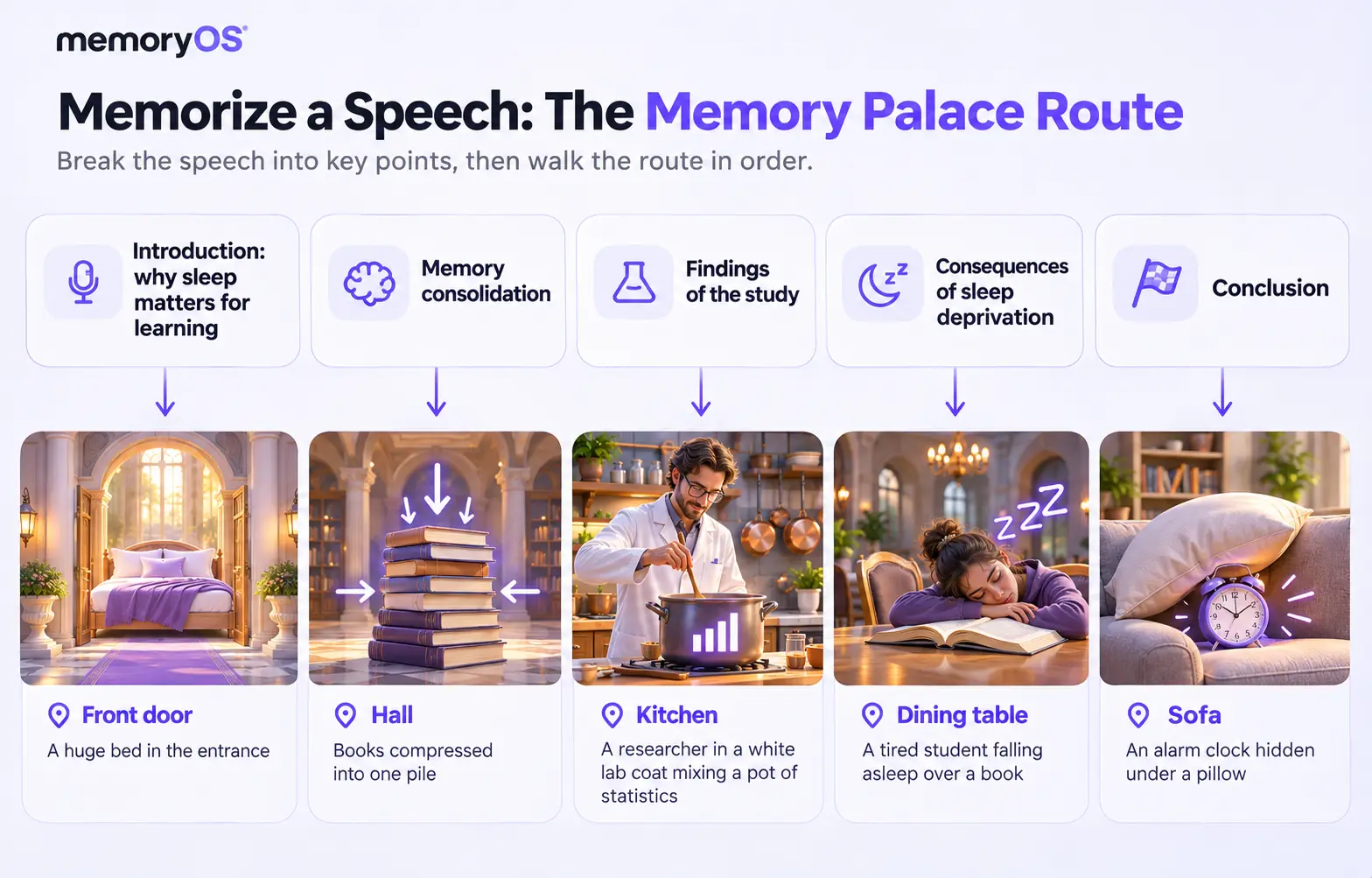
Front door: State the problem. Visualize a huge bed occupying the entry point. Use it to remember your introduction about the importance of sleep in terms of learning and memory formation.
Hall: Describe memory consolidation. Picture books being compressed into one pile. This visualization will aid you in understanding what memory consolidation is and how it works to make memories strong.
Kitchen: Provide the findings of the study. Imagine the researcher in his white lab coat standing in the kitchen, mixing up a pot of statistics. This is how you can remember the primary finding and also other important statistics.
Dining table: Describe the consequences of sleep deprivation. Visualize a tired student falling asleep over the book. Use the picture to state how inadequate sleep influences learning and memory processes.
Sofa: Come to a conclusion. Visualize an alarm clock lying hidden underneath the pillow. Use the image to sum up your thoughts and formulate your core message about the adequate amount of sleep needed during studying.
It is now time to rehearse the same process without relying on your written notes. Start describing the five locations in order and write down your ideas in your own words. In case you fail to mention what you had prepared in mind, go back to the picture of the location you remember. Once you feel comfortable with the order of your speech, try timing yourself and delivering the same. That is how to remember a speech without notes.
You do not have to replicate each sentence precisely. The memory palace is there for you to recall the argumentation as well as the flow, while your own words give it a natural delivery. In cases of scientific presentation, ensure that you are able to recall key terms, figures, and results.
If you want an interactive method of learning, memoryOS provides a way to build and revisit your virtual memory palace.
Other Ways to Remember a Speech Without Notes
Rehearsal Spacing
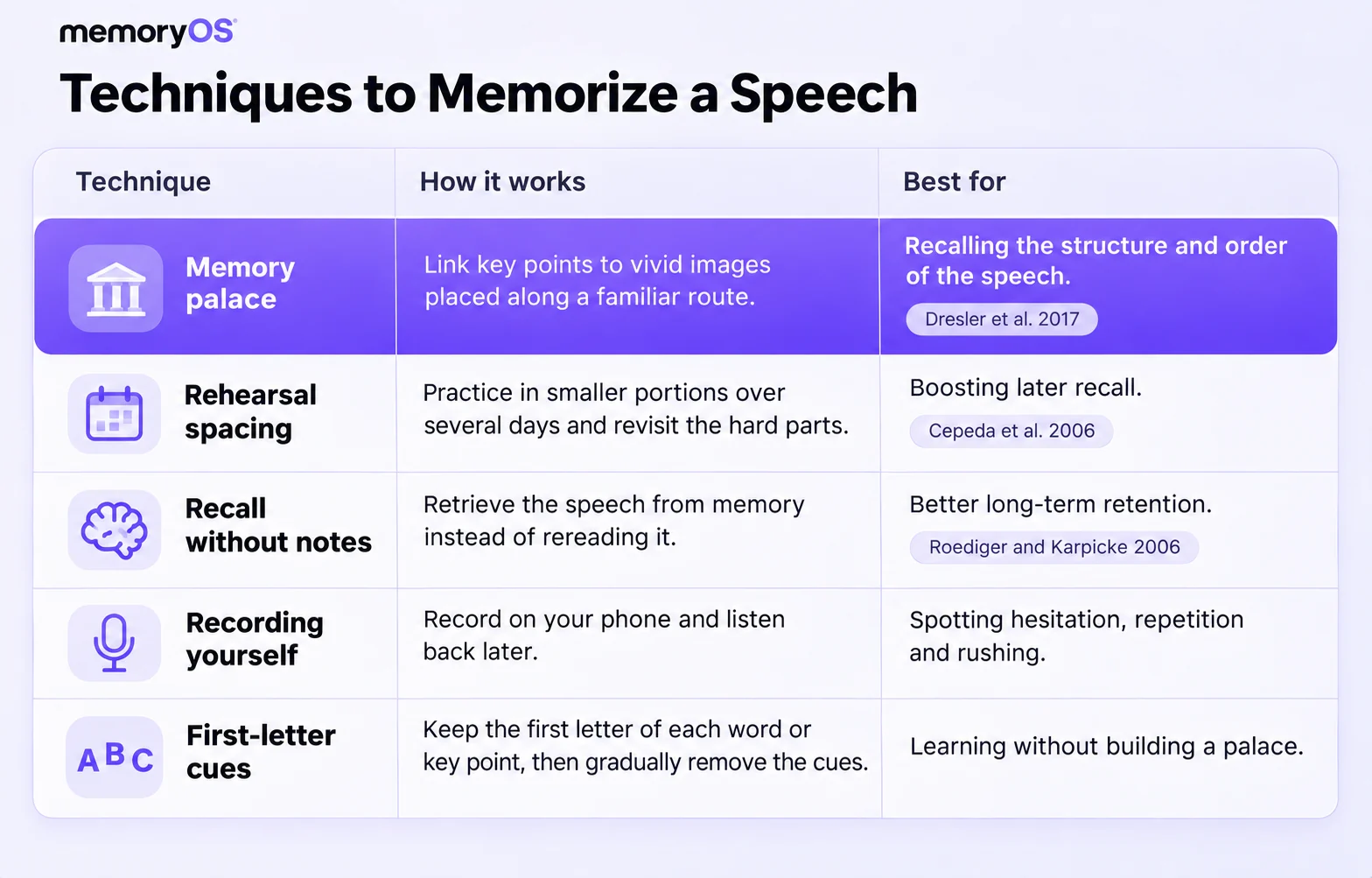
Do not attempt to master the whole speech in one training session. Rather, work on it in smaller portions over several days, revising those areas which you find difficult. According to a 2006 meta-analysis by Cepeda et al., involving 839 tests from 317 experiments, distributing practice over time may help boost later recall. The appropriate gap between practice intervals depends on your need for remembering. For more practical advice, please check how spaced repetition helps information stick.
Recording Yourself
Make a test recording on your phone and listen to it at a later time. You will know where you hesitate, where you repeat yourself, or where you rush over an important point. This is one of the techniques used in public speaking to recognize what areas you need to improve and practice the presentation without listening to the recording.
First-Letter Cues
In case you do not feel like constructing a memory palace for yourself, you may always choose the method of cue words based on the first letter of words or phrases. Take the first letter of every word or the key points you have, then try to reconstruct what was written using only those words. Gradually, you should start removing those cue words. In case of large chunks, use keywords instead of an array of letters. The intention is to trigger your memory, not to make you remember some other code.
How Jonas von Essen Memorizes Long Material
Jonas von Essen is the two-time World Memory Champion and the co-founder/head lecturer at memoryOS. In his profile, Jonas explains how he struggled with memorizing material in school, then trained himself in memory techniques, participated in memory competitions, and eventually started teaching other people.
Jonas’s case shows how memory techniques can be trained through practice. He applies spatial associations and imagery to arrange the information and facilitate its recall. When Jonas places the images at familiar spots and goes over them during practice, he builds links between the information and cues for its retrieval.
The memory palace is an effective tool for structuring different kinds of information in a coherent way and recalling the details in the proper sequence. It is considered one of the best techniques to remember a presentation or speech and reproduce it accurately.
How Long Does It Take to Memorize a Speech?
How much time is required to memorize a speech will vary depending on the length, difficulty of the speech, and your familiarity with the topic. A familiar speech that lasts five minutes may require less study time than an informative speech riddled with statistics and difficult terminology.
Practice Schedule
To remember a speech that you will be delivering after a few days, start by outlining the main ideas and creating cues. Then the next day, practice remembering the speech without looking at the script. On the third day, deliver the speech and review the parts where you struggle to recall something. Finally, on the last day, go through the whole speech and make some minor adjustments.
The given strategy incorporates spaced practice and retrieval practice. In their 2006 experiment, Roediger and Karpicke discovered that practicing the retrieval of studied materials led to better long-term retention than repeated study only. Although they tested the effect on the retrieval of prose passages, not speech, their findings prove the importance of practicing the retrieval of information instead of its repeated reading. If you have asked yourself how to remember a speech without notes, then the process must include regular attempts to retrieve the material.
Time for a 5-Minute Speech
The basic strategy is to spend 30-45 minutes on outlining and encoding the speech and use multiple 15-25 minute sessions to practice recalling and delivering the speech. If you have to memorize a speech fast, concentrate on the order of key points first. Then add word-for-word memorization where needed, and finally deliver the speech out loud with a timer. The goal is not just spending time memorizing but achieving reliable recall.
Learning how to memorize a speech becomes more manageable when you divide your preparations into specific steps instead of trying to do everything at once.
Common Mistakes When Memorizing a Speech
Understanding your errors will help you to practice efficiently. You may be very familiar with the content when reading it but have difficulty recalling it while presenting it to an audience. This is because of the way you are practicing it, rather than how many times you are reviewing it.
Word for Word vs. Key Points
Memorizing each and every sentence may make it difficult for you to move ahead once you forget some particular phrase. Try to concentrate on the central ideas and their sequence. You should practice presenting each of them in your own way without forgetting the essential facts. If you are memorizing a speech, memorize the message, not every word.
Cramming the Night Before
Repeating the script the night before may make the material feel very familiar to you; however, simply having that familiarity doesn’t mean that you’re going to remember it. Take the time to go through several rehearsals, and test yourself without notes in between them. There are also some short interactive memory games that can train your memory capabilities and activate learning power.
It is useful to organize the speech by breaking it into important points and attaching each point to a mental picture, a known place, or a cue. After that, practice remembering the ideas verbally until you are able to transition between the points without referring to your script.
There is no need to encode every word unless the situation demands precise language, like an official statement or a well-written introduction. Otherwise, understanding what you have to say and the proper sequence is all that is needed to help you deliver effectively and even overcome forgetting some words.
It may take up to two to four hours to memorize a 5-minute speech, but it may require additional time in case the speech contains complex information. Check your knowledge by repeating it without notes from the very beginning to allocate more time for the parts you find difficult to remember.
Separate the script into small portions, learn them one at a time, and associate each portion with a cue helping to trigger a recall of the following portion. Practice connecting the portions and rehearse starting from the beginning of the script without any text in front of you.
The memory palace is an effective solution if there is a need to memorize several elements in a particular sequence – assign every element to a familiar location in the virtual path. Use this method in conjunction with spaced practice and rehearsal.
Begin learning with the start of the script, its key elements, and its final part. Develop an easy trigger for each element, rehearse aloud, and practice the elements you cannot remember rather than those you already know.
Ready to start applying these memory techniques? Try memoryOS for practicing your memory skills, which may be helpful when giving your next speech or presentation.