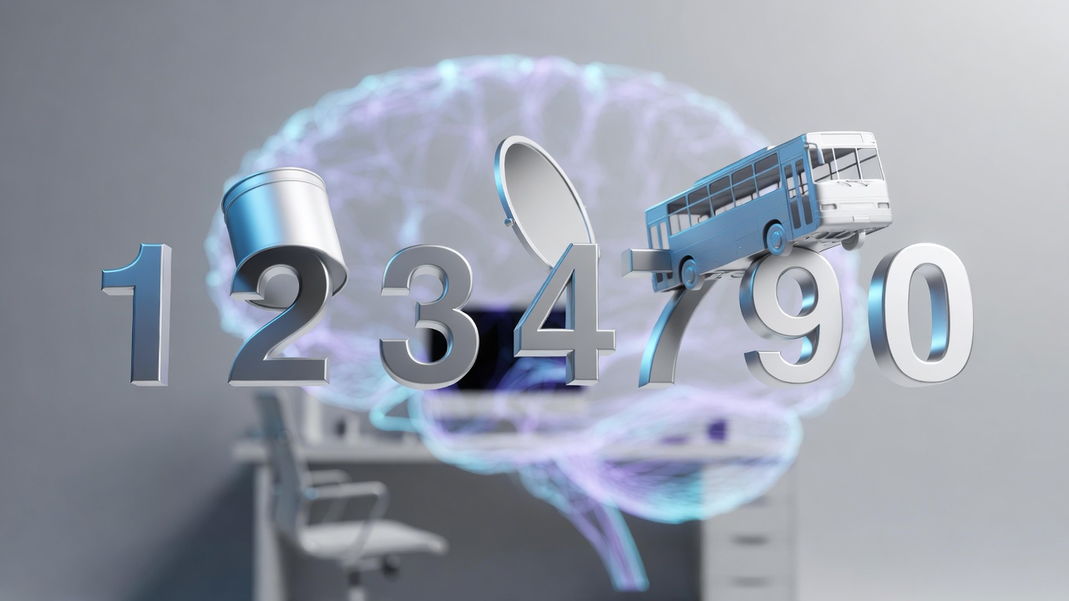
Mnemonic Major System: A Guide to Converting Numbers into Images for Dates and Passwords
Table of Contents
Memory is not a passive cognitive storage for information. It is an active process of selecting, organizing, and encoding information into forms that the brain can easily access under stress.
When new information comes in without organization, encoding is superficial. This is no surprise: rapid forgetting, slow access, and mental exhaustion during challenging tasks.
Mnemonics provide the brain with a data organization it can use. Mnemonics encode abstract inputs into rich stimuli, which the brain can process faster. This enhances cognitive skills by improving attention during encoding and clarity during recall.
In other words, organized encoding eliminates the need for continuous re-learning and allows the mind to focus on reasoning and decision-making.
One of the most effective ways to do this is through the major mnemonic system, which translates numbers into concrete images that the brain can latch onto. On the surface, the idea of translating numbers into images may seem abstract. However, it is actually the way in which memory naturally works—by association, emotion, and spatial reasoning.
This technique, when practiced on a regular basis, demonstrates tangible benefits in practical applications, such as recalling dates effortlessly, remembering sequences under pressure, and retaining information in the presence of distractions. Platforms such as memoryOS use these principles to make the technique second nature, and memory enhancement occurs where it actually matters.
What is the Mnemonic Major System?
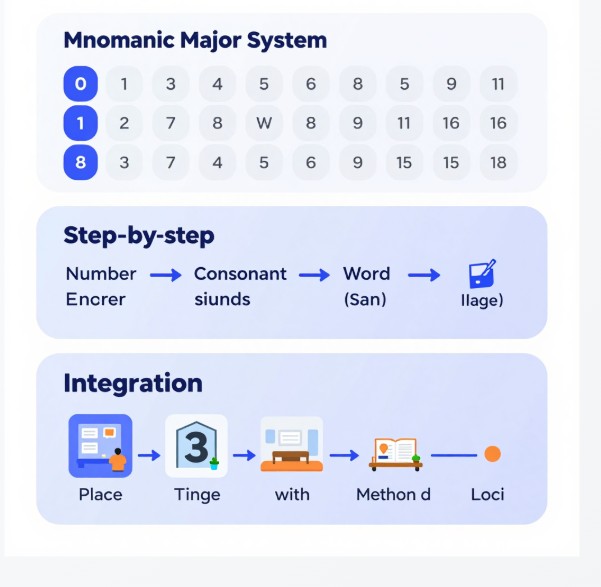
The mnemonic major system is a phonetic system that breaks down numbers into consonant sounds and then decodes these sounds into tangible words and images. Instead of attempting to memorize numbers as symbols, you decode them into scenes that the brain can see and recall under pressure.
The point of all this is simple: turn abstract numbers into concrete objects the mind can visualize.
The Major System
Convert numbers into consonant sounds, build vivid words, and anchor them to memorable images along a mental journey.
For example, a short number is represented by one image that you can visualize in a familiar setting. The image serves as the anchor for the sequence, making it easier to remember. The details come later; the first prize is understanding.
The method alters the biological process of encoding information. The brain is wired for patterns, images, and meaning. Without structure, numbers fade fast. When numbers are turned into images, they acquire meaning. Meaning provides stability to memory. This makes recall faster and less taxing, especially when recalling information under stress.
Over time, this reshapes the experience of learning. Rather than trying to force repetition, you create cues that the brain wants to trace. This is why memory improvement techniques based on visual association will always beat simple repetition. They transform complexity into a shape that the brain can follow.
A mnemonic major system generator quickens this process by taking the hassle out of the beginning, so you can concentrate on creating strong associations rather than developing them from scratch.
The difference manifests in practical application. Dates stop being chaotic. PINs and passwords become distinct elements. Long sequences become short mental walks. This is number-to-image encoding, and it’s the application of a technique that converts unstable recall into solid retrieval. The benefit is more than mere accuracy. It is confidence in a pressured environment.
There’s a reason why this technique has been passed down through the ages. As William James so aptly put it, “The art of remembering is the art of thinking.” Encoding, not storage. Interpretation, not memorization. The better the interpretation, the stronger the memory trace.
This technique is for those who require accuracy. Students can encode formulas, dates, and organized facts. High-functioning professionals can commit numbers, codes, and sequences for quick recall without having to refer to them constantly. Cognitive health enthusiasts can maintain peak recall as information density escalates with age.
If your line of work requires accuracy under pressure, or if your learning requires retention over exposure, the major system is a robust upgrade to how memory can function.
The Phonetic Code: How to Map Digits to Consonants
The major system uses a phonetic code. Each digit is mapped to one or two consonant sounds. This allows you to convert any number into a word that you can then encode into an image that you can place in your memory.
Here is the core mapping:
| Digit | Consonant sounds | Why these sounds fit |
| 0 | s, z | “Zero” starts with a soft s/z sound |
| 1 | t, d | One downstroke in the letters t/d |
| 2 | n | Two downstrokes in “n” |
| 3 | m | Three downstrokes in “m” |
| 4 | r | Last letter of “four” |
| 5 | l | Roman numeral L = 50 |
| 6 | j, sh, ch | Soft “j” in “six” |
| 7 | k, g | Hard “k” sound |
| 8 | f, v | Cursive “f” has two loops |
| 9 | p, b | Mirror shapes of p/b |
This is not random. The sounds were picked for their consistency. They are easy to say, easy to differentiate, and consistent across languages. This is important. It helps avoid confusion when recalling and ensures that the process remains quick, even when under time pressure.
With the sounds, you create words. Words are turned into images. Images are turned into anchors. This is the engine that powers number-image encoding.
Here is a simple example.
The number 12 corresponds to t/d (1) and n (2). You could use the word “tin.” Imagine a crumpled tin box on your desk. This one image holds two numbers. The mind remembers the picture first. The numbers come next.
Use concrete images. Make them dynamic. Have them interact with familiar settings. The aim is not artistic expression. The aim is rapid recall.
The system seems very mechanical at first. After brief practice, it becomes second nature. The numbers cease to be abstract concepts. They become signals your mind can easily follow.
From Sounds to Images: Building Your Peg Words
The phonetic code provides you with consonant sounds. Vowels are fillers. They carry no numerical value. Their purpose is to make sounds word-like and images associative-like. This tiny trick is the key to speed. You no longer fight with numbers but build words the brain can see.
Let’s try to use 21 now. With 12, we had a “tin” word, but now that we have the same letters, we can create one more peg for another number.
So, two maps to “n.” One maps to “t/d.” The sound box is N-T. Now include vowels and you have “net” or “nut.” Both are valid. Pick the one that paints a better picture in your mind.
This is how the mnemonic major system transforms boring numbers into lasting hooks. The number is gone. The picture stays. In recall, the picture comes first. The number follows.
Add more examples to increase fluency.
34 becomes M-R → “mare” or “mirror.”
56 becomes L-J/SH → “leash.”
90 becomes P/B-S/Z → “bus.”
Use active images. A horse is kicking a door. A leash is pulling your wrist. A bus is crashing into a billboard. Movement holds attention. Attention fixes encoding.
This approach excels at real-world applications.
On tests, encode important dates as images and arrange them on a mental map. A “bus” parked in your classroom might remind you of 1900. A “mirror” in the hallway might remind you of 34 in a formula series. The image triggers recall without cognitive effort.
More real-world applications include encoding phone PINs, case numbers, or timelines of historical events. A brief series becomes a brief story. Stories are easier to recall in high-pressure situations than a series of numbers.
Consistency is key. Choose one picture for each number and stick with it. This will give you a solid peg system that you can apply across multiple topics. As time passes, recall speed will accelerate because your mind is working with familiar pegs.
The major mnemonic system is not about being creative for creativity’s sake. It is about having a consistent way to retrieve information that is stored when the environment is noisy or stressful. This is why advanced techniques can be applied to everyday learning. The reasoning remains straightforward. The benefit multiplies with repetition.
To make the initial process smoother, most people turn to user-friendly memory training apps that provide assistance in sound-to-word associations and peg creation. The aim is not to automate the process. The aim is to develop a habit. Once you grasp the rhythm, your recall will be faster, smoother, and more reliable.
Practical Applications: Memorizing PINs and Complex Passwords
The human element is where good security consistently goes wrong. Humans generate passwords they can remember, not passwords that are secure. This leads to predictable patterns, repeated passwords, and weak security. The solution is not more self-control. The solution is better encoding.
Using the major system, long numbers are no longer random. Instead, they are short image sequences that can be placed in familiar spots. Each piece becomes a specific scene. Remembering is a journey through pictures, not a scan through noise.
This is a straightforward process.
Break a long number into pairs. Translate each pair into a word. Each word becomes an image. Finally, position the images along a simple mental path. This path might be your workspace, your kitchen, or your daily commute. The order retains the sequence. The images retain the digits.
This method is supportive of security best practices. You can create high-entropy PINs and numeric cores for passwords without worrying about remembering them. The images carry the load. Your conscious mind is left free for the task at hand. The memory trace is robust under stress.
The major mnemonic system is scalable with usage. After you have developed a robust peg set, new credentials fall into place rapidly. You are not memorizing from scratch each time. You are leveraging an already known system.
One warning is important. Never store actual passwords in plaintext. Never use the same pattern on multiple services without changing it. The technique improves memory. Safety relies on distinct, well-formed secrets.
The benefit is useful. You get passwords that are difficult to guess and easy to remember. You quit using poor patterns. You quit writing down secrets. In real life, this is what good memory looks like: secure, cool under stress, and available when access is important.
Boosting Learning Speed: Why Use a Mnemonic Major System Generator?
Learning should begin with momentum, not weigh down the mind. New learners can stall because the initial process of peg word development is too slow and boring. A mnemonic major system generator avoids this problem. It offers choices for sound-word correspondences, so the learner can begin encoding immediately.
This is crucial for building habits. If the first few lessons are easy, it is easy to maintain the habit. Consistency compounds benefits. Instead of expending effort on coming up with new words, you expend effort on creating detailed images and placing them in fixed locations. The process is the same. The difficulty of beginning decreases.
Over time, you memorize the patterns and no longer need the tools as much. The generator is a helpful tool, not a safety net. It assists you in learning faster without losing precision.
Integration: Major System and the Method of Loci
The major system produces images. The method of loci provides a permanent location for these images. Both systems help create a full image encoding process that reflects how the brain processes experience.
Here’s how the two techniques support each other.
First, you encode digits as images. Then, you position each image along a well-known route. The route provides order. The images provide meaning. This combination resists forgetting under pressure because spatial memory is one of the brain’s most resilient systems.
From a cognitive standpoint, this technique is powerful because memory improves when multiple cues lead to the same trace. Visual features anchor information. Spatial cues anchor sequences. Transitions between locations anchor timing. This combination suppresses interference and fastens recall, providing robust number-to-image encoding that withstands distraction.
Apply this technique in practice.
Create a short route that you know well. Position one image per location. Walk the route once during encoding. Walk the route again during recall. The second walk tests recall and cements the image in place. The key principle of the method is that our memory is best at recording when it is organized.
This method of integrating learning from study to work is scalable.
Students learn to associate dates and formulas with routes in the classroom. Professionals learn to associate figures and codes with routes in the office. Enthusiasts of cognitive health learn to associate images with routes in their homes. The world is turned into a retrieval system.
To encode these images in the long-term memory, use the method of loci. Make the route permanent. Reuse it. Let the route’s organization bear the burden so that your attention remains focused on understanding. Once you’ve built a few of these routes, our number memory game is a fun way to put the major system to the test.
FAQ:
Is the major system the same as the Dominic system?
No. The major system involves assigning consonant sounds to digits, while the Dominic system involves assigning numbers to individuals. Both are effective, but they use different logic for encoding.
How long does it take to learn the phonetic code?
Most people learn the code in one session. Daily practice for one to two weeks helps develop automatic recall.