Spatial Orientation: What It Is and How to Train It
Table of Contents
Spatial orientation is the ability to identify your location and understand your position and direction with respect to your surroundings. It helps you figure out how to navigate from one point to another, take the correct turns at intersections, or adjust your location if the environment around you changes. Orientation is connected with spatial memory; however, they are not the same thing, because orientation relates to location and direction, while spatial memory is about information stored from previous experience.
What Is Spatial Orientation?
Spatial orientation, in its most basic form, involves awareness of one’s own location within the surrounding environment and how that location changes as one moves around. Your brain continuously processes this information by integrating data related to landmarks, distance, orientation, posture, and movement.
That process can happen even when you are in an unfamiliar place. Entering a large building and using the entrance as a reference point to find one’s way to another room would be an example. One is not necessarily recalling a familiar path, but rather mentally creating a map of one’s current location and deciding on what course to take based on that map.
This is important since having an excellent memory of places does not automatically mean being good at navigating them.
Spatial Orientation vs. Spatial Memory
The distinction between spatial orientation vs. spatial memory lies in the way your brain processes spatial information.
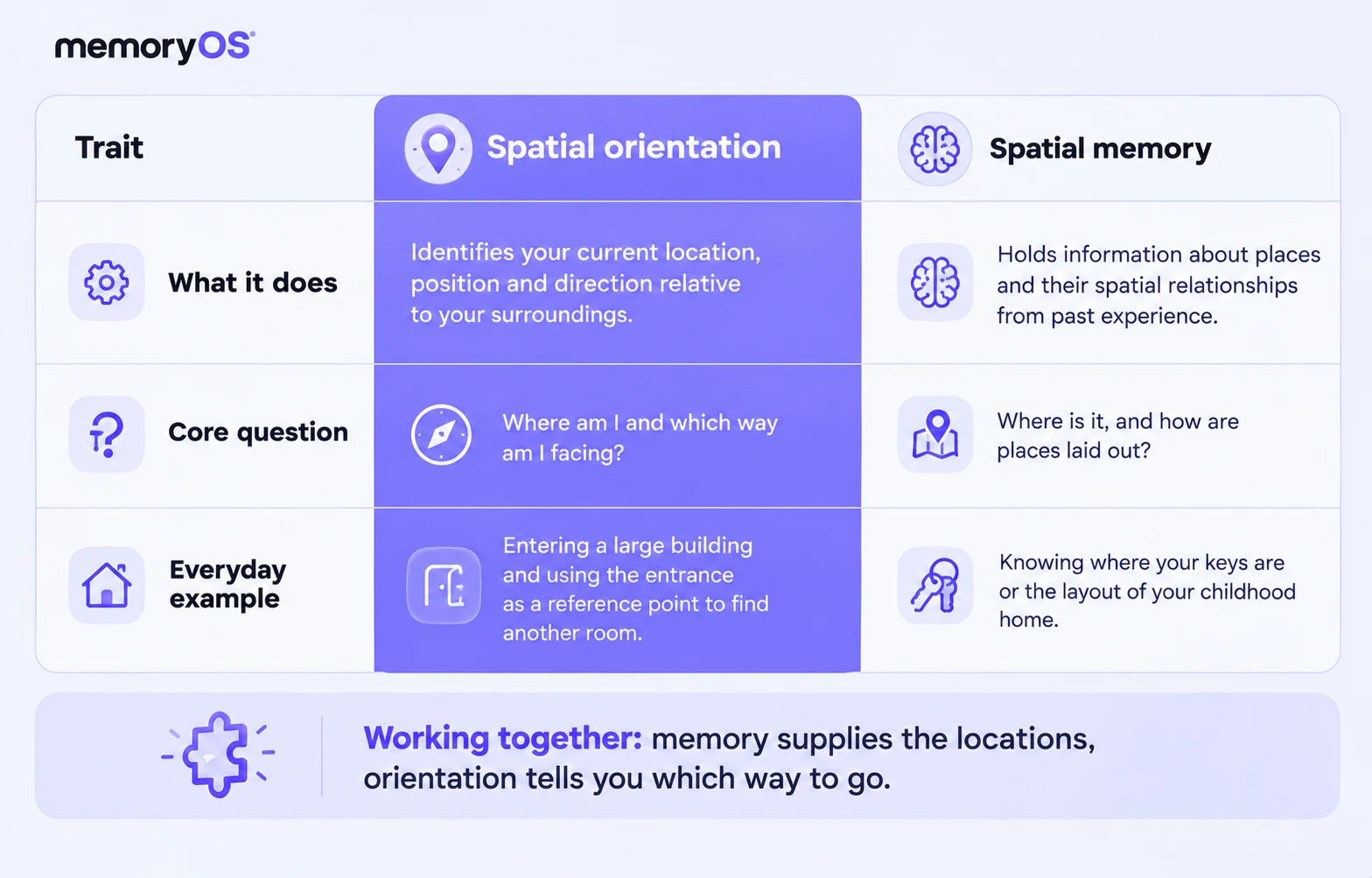
Spatial memory lets your brain hold onto information about places and their spatial relationships. It means that you can store information about where your keys are, the structure of your childhood home, or where some landmark stands in relation to a well-known path. Spatial orientation, on the other hand, focuses on processing information that helps you understand your current location, orientation, or motion.
Both of these processes usually go hand in hand; for example, if you know that there is a café behind you and a station to the left of you, then your memory may provide the relevant locations, whereas orientation will help you determine which direction to take.
If you want to learn more about the role of the hippocampus in spatial memory formation, read how the hippocampus supports spatial memories.
What Is Spatial Orientation in Psychology?
What is spatial orientation in psychology? In psychological studies, it is considered to be a part of the cognitive processes that enable individuals to represent and manipulate their spatial environment. An interesting aspect of this process is that the brain does not depend on just one source of information.
Both external cues, such as landmarks and environmental constraints, and internal cues related to motion and body location can be used. If you walk through space, visual information together with the vestibular system can be used to update your spatial orientation.
This makes spatial orientation easier in case of a familiar environment due to having more information points available. It will take more effort in a novel environment, as your brain has to get familiar with turns, landmarks, and distances.
What Does Spatially Oriented Mean?
Someone who is spatially oriented has the capacity to monitor their spatial position within an environment and use this information to guide their movements. What is remarkable about this is that this process can happen even without forming a complete mental map.
As an illustration, think of walking in an unfamiliar hotel. You take several turns after which you realize that you are oriented the wrong way around. Although it might be difficult for you to recall your complete path, you can still stop, assess the hallway around you, and determine the directions to turn. This example demonstrates how it is possible to use the information around you to orient yourself without memorizing the whole path.
It also explains why orientation is useful outside navigation. For example, grabbing an object from an area where your eyes cannot see, estimating whether your suitcase can pass through an entryway, or changing the direction of your body when getting into a chair.
How Spatial Orientation Works in the Brain
Orientation in space involves the cooperation of many systems instead of using one special “navigation centre.” Visual perception provides information about landmarks, surfaces, distances, and movement. The inner ear’s vestibular system senses changes in the position of the head and acceleration, whereas muscle and joint input provides information about the body position.
Then the brain should integrate all these inputs very fast. For instance, if you rotate your head while walking, the visual scene changes, but the movement system also tells you that the change was due to your movements. Maintaining these channels synchronized is important to maintain stable orientation.
Working memory is also important since certain spatial information must be kept available during its use. It may happen that you realize the staircase is behind you and turn your attention to it, storing this information while walking down the hallway. The information does not have to be consciously repeated by you, but it should be kept available long enough for further actions. All of this belongs to the more general role of working memory in thinking and learning, which is particularly helpful when spatial information is changing from one moment to another.
The brain can adjust spatial information depending on the changing conditions. The route that used to be familiar may suddenly change. So proper orientation implies that it is possible to update the existing spatial image rather than rely on previous expectations.
Signs of Strong and Weak Spatial Orientation
Spatial orientation appears in daily activities such as navigating through a new building, gauging the placement of your car relative to the other cars around you, or orienting yourself in an environment that keeps changing.
Navigation and Sense of Direction
The feeling of direction is not just about not getting lost; a person might make a mistake but still get back on track easily since they realize where they are and compare their position with where they should have been going.
Those with poor navigation skills might depend excessively on familiar landmarks or a series of instructions. When one landmark becomes unavailable, they might have difficulty figuring out what to do next. However, this does not always mean that such individuals have poor memory. Navigation involves a number of skills simultaneously, such as perception, memory, spatial reasoning, and integration of information over time. Wolbers and Hegarty define navigation as a multifaceted multisensory task, which accounts for differences in navigational skills among people.
Flexibility is one of the indicators of good orientation. When your usual route becomes unavailable, can you find a reasonable alternative, or do you feel like there is no route anymore?
Sports and Driving
It is even more apparent when there is less time for thinking. In sport, you may need to take into account your teammates, the opponents, the ball, and yourself simultaneously. A basketball player, for example, needs to predict the movement of another player in a second or two.
In driving, too, you always keep an eye on your location in relation to the lane, the movements of other cars, and the movements of surrounding objects. The information is coming all the time, so there is little benefit in building a detailed mental picture and then stopping to analyse it.
That is why performance in everyday situations can give you some insight into your spatial abilities. Orientation is also about the speed of updating your perception of a situation as it develops.
How to Train Spatial Orientation
The useful question is not whether you were born with a good sense of direction. The key question lies in what you can practice. Spatial awareness training can be effective if it involves active decision-making about position, direction, and routes, rather than simple recognition of it.
The following spatial orientation exercises do not require specialised apps and can be used in daily situations.
Mental Rotation Tasks
This exercise is great for practicing your ability to manipulate objects in your mind. The classic work of Shepard and Metzler showed that people take longer to decide whether two three-dimensional objects are the same when the angular difference between them is greater. The study offered one of the earliest classic demonstrations of mental rotation.
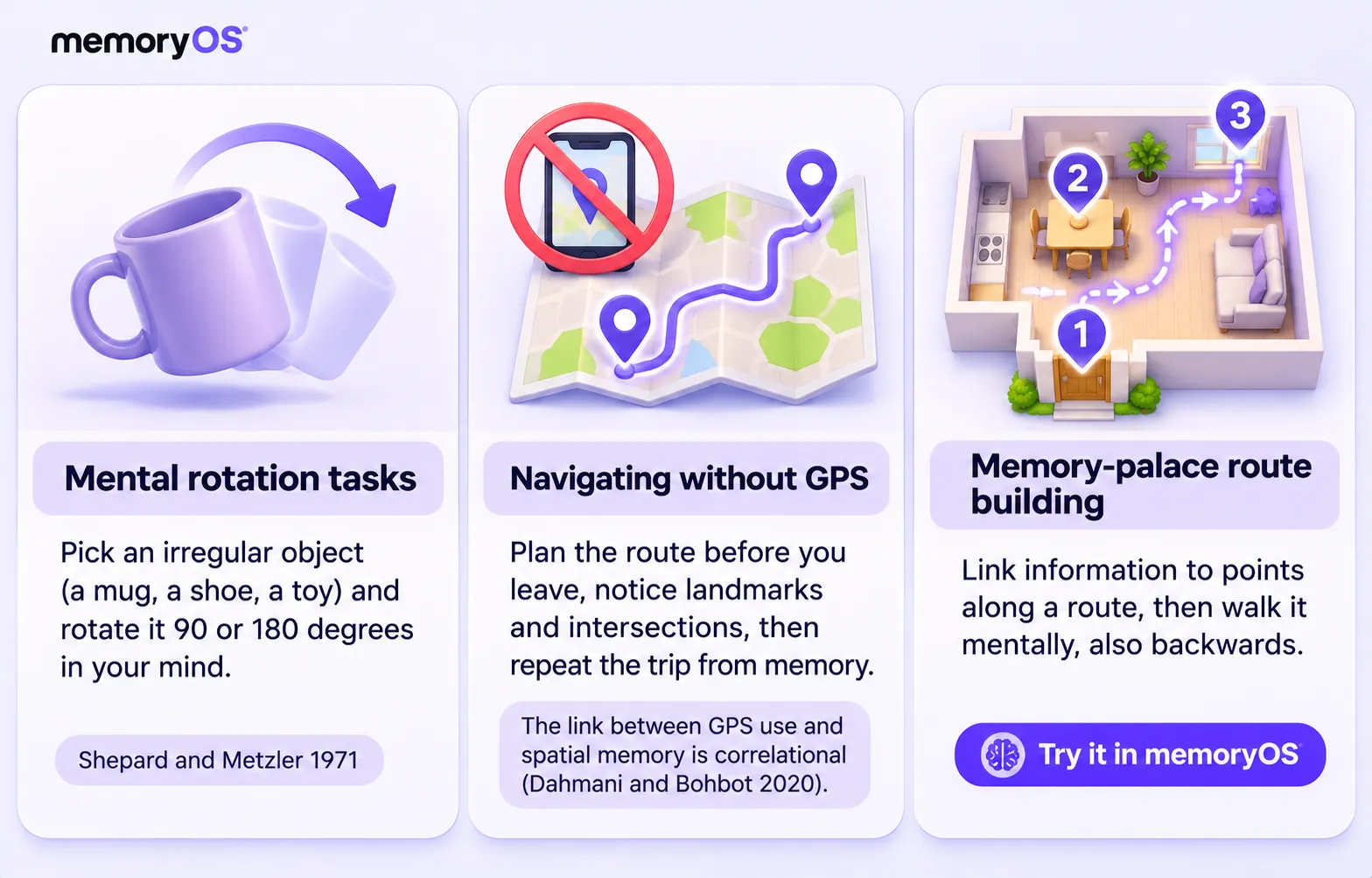
To conduct an easy mental rotation exercise, you need to find some object with an irregular form, for example, a mug, a shoe, or a toy. Spend a couple of minutes looking at it and then try to rotate this image 90 or 180 degrees in your mind. Try to guess how a certain side or any other element would look from this position.
The idea is not to master the task quickly. This practice helps develop skills in manipulating spatial data in the mind; therefore, it’s one of the most direct spatial orientation exercises you can try without using an app.
Navigating Without GPS
The easiest way to practice your navigation skills is not to rely entirely on your mobile phone for your decisions. If you have an upcoming trip, choose a destination point and make a route plan before leaving. Have your phone handy in case of an emergency, but try not to use turn-by-turn directions unless absolutely necessary.
All that you should do is pay attention to the landmarks, intersections, direction of travel, and what you would use as your point of reference in case you need to take another route. Lastly, try to repeat the journey from memory.
There is a useful research reason for doing this. Dahmani and Bohbot studied 50 regular drivers and discovered that higher lifetime usage of GPS was correlated with lower spatial memory function during self-guided navigation. Even a smaller follow-up group showed a correlation between the increase in GPS usage and a decline in some tests on spatial memory. However, the research wasn’t a randomised experiment; thus, this correlation cannot prove the fact that the use of GPS directly causes this deterioration.
Memory-Palace Route Building
The use of a memory palace allows you to practice your route more deliberately. Instead of trying to memorize all the objects on the list, choose a current route and link information to various points along it, such as placing your first object by your front door, the second one at your kitchen table, the third one close to a window, and so forth.
What is important about this memory method is maintaining your current route constant. While navigating it mentally, you will use every single point as a stable cue, which is connected with specific information located there.
For a more engaging approach, you can try a virtual mind palace and learn how the technique works in a spatial environment. If you like making routes, you can make another one and visualize going backwards along that route. This is not about memorizing more places but about practicing how to build a route, remember it, and navigate through it.
If you want to improve overall cognitive function, you can also test your sequence memory independently to measure how well you can remember and repeat the sequence, or experiment with memory games to practice different cognitive skills.
Ready to explore this approach further? Get Early Access to memoryOS and its upcoming tools.
FAQ
What is spatial orientation?
Spatial orientation refers to the capacity to be aware of your position and direction relative to the space. It helps you move through environments, judge distances, and change your position during movement.
Is spatial orientation the same as spatial memory?
No. Spatial memory helps you retain information about locations and their relations, whereas spatial orientation helps you determine where you are and how to navigate your environment.
Can spatial orientation be improved?
Yes. Spatial skills can be honed through activities that involve judging directions, rotating objects in your mind, navigating without step-by-step instructions, and working with spatial configurations. The more you do this, the easier it becomes.
How to improve spatial orientation?
Engage in real-life tasks instead of depending only on apps. Try activities that require you to actively process spatial information.
What are spatial orientation exercises?
Some examples of spatial orientation exercises include mental rotation, route planning, navigation without using GPS, and memory palace route building.
Is spatial orientation the same as sense of direction?
These two concepts are related but not always identical. Sense of direction normally means one’s capability to navigate, while spatial orientation means the ability to understand one’s position and recognize movement in terms of direction.
Want to practise these skills in a more structured way? Explore memoryOS and see how its memory training approach can turn spatial and memory challenges into regular practice.