
The Zeigarnik Effect: Why Unfinished Tasks Linger and How to Master Productivity
Table of Contents
Have you ever noticed that unfinished tasks tend to stick in your mind longer than finished ones? This is no coincidence, but rather a well-known psychological phenomenon called the Zeigarnik effect. This effect, first discovered by psychologist Bluma Zeigarnik in the 1920s, shows that interrupted or unfinished tasks create cognitive tension, making them more memorable than finished tasks.
In Zeigarnik’s famous study, participants were asked to perform a set of simple tasks. The surprising finding was that when these tasks were left unfinished, participants remembered them much more accurately than the ones they had finished.
From a neuroscientific perspective, this phenomenon is explained by the way our brains keep track of goal-directed attention: unfinished tasks cause increased activity in the brain, keeping the task in mind until it is completed.
This phenomenon is not merely of academic interest but can be used to your advantage to boost your focus and productivity. By combining the Zeigarnik effect with memory techniques or memory games, you can use unfinished tasks to supercharge your memory and productivity.
What is the Zeigarnik Effect?
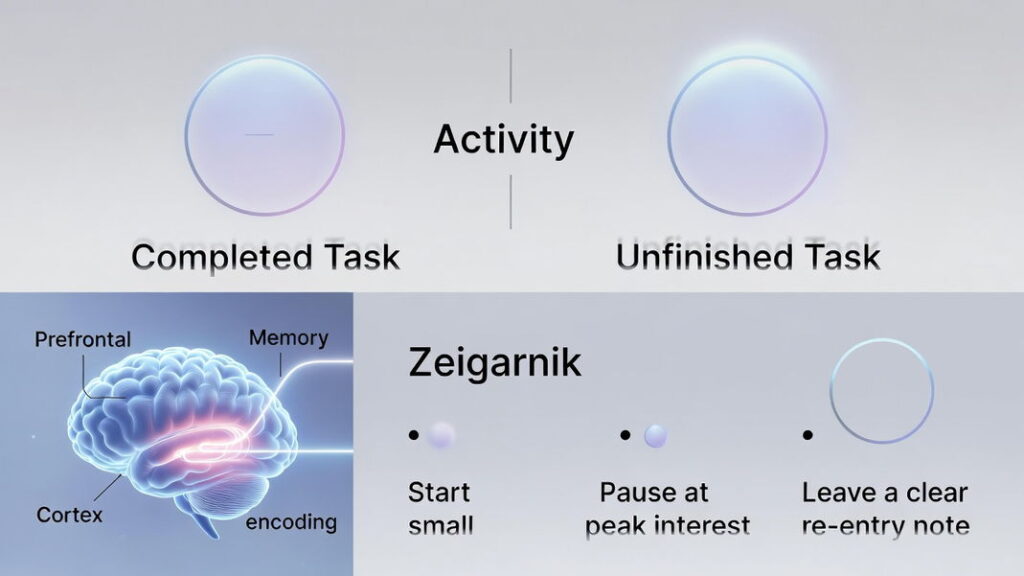
The Zeigarnik effect reflects how the brain retains interrupted tasks more effectively in memory than completed ones. This means that if a task is left unfinished, the brain keeps it at the forefront of its memory, making it more likely to resurface even when the brain is trying to concentrate on something else.
This cognitive effect has been proven in a series of psychological studies. In one such study, adults revealed that they were able to recall interrupted tasks close to 90 percent, while completed ones were recalled by only 30 percent.
This phenomenon can be used for strategic purposes. By designing our work in such a way that things are “started but not fully closed,” we can tap into a natural cognitive impulse to come back to them later. This is related to how to memorize things fast and improve learning efficiency.
This effect of memory bias helps explain why interruptions can be problematic for our focus, but can also be used to improve concentration, reduce procrastination, and improve recall in structured learning and productivity systems.
Bluma Zeigarnik’s Scientific Breakthrough
In response to the question, “What is the Zeigarnik effect?”, let’s travel back in time to the experimental psychology of the 1920s. A young Lithuanian psychologist named Bluma Zeigarnik observed an interesting phenomenon in everyday life. Waiters were able to recall all the orders they needed to complete to perfection, but once the customers had paid and the job was done, they forgot the details almost instantly.
Zeigarnik was intrigued by this phenomenon and conducted one of the first experiments in psychology related to interruption and recall. Test participants were presented with a series of puzzles, math problems, and simple tasks. Half of them were interrupted before completing. Later, when asked to recall all the tasks they had been working on, they were twice as likely to remember the ones they had not finished as the ones they had completed.
This finding underscored the fact that cognitive tension is what keeps uncompleted tasks in our minds until they are resolved. As organizational psychologist Adam M. Grant explains:
“Once a task is finished, we stop thinking about it. But when it is interrupted and left undone, it stays active in our minds.”
The findings of Zeigarnik’s research, published in her 1927 paper “On Finished and Unfinished Tasks,” explained why uncompleted goals and unfinished tasks are so prominent in our minds. Thus, such phenomena are at work in a variety of real-life situations, ranging from to-do lists to memory loss test situations.
The Mental Itch: What Unfinished Tasks Do to Your Memory
Do you ever feel as if you have a mental itch to return to an unfinished task, even if you are engaged in a different activity? This is because your brain has a natural desire to complete what it has started. This condition is known as cognitive tension, a type of mental energy that continues until the task is completed. Unfinished tasks create what is known as open loops in the brain.
Open loops are much more than an interesting effect of human cognition; they are a fundamental process of goal prioritization. Neuroscience research has discovered that when a task is not finished, the prefrontal cortex remains active in relation to that task.
This activity is not just significant for our recall but also functions as a motivator to return to the task and finish what was started. It is an interesting phenomenon that increases awareness of even the smallest aspects of the task that were not completed.
The presence of open loops also explains why people tend to have flashes of insight or problem-solving solutions for pending tasks at unexpected times, such as during a walk, a shower, or a commute.
This mental itch also has a fine line. When open loops are accumulated, they can cause stress, distractibility, and mental fatigue. On the other hand, the effective application of cognitive tension can help people organize their work to maximize their focus.
By breaking down big projects into intentional pieces and leaving tiny unfinished tasks, people can harness the motivational power of open loops without overwhelming their minds.
Practically speaking, an understanding of the Zeigarnik effect allows students and professionals to leverage the natural mental tension in their favor. By acknowledging the brain’s need for closure, it becomes possible to leverage open tasks as a means of fostering sustained attention, better recall, and increased efficiency.
The Productivity Paradox: Focus and Procrastination
Open tasks are a subtle cognitive itch that competes for attention. When multiple tasks remain open, the mind is left divided, resulting in an increase in workload and stress associated with it.
However, the same force of the mind can also be harnessed as fuel. Productive pressure is the focus of attention on what still needs to be accomplished, and this tug towards the task is natural. When work is considered to be a series of important steps, this tug becomes an incentive rather than a barrier.
This paradox is what causes some people to procrastinate under pressure while others speed up. Procrastination usually happens when there is a lack of clarity about what needs to be done, and motivation occurs when the next step is clear and possible.
The functional lever is the design of tasks. Breaking down big goals into sharp, clear, and well-crafted actions is a stress-reducing technique that maintains motivational tension.
“Re-entry points” are short reminders of what to do next, which reduce the resistance of picking up where one left off and maintain mental momentum in the right direction. In this context, the Zeigarnik effect is leveraged as a tool for productivity.
How to Apply the Zeigarnik Effect in Everyday Life
The key to building momentum from incomplete tasks is a simple process. Instead of fighting the brain’s need to keep incomplete goals in mind, the process can be harnessed to work in harmony with it.
This strategy allows the brain to view incomplete work as a signal to focus, rather than a source of stress.
Step 1: Begin the task (the hardest part).
The main issue with most productivity plans is that they do not succeed at the beginning. The brain dislikes ambiguity, and the most effective way to get around this is to begin with a small step and act on it, such as opening the file, writing the first sentence, or making a rough sketch.
This will help decrease psychological resistance and give the brain a “hook” to pull it back to the task.
Step 2: Take deliberate breaks at points of high interest.
Taking a break before the point of energy drop, when interest is still high, is often more productive. This helps maintain the flow of creativity.
Step 3: Employ open loops to keep the momentum.
Leaving a specific note before taking a break ensures that the focus remains on track. This ensures that a controlled open loop is created and pulls the focus back to the task without cluttering the mind. Over time, these open loops ensure that a light infrastructure is created for complex tasks, and they are finished even after a long break.
Taken together, these steps provide a useful framework for how to use the Zeigarnik effect without inducing feelings of overwhelm. The technique is consistent with the natural processes of memory, attention, and motivation.
By controlling when tasks are begun, when breaks are taken, and when work is left outstanding, cognitive tension is converted from a source of anxiety into a reliable motivator.
Applying Cognitive Tension with the Method of Loci
Mnemonic techniques are greatly enhanced when they are consistent with the natural processes of the brain in maintaining attention upon incomplete tasks. The Method of Loci is effective because the brain’s spatial memory is strongly linked to the brain’s navigation and scene-building systems. When information is encoded in a meaningful environment, memory is less reliant on repetition and more reliant on retrieval cues that are spatially defined.
Cognitive tension increases the potency of this process. If a memorization task is interrupted before all items have been fully consolidated, the brain remains committed to the uncompleted task.
This continued activity keeps the mental pathway open, making related stimuli re-emerge during idle periods. In other words, incompletely finished memory palaces are still actively engaged in the cognitive realm, which further enhances consolidation by repeated, effortless reactivation rather than forced rehearsal.
From a biological perspective, this process involves the interaction of the hippocampus and prefrontal cortex. The hippocampus is responsible for the encoding of spatial information, while the prefrontal cortex is responsible for goal relevance.
Pausing the encoding process in the middle of a sequence keeps these two processes actively interacting with the uncompleted structure, which further strengthens the association between locations and the information they contain. This is why it is often the case that uncompleted memorization tasks result in spontaneous recall of particular locations and images hours later.
When used intentionally, the Zeigarnik effect can be used to more effectively anchor information in a memory palace. To close a learning session at a significant structural point, such as the midpoint of a known path, is to maintain continuity without breaking the memory map into disjointed pieces. This creates a memory trace that is sustained without becoming noisy in the mind.
The use of digital space can further stabilize this process by providing an external structure. Apps such as memoryOS offer sustained, navigable locations that reflect the way in which the brain is wired to represent scenes and paths.
This allows the learner to restart where they left off with ease, while maintaining the cognitive tension that facilitates recall. In time, the use of structured locations and strategic pauses can turn the process of memorization from a rote repetition into a self-reinforcing system. With memoryOS, anyone has access to resources that help increase cognitive power.
FAQ
Is the Zeigarnik effect related to the Ovsiankina effect?
Yes, both the Zeigarnik effect and the Ovsiankina effect are related to the same tension, but they focus on different aspects of it. The Zeigarnik effect can be seen as the answer to why people tend to remember unfinished tasks, while the Ovsiankina effect is the answer to why people have a strong impulse to return and complete them.
How does the Zeigarnik effect impact sleep?
Open tasks can be actively engaged in the cognitive system before sleep, making it difficult for the brain to enter a sleep state. Organizing work by establishing stopping points and next actions helps avoid rumination during sleep by providing cognitive closure without abandoning tasks.
Can you turn off the Zeigarnik effect for better relaxation?
The Zeigarnik effect cannot be turned off completely because it represents a basic process of goal management in the brain. However, writing down open tasks and establishing the next step helps release tension in the nervous system without abandoning tasks.