Best Free Language Learning Apps Ranked by Polyglots
Table of Contents
Learning languages has never been easier, thanks to the wide range of free language learning apps available today. Most of these platforms help memorize words and understand the basic structure of languages. However, language learning experts always stress one critical aspect that must be considered when learning a new language—structured cognitive systems that transform short-term understanding into long-term fluency.
According to neuroscience studies, rote repetition of any sound will fail to form a long-lasting connection in your brain. On the contrary, your brain requires recalling information for it to have a chance of becoming a part of long-term memory.
The effects of this procedure go beyond language. By enhancing the neurological connections for language, the mind also strengthens working memory, attention regulation, and even critical thinking skills. When the mind becomes adept at processing the complex grammatical systems of languages and deciphering unknown sentences, it also gets better at identifying patterns and problem-solving in completely unrelated contexts. It is partly because of this that polyglots tend to have greater cognitive flexibility.
Nevertheless, many of these polyglot language apps do not consider the brain’s ideal method for processing and recalling information. Consequently, students may learn quickly yet have difficulty retaining what they learned over time. Polyglots offer insight into language learning by demonstrating how they match language learning tools to their cognitive abilities.
Why Most Free Language Apps Don’t Work Long-Term
While free applications ensure access, access does not necessarily imply lasting retention of knowledge. Learners usually start enthusiastically; however, with time, they experience a moment where progress stagnates, and what was once known becomes forgotten. The problem shows a structural deficiency of many free language learning apps, which emphasize usage above all else.
Gamification vs Real Learning
Gamification implies adding motivational elements such as scores, progress bars, and achievements to encourage the learner. Although the level of motivation increases significantly, the actual depth of thinking may be insufficient in many cases since gamification does not optimize cognitive processes.
Streak Addiction Problem
Daily streaks motivate students to learn regularly, but they change their perception of progress. Instead of wondering about how much they have memorized, learners become concerned with finishing daily tasks. This makes learning a matter of following routine rather than developing cognitive skills.
Recognition Learning Instead of Recall
Most software utilizes methods based on recognizing things rather than recalling. Multiple-choice and matching tests might be easier, but they do not train the brain to use specific neural pathways for recall. They only allow the brain to recognize things through pattern recognition without committing them to memory.
Vocabulary Decay After Short Retention Cycles
Lack of proper review techniques causes newly acquired vocabulary words to quickly disappear from one’s brain. This problem can easily be seen in mobile applications that focus too much on vocabulary exposure. The vocabulary might seem to be remembered while using the software; however, once outside its realm, learners forget most of the new words. Thus, vocabulary retention systems have to be more than just repetition, but a structured way to encode words for further use.
What Polyglots Actually Do Differently
Professional language speakers have a completely different approach to vocabulary acquisition. Unlike novices, polyglots are able to design efficient systems, which work according to how memory and exposure work together in the brain.
Polyglots Are Not Dependent on Just One Tool
Polyglots do not rely on a singular app but rather use several apps, each having its own purpose within the process of learning. Doing so prevents cognitive blind spots and helps avoid any limitations that slow down the process.
Input + Output
A balanced approach is needed, which incorporates listening and reading (input) and speaking and writing (output). Immersion learning apps provide input, while other methods ensure that the content is remembered through practice.
Focus on Retention Rather Than on Exposure
Learning something simply by exposing oneself to new content is not enough. The question of being able to recall that information becomes important. That is why polyglots are ready to learn languages for free, but only if they can achieve good results in recalling information in real-life scenarios.
They Create Personal Learning Stacks
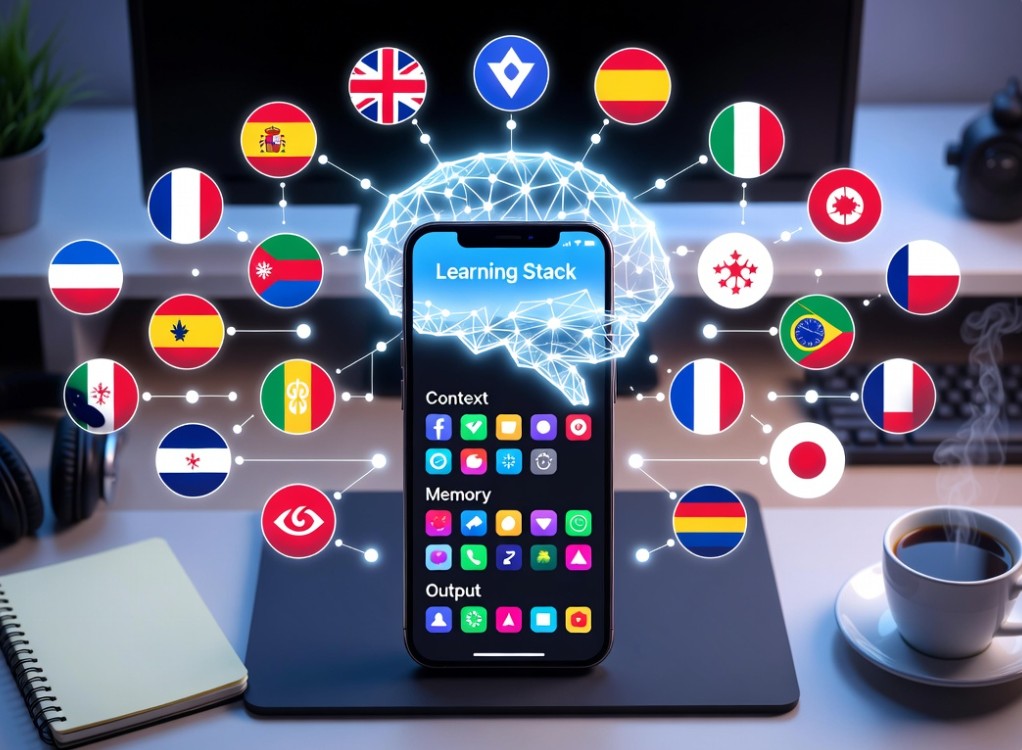
In contrast to adhering to a linear path, advanced learners design custom stacks that incorporate various techniques. This frequently involves the use of repetition techniques, contextual input sources, and practice strategies. Often, systematic flashcards become efficient as the process advances, particularly when Anki becomes necessary.
Best Free Language Learning Apps Ranked by Efficiency
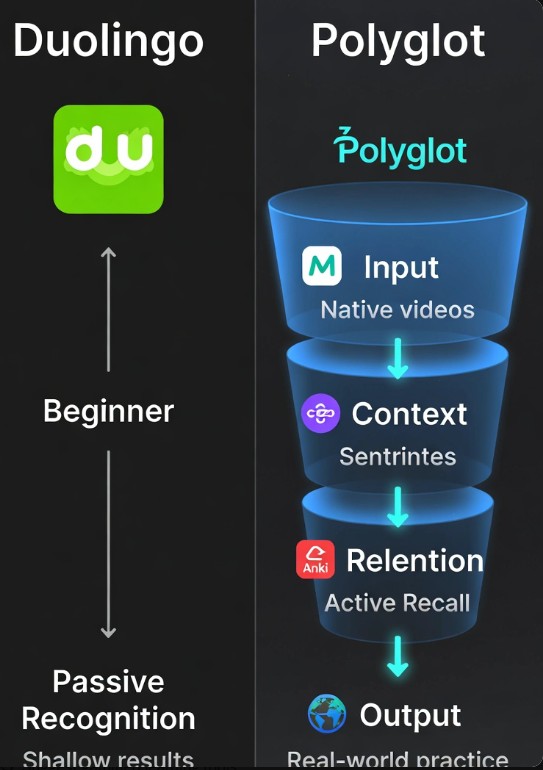
To choose the correct resources, one must be aware of both their capabilities and their effects on the brain. Here are some of the best free language learning apps, which go beyond mere interaction.
🥇 Clozemaster (Best Context-Based Learning)
Sentence structure learning is the core principle behind Clozemaster. Clozemaster allows contextual exposure and helps users identify patterns while learning new vocabulary. As such, Clozemaster is superior compared to basic flashcards.
🥈 Memrise Free Tier (Best Native Exposure)
Using videos that feature native speakers of the language, Memrise ensures that pronunciation, context, and visual information are all included. Therefore, this makes Memrise one of the best immersion applications when it comes to free learning apps. However, without any structure in place, memorizing might become an issue.
🥉 Anki (Best Free Memory Control Tool)
With its ability to create a customized schedule and manage many flashcards within the deck, Anki can help reinforce memory in ways no other application can offer. By fully controlling the interval of spaced repetitions, Anki offers the user a powerful tool in memorization. Its effectiveness explains why Anki works but still needs structure.
Duolingo (Baseline Only)
While it might not be the best in terms of memory reinforcement, Duolingo serves as an excellent platform to learn vocabulary and grammar. With a great interface and ease of use, Duolingo is ideal for absolute beginners. However, retention can still prove to be difficult without a structured platform, especially a paid progression path after the free stack.
Busuu Free Tier (Light Structured Feedback)
The hybrid nature of Busuu includes elements of limited native speaker feedback and structured lessons. Though useful, this system can only be used effectively as an add-on and not a full-blown solution.
Free vs Paid Learning Reality
Though free learning sites have revolutionized access to education in various fields, their inner logic often puts engagement before actual fluency development. The best free language learning apps rely on a reward system and daily streaks. It allows consistent training, but consistency alone is insufficient for learning, as the brain needs structure.
To address that issue, paid solutions offer a path with a clear focus. They allow progress tracking, lesson planning, and increasing difficulty levels gradually, which gives learners the necessary structure in their learning process. However, most solutions fail at the last step and only offer consistent and structured content without proper knowledge management strategies.
The problem lies not in the amount or type of content provided. The problem lies in the lack of a good retention system. Some paid and free language learning websites ignore the process by which information gets stored in one’s long-term memory storage. This is why students are able to complete their language lessons but still find it difficult to remember basic words after weeks of using the program.
The Missing Piece in Free Learning Systems (Memory Gap)
Exposure to a particular language helps a learner become familiar with it, but this does not guarantee retention. It is easy for students to believe that the more they use the language on a daily basis, the better they will become at speaking it. However, the brain automatically categorizes most of this information as temporary. This is where the gap becomes visible, even within the best free language learning apps.
Nevertheless, mere repetition will not suffice. Repetition without any structure is not effective, as it can lead to recognition rather than recall. For this reason, to memorize new words, one needs to use a method of active recall and attempt to reconstruct the learned piece of information rather than recognize it; otherwise, there is a danger of forgetting everything despite the constant usage.
This means that a well-known pattern happens. Words learned during a single study session may be easily remembered at first, but quickly forgotten if there are no regular repetitions. In such a way, people continue learning old information again and again, but cannot learn anything new.
The matter of the problem is structural. Namely, most often, students do not create a certain structure and connection between pieces of knowledge. This leads to the situation when the brain does not receive structured information but just separate pieces of it. Lack of structure for further recall renders all efforts useless regardless of advanced technologies.
How Serious Learners Actually Combine Free Tools
Fluency in a foreign language is not usually acquired through a single software program. Efficient language students know how to integrate various applications into a system that works together to form an overall framework.
A good setup for learning typically starts with the use of context in language exposure. Clozemaster provides learners with vocabulary words in sentences to help them discover patterns. This is followed up with programs such as Memrise, which incorporate pronunciation and natural speech rhythms through the native speaker’s voice.
Active recall is the focus of the third level. Spaced repetition language learning systems make sure that vocabulary is recalled right when the user starts to forget it. In doing so, they turn passive input into solid knowledge. Anki is usually the one that does this, providing a high degree of customization and precision.
The final stage is output. The necessity of speaking makes the user retrieve information, making memory connections stronger and revealing gaps that passive learning cannot expose. Output is crucial as it turns stored knowledge into real language skills.
The main point here is that tools become efficient only when they function as part of a larger system. Even if the best apps to learn languages without paying are very good, their efficiency will be achieved only in combination with other elements of the learning process.
From Learning Apps to Memory Systems (Optional Upgrade Layer)
In time, as the learner advances, another issue arises – scalability. The handling of hundreds and eventually thousands of words becomes progressively less efficient using linear models. Here, certain individuals may start looking into memory structures that go beyond flashcard-like learning modules.
These types of structures organize vocabulary based on meanings, contexts, and relationships, as opposed to sequencing. In effect, this means that the learner does not need to remember individual words but instead needs to move around a web of related ideas, thus making the task more effective.
One of the most notable advantages of such a framework is that it works alongside forgetting curves. Through classification into groups, such frameworks generate several paths for information retrieval, making the learning process more resilient against forgetting.
Conclusion
Fluency never comes from one revolutionary invention alone. It comes from a change in viewpoint—from passive use to active management of storage and retrieval. Free services are useful as a way of getting started and reducing the barrier to entry, introducing key concepts that open up greater possibilities.
The hallmark of the most successful students isn’t time spent; it’s the system behind the time spent. Exposure is important, but without the ability to recall that exposure, it has little value. Repetition can be highly effective, but only if it’s done in an organized manner.
The real benefit is knowing that learning a language isn’t just about learning new words; it’s also about training your brain to remember, connect, and use them. Once you understand this idea, you can choose your tools more carefully. Instead of looking for the best app, students start to make systems that show how memory really works. This is why evaluation of learning tools vs real cognition systems is vital.
In this case, free resources are no longer obstacles; they are building blocks. When put together in a smart way, they make a base that can grow from basic understanding to long-term fluency, turning chaotic learning into a clear and lasting cognitive process.