How Long Is an IQ Test? What Cognitive Tests Actually Measure
Table of Contents
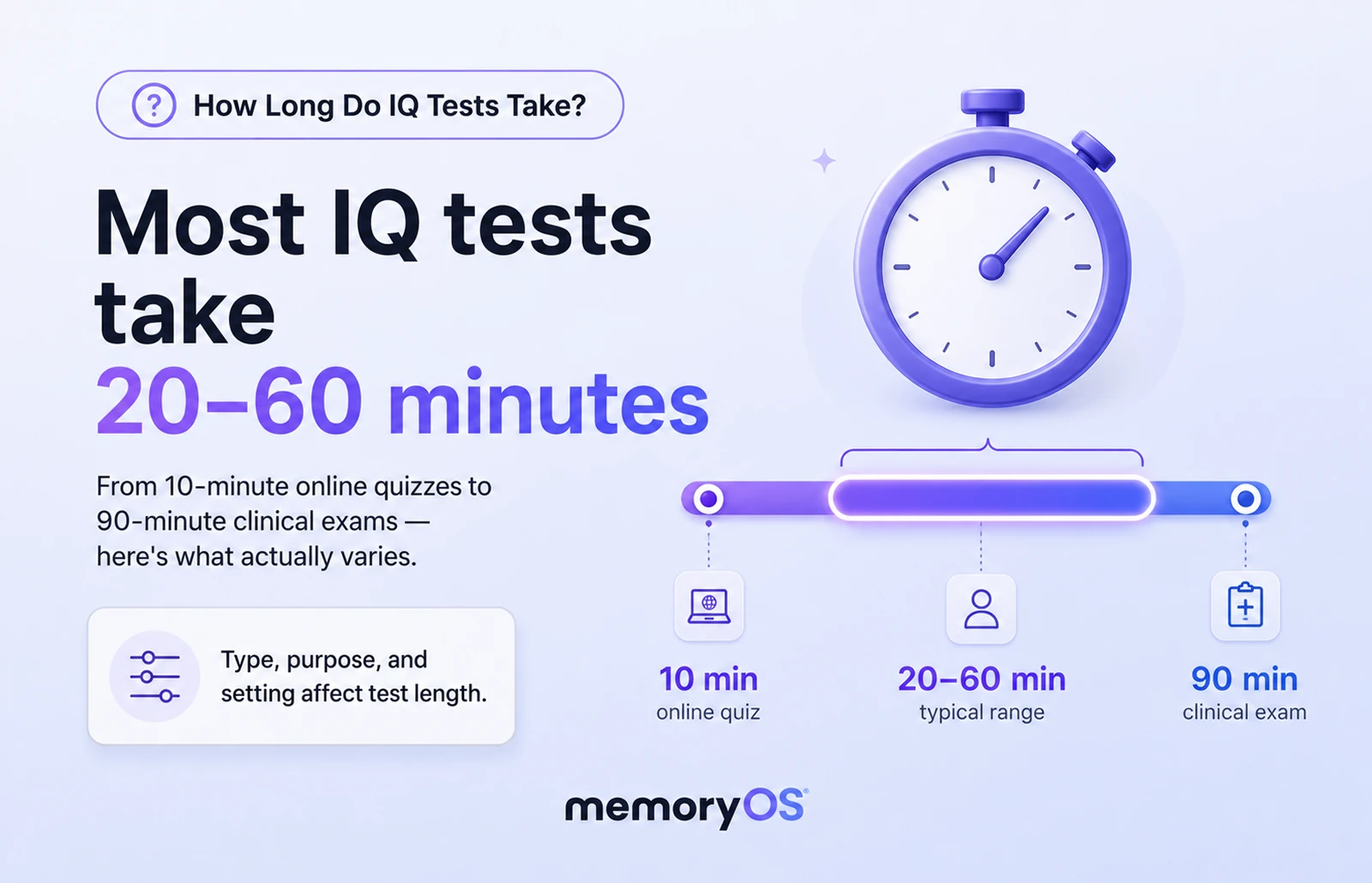
How long is an IQ test? Most tests take 20 to 60 minutes. Shorter versions online might take only 10 or 15 minutes, while full-scale cognitive assessment can take up to an hour.
Shorter tests will probably require you to solve several pattern recognition and reasoning questions to provide quick estimates. A longer test will include several aspects of cognitive abilities to check, with different time limits or procedures for each.
This is why IQ test duration doesn’t say much on its own. Some questions in IQ tests are timed because processing speed is important; other tasks allow more time because speed isn’t a priority.
Therefore, the difference between IQ tests shouldn’t be viewed in terms of how much time they take but in terms of what they measure.
How Much Time Does an IQ Test Usually Take?
The 20–60-minute range for an IQ test is common but not standardized, because not every evaluation is designed to assess the same things. A short IQ test can cover a small number of questions to evaluate reasoning quickly. Once the test starts covering cognitive abilities beyond reasoning, there are simply more tasks to complete.
Suppose we have a short test that is 20 minutes long, and it mostly contains questions related to patterns and reasoning. In such a case, there may be enough time to answer all the questions in the test. However, a more complex version of a cognitive test may require assessing verbal reasoning, working memory, and speed of processing separately. This means that the number of questions is determined not only by the test duration but also by the number of cognitive skills being assessed. That is one reason why there is no standard answer to how many questions an IQ test should have.
Your test-taking method adds yet another variable. An online test can show the next question once you have completed the previous one. From a professional standpoint, some time goes into task explanation, giving practice items, recording responses, and adhering to administration guidelines for each subtest.
This is especially true when comparing two scores. A 15-minute online score can provide you with valuable information regarding your performance on this particular set of questions. However, this does not mean that the same score is comparable to a professional cognitive assessment score.
Online IQ scores add another source of confusion. Searching for who has the highest IQ, you can find long lists of seemingly amazing numbers. However, these numbers may come from different assessments, scoring systems, or even historical calculations. When it is not clear how these numbers were derived, comparisons become inaccurate. This is especially important when comparing IQ tests, because test time is just one factor in an assessment. Test tasks and scoring may also vary.
From Quick Online Tests to Full Clinical Assessments
Once you look at the actual testing formats, the time difference becomes evident.
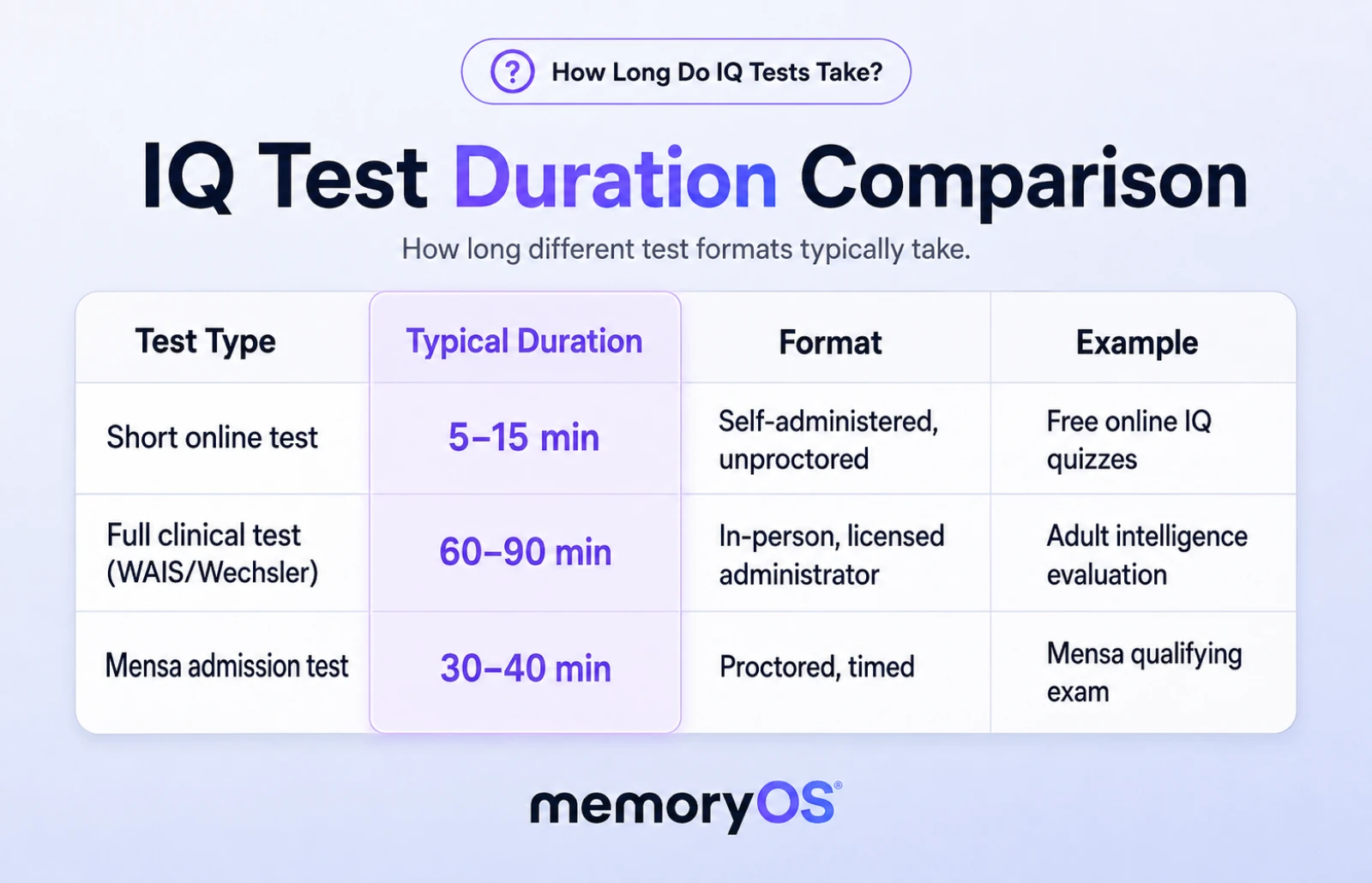
An online IQ test, meant to provide a quick evaluation of a person’s cognitive performance, typically includes an assessment with a limited number of tasks and a single final score. For example, the online Mensa IQ Challenge gives you 25 minutes to solve 35 puzzles, while Mensa itself classifies this as a practice challenge rather than an admission test.
However, clinical assessments take a different approach. The Wechsler Adult Intelligence Scale (WAIS) is administered individually and offers a much wider perspective on intelligence. The latest WAIS-5 will take 45 minutes if the clinician chooses to calculate the Full Scale IQ through seven subtests, or about 60 minutes if the entire 10 index subtests are administered. In other words, Wechsler IQ test length depends on which scores the clinician needs to calculate.
Extra time has its purpose. The test will cover areas such as working memory, fluid reasoning, and processing speed, rather than doing a single general reasoning test, scoring it, and leaving the tester with no further information on the individual’s strengths and weaknesses.
As for Mensa, not all tests are the same. While admission tests must be conducted under supervision and comply with Mensa’s standards, different national bodies will adopt varied methods.
For instance, Mensa Singapore has a timed 40-minute MSAT. On the other hand, the American Mensa standard admission session will consist of two timed tests with an interval, taking around two hours in total. So, the official Mensa IQ test and how long it takes depends on which Mensa test you are talking about.
Why Do Some IQ Tests Take Longer Than Others?
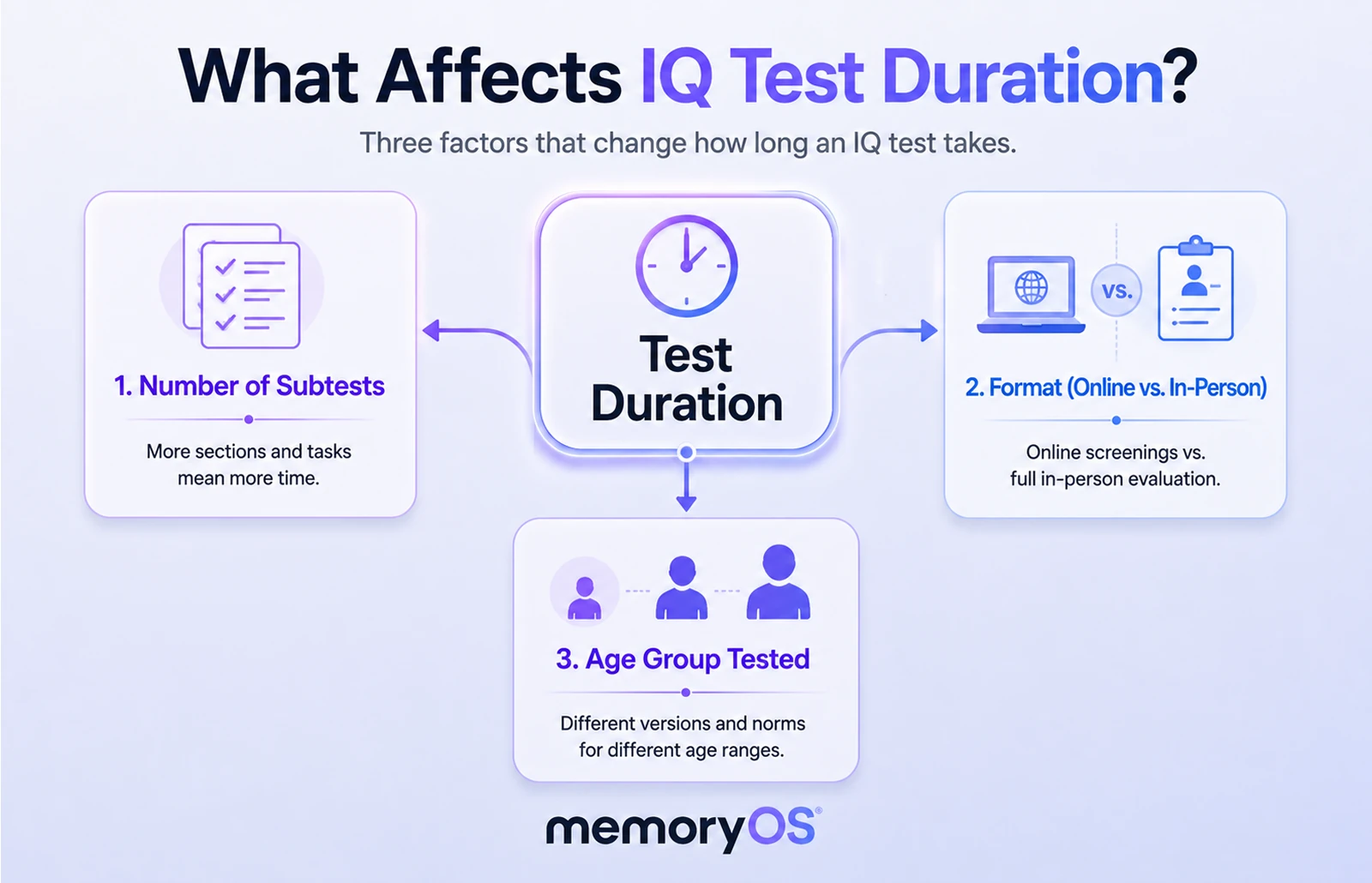
There is no global stopwatch for an IQ test. Several factors can influence how long it takes.
Number of subtests
It is quite clear why the number of subtests is important. The short test includes one type of reasoning or pattern recognition task to calculate an overall score. In the case of a more thorough test, cognition is divided into several fields, so obviously there is much more to go through.
This becomes evident through the example of WAIS-5, as such tests estimate a person’s level of functioning in verbal comprehension, visual-spatial skills, fluid reasoning, working memory, and processing speed.
There is also one other reason why the number of questions may be a misleading measure. A single demanding task may take more time to administer than several simple questions. The examiner may need to explain the instructions, record the response, or follow specific rules.
Online vs. in-person testing
The setting is important too.
An online test automates many parts of the procedure. Instructions appear on the screen, a clock starts, your answer is registered, and another question is presented. You probably will not have to pause to write down your answer or listen to what to do next.
In a clinical evaluation, these steps become integral to the test itself. Your examiner would check if you understand the instructions and adhere to certain procedures for when to start and stop.
Thus, comparing the time taken by an online test with the time taken by a clinical test can be somewhat misleading. It does not consist only of the time needed to answer more questions.
Age group and abilities
Aging also plays a role here. Each cognitive test is specifically designed for certain ages. Instructions, levels of difficulty, norms, and even the test may be different.
The WAIS-5 test, for example, is suitable for those who are between the ages of 16 and 90 years and 11 months. Younger people are assessed using age-appropriate Wechsler tests, such as the WISC-V for children.
Age can influence how quickly one finishes certain tasks. There may be different starting or stopping rules based on age, and a person’s abilities may also determine which rules apply. For example, Pearson explains that there are special start points for intellectually gifted individuals in the WAIS-5; they help save about 25% of the time needed to conduct the test.
Other factors that can change the clock
The reason for conducting the test is important. A clinician requiring a limited number of scores does not have to conduct all the tests. The more comprehensive the assessment becomes, the more tests are necessary and, consequently, the time required to complete it increases.
There are smaller things, too. There might be instructions that need further explanation. There might be people who need breaks. The examiner might need to repeat certain parts of the instructions. None of these has anything to do with the intelligence level or how well the test is conducted.
Test time and cognitive ability must also be differentiated. Does a longer test always have to be a better test? No, just like how completing a test quickly does not imply that one is smarter. Can you increase your IQ through practice and training? That question is more useful than simply asking how quickly you can answer a set of test questions.
Does a Time Limit Affect Your Score?
Time constraints can influence your score. A clock alters the context in which you work on a particular problem; however, the result is not necessarily less reliable. In some cases, the speed becomes an integral part of the exercise. In other cases, the time constraint keeps the testing conditions standardized.
With time being so limited, it becomes difficult to invest more time in an unclear task. One may have to choose between two possibilities instead of testing both. Attention should focus on the problem itself, while working memory works harder than ever before. An easy problem without time limits becomes a much more challenging one when the remaining time is visible.
The research done on time pressure reveals the impact of various factors such as attention and cognitive load on working memory during difficult tasks. It does not mean that everyone will react to time pressure in the same way, but this explains why the same problem might be viewed differently in different contexts.
The key here is the fact that one test format is not necessarily better than another. If the purpose of the test is to evaluate both processing speed and reasoning, the time factor is essential in the test itself. If the purpose is to test reasoning without emphasizing processing speed, more time may be better.
How long is an IQ test? This question also puts the issue into perspective. Time is only one of the criteria. You need to know the nature of the task that the individual needs to perform, what skills are tested, and how it is evaluated.
FAQ
What is the length of the official Mensa test?
There is no one standardized duration for all of them globally. Different Mensa organizations have different test types. American Mensa states that its entrance test takes from one to two hours. At the same time, the online Mensa IQ Challenge test that takes 25 minutes is just a practice test, and it will not grant you membership in the Mensa organization.
Is there an IQ test with unlimited time?
Yes. Some IQ tests on the Internet have no time restrictions. But the absence of time limits can alter the nature of the test. If an IQ test is designed in such a way that it evaluates both processing speed and reasoning, then the lack of time will make it impossible to compare the results.
How many questions are in a standard IQ test?
There is no fixed number. It depends on the assessment, how many subtests it contains, and whether you are taking a short online test or a full cognitive evaluation.
Test Your Memory, Not Just Your IQ
The IQ score is an indicator of how well a person does on a specific kind of cognitive task. It does not cover all aspects of how your mind processes information. One such aspect is memory, which is quite unique since you can practice it and then measure your improvement.
If you want to test how much information you can hold in mind, try a number memory test offered by memoryOS. Start with a sequence of digits and see how far you get before the numbers become difficult to hold in the correct order. You can also explore other memory games that focus on visual memory, working memory, and pattern recall.
This makes the exercise a lot different from an IQ test because you can test a particular memory skill. With memory tests, you can keep track of where you begin and then come back to check whether you’ve improved.
Contributors