Best AI Study Tools for Students: Top Picks
Table of Contents
There is no single AI study tool that does everything well. If you need the best general-purpose option, ChatGPT remains the starting point thanks to its flexibility, efficiency, and ability to explain virtually any topic.
Still, the best AI study tools can be considered as tools that are designed not to replace each other but to work in harmony. Some apps can help you understand complicated things, some apps will help with research organization, and some are focused on memorization.
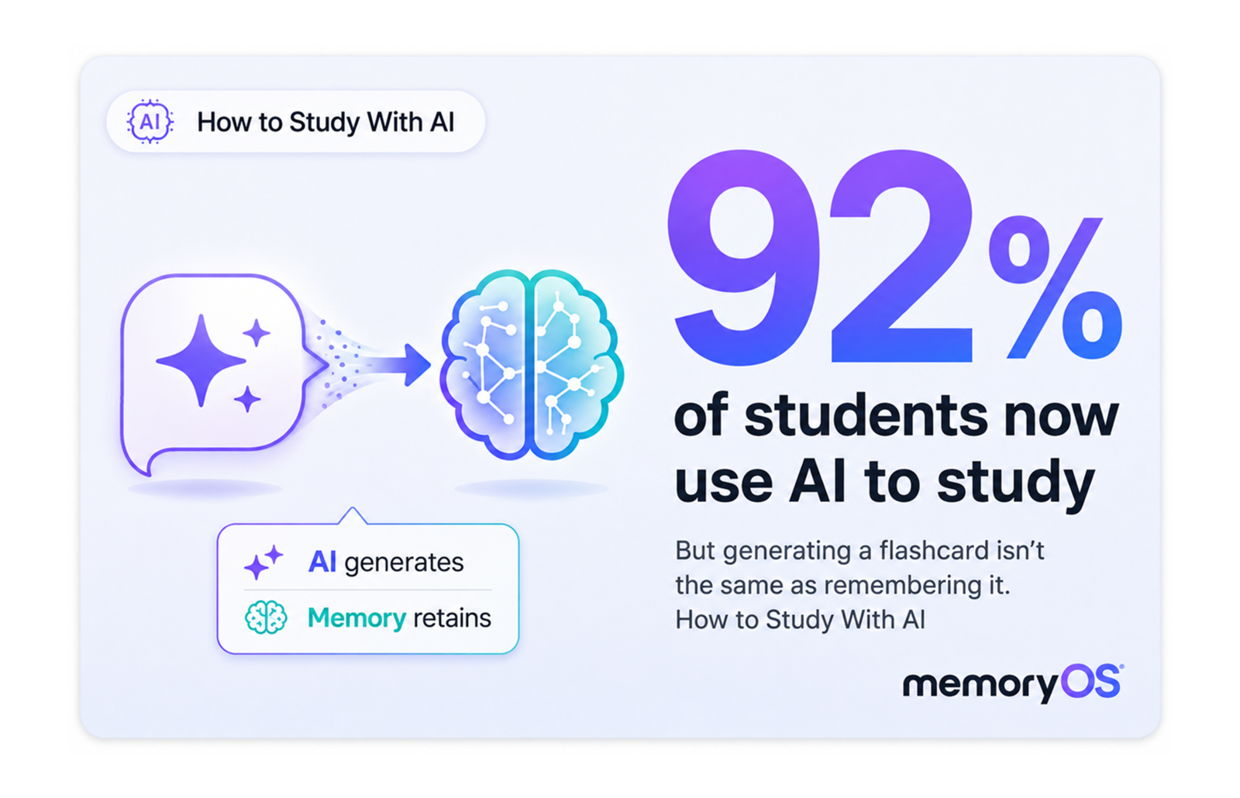
AI technology is already an integral part of the daily education process. According to recent studies, about 92% of students currently use generative AI, whereas 57% of U.S. university students use AI at least once per week when completing assignments. With so many applications to choose from, the choice itself becomes crucial.
This guide evaluates the top platforms based on the following criteria, which are significant from the standpoint of practical education: they should stimulate active recalling rather than passive reading; provide for spaced repetitions; be compatible with your personal notes and lectures; create useful tests; and have a free version available for students to use.
Considering these aspects, it is possible to choose the best platform for getting great learning results.
For finding the best AI tools for college students to prepare for high school tests or do university assignments, it is important to know the strong and weak points of each platform and the ways you can construct your study routine.
How We Evaluated These Tools
The most effective study aids not only provide information but also aid in retaining it. Thus, all recommendations listed in the guide below are assessed using five pragmatic criteria that affect learning rather than short-term memorization.
First, an effective study tool promotes active recall through quizzes or flashcards rather than just creating summaries of a subject matter.
Second, it provides spaced repetition, as revisiting material over time consistently outperforms cramming. Research, including a meta-analysis of classroom-based studies involving more than 3,000 participants, suggests that spaced learning resulted in a significant increase in learning efficiency.
Third, an efficient learning tool should utilize one’s own lecture notes, PDF files, slides, and textbooks instead of just using general web-based knowledge.
Fourth, the tool should create practice questions or even tests that would reflect how the student is going to be tested.
Last but not least, a user-friendly free version of a product is important, as students often need to test their learning aids before purchasing.
Research consistently shows that active learning is more effective than passive reading. A 2025 Harvard randomized controlled trial extended this evidence by demonstrating that an AI tutor built around active-learning principles produced significantly greater learning gains than an in-class active-learning lesson. Together, these findings suggest that the way AI is used matters: students learn more when AI encourages them to actively retrieve, apply, and explain information rather than passively consume it.
The above point is essential since data summarizing does not equate to learning. Even though summarizing information might appear productive, recognition is a completely different process compared to retrieval.
While most AI technologies excel in organizing and explaining information, relatively few technologies exist that aim to test what the user knows over time. Thus, apps that make you smarter can be a great addition to learning. They can boost various cognitive functions, which will help you manage the information encoding processes better.
8 Best AI Study Tools for Students
There isn’t a single application that can help in all the stages of the learning process. One application can be good at explaining complicated concepts, while another app can be more suitable for note-taking or creating practice quizzes.
In most cases, students should use two or three different applications that complement each other rather than try to find some one-size-fits-all tool. Here is a list of the best AI study tools. Each of them performs a certain function in the learning process.
ChatGPT – Best All-Purpose Explainer
When it comes to quick comprehension of a new subject matter, ChatGPT is hard to beat. This chatbot can explain complicated concepts in a clear manner, compare theories, simplify textbook sections, or solve even tough homework problems 24/7.
No wonder that many students start with ChatGPT for studying and then proceed to more specific tools. The free version will suffice for daily studying needs, but those who want to access more powerful models may consider a ChatGPT Plus subscription that costs $20/month. Read more about features on the ChatGPT product page.
NotebookLM – Best for Source-Grounded Research
When accuracy is considered more important than speed, the NotebookLM for students tool will be among the best ones available. This is because the program uses only uploaded materials as sources instead of creating answers on the basis of general knowledge. More importantly, it shows where the particular piece of information comes from, helping you check facts more easily during your studies and when completing assignments.
The free package allows uploading 50 sources per notebook, which is quite sufficient for most individual courses. The only limitation is the fact that NotebookLM relies on well-organized materials to become helpful. Unlike ChatGPT, it cannot fill in missing pieces by using general knowledge. Those who want to try the current functionality and find out the limits of usage can visit the Google NotebookLM page.
Perplexity – Best for Cited Web Research
Perplexity stands out when you are studying unfamiliar subjects or searching for credible sources for your essays. All answers have links to the sources that were used to provide them. This means that you get to verify the information instead of taking the answer on faith, which is the main distinction between Perplexity and ChatGPT.
The basic version will be enough for most students conducting their regular research. However, Perplexity is aimed at helping you gather information rather than learn it. It does not offer any features to create study guides or flashcards, and should therefore be complemented with some other tool after you finish your research.
Quizlet AI (Q-Chat) – Best for AI-Generated Flashcards
In case your primary objective is to turn your notes into study aids as fast as possible, then you should definitely try Quizlet AI. It is one of the best AI flashcard generator services. It will turn your uploaded notes into flashcards, quizzes, and practice tests in just a few minutes, thus saving you lots of time that would have been needed to create study materials manually. You can use both free and Plus plans, as well as enjoy various AI tools provided to subscribers.
The most useful tool at hand would be Learn mode, as it is self-adaptive. The questions that have already been answered correctly by the student will be shown less frequently, while all weak points will be asked again and again until improvement occurs. However, the auto-generated flashcards are not ideal. Sometimes definitions are too general or lack crucial information, so the user should edit flashcards before using them to prepare for exams.
For students who wish to explore some more options of spaced repetition flashcard apps, we recommend you check out best flashcard apps for students and Anki alternatives.
Khanmigo (Khan Academy) – Best Free Socratic Tutor
Instead of revealing the answer right away, Khanmigo leads students into the solution step-by-step through the questions. Such an approach is perfect for problem-based subjects like math and science, since the most important thing is the process, not the answer itself.
Khan Academy continues to be a free platform; however, the availability of Khanmigo depends on whether users have personal subscriptions or their schools are partnering with Khanmigo.
Therefore, the list of possible features might vary from one student to another. In case your school already allows access to Khanmigo, you will find it an invaluable assistant for your STEM classes because it focuses on reasoning rather than quick solutions. You can find the latest availability, pricing, and school access options on the Khan Academy Khanmigo page.
Notion AI – Best for Organizing Scattered Notes
Notion AI is more like an organizing tool than a tutor. It can summarize notes taken in meetings, collate lectures scattered across different pages, help create study guides, and make discoveries in your entire workspace that could have gone unnoticed. Its workspace-wide search function is especially helpful in cases where information is dispersed across numerous notes.
Even though there are free plans, the features offered by AI require the purchase of a paid add-on to fully work. Notion AI is useful in organizing information but lacks any quizzing or retention functions.
Photomath – Best for Step-by-Step Math
Photomath is designed to perform one task, but does so really well. Just point your mobile phone towards an equation, either handwritten or printed on paper, and Photomath will solve the problem while displaying the step-by-step process. This way, it is useful in verifying homework, learning math concepts such as algebra or calculus, and determining errors.
While the free version displays the solution, the premium version offers a more elaborate step-by-step explanation.
Grammarly / QuillBot – Best for Writing Polish
Grammarly and QuillBot should be thought of more as editing assistants than study aids. They provide enhancements related to grammar, clarity, sentence structure, and readability in your essays or assignments after they have already been written. Both sites provide free versions that can be used effectively, and their paid versions allow for more sophisticated editing/rewriting capabilities.
Neither site was created for memory improvement, test-taking, or any other way to assist in the retention of the information you learned. Grammarly and QuillBot are usually used alongside the best AI study tools mentioned above once your research is completed. If memorizing information rather than writing assistance is your aim, using AI in conjunction with a memory app/memory palace is far more effective.
AI Study Tools Comparison Table
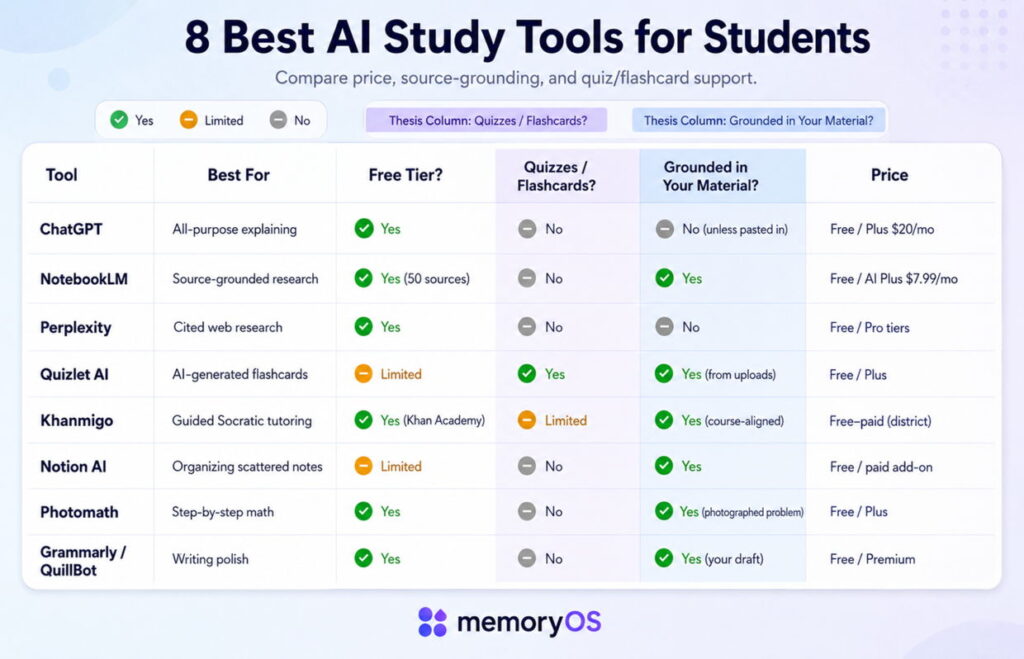
Choosing among the available AI tools for studying/AI study apps is much simpler once you look at them in comparison. The following table gives the necessary information about the best learning tools in terms of free availability, the presence of quizzes and flashcards, personal study materials options, and prices. While almost all the tools provide explanations well, not many can help you remember things.
| Tool | Best For | Free Tier? | Quizzes / Flashcards? | Grounded in Your Material? | Price |
| ChatGPT | All-purpose explaining | Yes | No | No (unless pasted in) | Free / Plus $20/mo |
| NotebookLM | Source-grounded research | Yes (50 sources) | No | Yes | Free / Google AI Plus $7.99/mo |
| Perplexity | Cited web research | Yes | No | No | Free / Pro tiers |
| Quizlet AI | AI-generated flashcards | Limited | Yes | Yes (from uploads) | Free / Plus |
| Khanmigo | Guided Socratic tutoring | Yes (via Khan Academy) | Limited | Yes (course-aligned) | Free–Paid (district access) |
| Notion AI | Organizing scattered notes | Limited | No | Yes | Free / Paid AI add-on |
| Photomath | Step-by-step math | Yes | No | Yes (photographed problem) | Free / Plus |
| Grammarly / QuillBot | Writing polish | Yes | No | Yes (your draft) | Free / Premium |
The One Thing AI Study Tools Don’t Do
The most important limitation of modern study aids in AI is not in the ability to explain the information but in the ability to recall it after several weeks. It only takes a few seconds to create a summary or a flashcard, but none of these actions can guarantee that your brain will store this information long-term. To achieve it, you need to retrieve the information multiple times without seeing the answer.
It has been proven by dozens of studies. In their famous Science study, Karpicke and Blunt (2011) showed that students who used retrieval practice could recall 50% more information long-term than students who just reread the same information. It was shown once again in the earlier-mentioned meta-analysis about spaced practice.
It’s at this point that most AI applications end up falling flat. ChatGPT, NotebookLM, Perplexity, and Notion AI are fantastic in helping understand concepts; Quizlet AI does even more in the inclusion of adaptive review; however, AI is not responsible for efficient and high-quality data encoding.
Forming long-lasting memories is going to take an intentional approach through the combination of active recall and spaced repetition. In case you are interested in knowing how spaced repetition works, it would be a good idea to explore this first before switching your study methods. You can also practice with memory games to strengthen recall in a more engaging way rather than relying on passive review alone.
Building an AI + Memory Training Study Stack
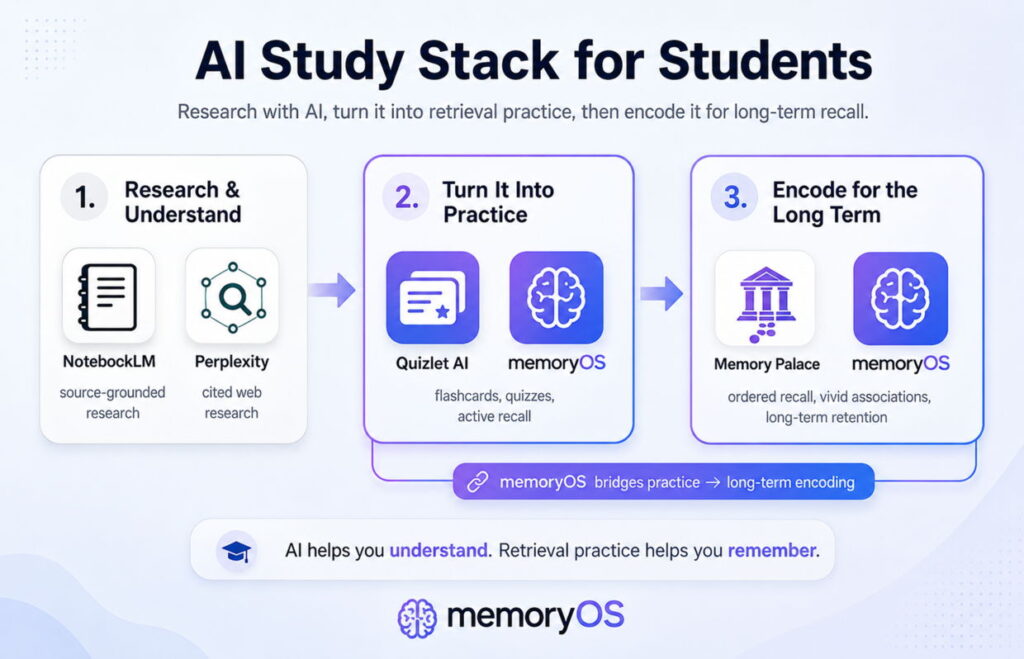
An optimal configuration for studying does not rely on one app but rather uses apps that solve a unique problem within the process of learning. For some students who are looking for the best AI tools for college students, a three-phase process is ideal as it provides a good balance between speed and retention.
Begin by using NotebookLM or Perplexity for comprehension, verification, and note-taking.
Then create something that you can recall. It is highly advised to use Quizlet AI to generate flashcards and quiz questions or use memoryOS for creating memorable visual connections and structured review periods.
Lastly, apply the memory palace method whenever you are learning any sequences, history timeline, biological processes, speeches, or any other information that is hard to remember using repetitive methods. This is a strategy that has been developed by two-time World Memory Champion Jonas von Essen, and it is an essential component of the memoryOS learning method.
The use of these three methods together will result in a workflow that fosters comprehension, practice, and retention; features that make the best AI tools for college students different from just fast answer generators.
There is no one winner because each tool caters to different needs. For example, ChatGPT is the best choice when you need to understand complicated theories, NotebookLM is great when you need answers based on your course materials, Perplexity can be used to find research references, and Quizlet AI is perfect for active review using flashcards. The most efficient workflow is typically a combination of two or three of these applications instead of a single one.
It is definitely good for learning how to do something, asking questions, and getting an explanation of complex matters. But ChatGPT cannot be used to plan spaced repetition, track which knowledge is forgotten, and quiz you about previously done learning. It is meant to be the initial step of learning, with additional apps used later.
AI can aid memorization through the creation of summaries, flashcards, quizzes, and practice questions, but it does not memorize information itself. For long-lasting learning, however, one needs active recall and spaced repetition, which involve repeated attempts to remember something rather than reading. This is why using AI together with evidence-based memory techniques yields more success.
The majority of the platforms provide free options that are enough for studying on a daily basis, such as ChatGPT, NotebookLM, Perplexity, Quizlet, and Khan Academy. Most of the time, premium services either expand usage limitations or unlock more AI features, but not change the essence of the tool. Thus, students may construct a useful study system without paying for all subscriptions.
Usage of AI for explanation of concepts, generation of practice questions, or summarization of material made by yourself is generally regarded as an acceptable way to study. However, completion of the graded assignments and submission of work done by AI may be against the academic integrity rules of your school/university. Since institutions keep updating their AI policy, it might be useful to check your institution’s policy regarding this topic.
AI should go hand in hand with tested learning techniques rather than act as a substitute for them. Active recall and spaced repetition are still some of the best scientifically proven ways to remember information, while techniques such as memory palace are especially helpful for remembering sequences, definitions, and complicated details. Combining AI with structured memory training gives a far more complete learning system compared to just summaries created by AI.
AI has transformed the way students learn. It provides explanations of complicated topics within seconds, arranges research, generates practice questions, and saves time that you spend looking through notes. However, comprehending the information is one thing; remembering it is another. And even AI cannot help you with the latter.
That’s where memory training comes into play. With the combination of AI-assisted studying and the usage of active recall, spaced repetition, and visual memory techniques created by Jonas von Essen, twice World Memory Champion and co-author of memoryOS methodology, students can create an effective learning system that would not be limited only to the realm of productivity.
And if you want to see for yourself how these techniques work, try memoryOS free and check how memory training can enhance your use of today’s AI technologies. If you want to look for other top study apps for students, go ahead!